


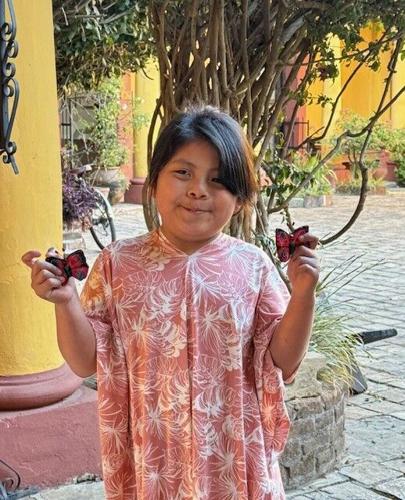
To spin a phrase, she floats like a butterfly, but she does not sting like a bee. Rather, she hugs gently like her sweet teddy bear, Galleta (cookie in Spanish). I am asking readers to help Chanpepen’s parents to save her life. The following background information should aid your decision whether to spend the cost of a “cheap” bag of American groceries for this sweet butterfly.
I have spent my last ten “Idaho winters” in Chiapas, Mexico, home to indigenous Mayan communities. Coming to Chiapas allowed me to escape a dreary Idaho winter; I had also volunteered to work with the impoverished communities. It was to be a one-winter stay before pursuing other charitable adventures in exotic lands like I had done in Peru and Ecuador the prior two years.
Rather than staying one winter in Chiapas, it has become my second home. It is the poorest state in Mexico, with its rugged mountain terrain, where delicious coffee is grown. The area is resource-rich, but the federal government does a lousy job of helping the Mayans, who often live in remote villages. The Spaniards never fully conquered Chiapas, where the people fled into the mountains to escape robbery, rape and religious desecration.
There are no roads to many of the distant Mayan communities. Despite the lack of monetary wealth, the Lacondan Mayans live a life filled with the richness of simplicity in a beautiful rain forest. I have stayed in that forest filled with jaguars and felt completely at peace… whenever I couldn’t hear buzzing mosquitoes.
With this backdrop, I had stopped to shop at the Na Bolom Museum and Cultural Center in San Cristobal de Las Casas (my 2nd home). The Mayan women from these remote communities come to Na Bolom to sell stunning handicrafts in the open courtyard.
Na Bolom is a fascinating complex with expansive gardens. It has an interesting museum displayed throughout the sprawling 22-room house that was originally a Catholic Seminary. The verdant grounds contain many cabins nestled amongst towering trees. The property was purchased in 1951 by Frans Blom from Denmark and his Swiss wife, Gertrude Duby de Blom.
Gertrude was a journalist and photographer, and Frans was an explorer and archaeologist; they met in the jungle (not swinging from trees) where “Jane and Tarzan’s chemistry” quickly fused into a lifetime marriage. The Bloms dedicated themselves to preserving the Mayan culture, and in particular, helping the Lacondans protect their rainforest habitat.
As I entered the courtyard at Na Bolom, I saw four women sitting on blankets selling their wares. I bought several cool gifts for friends. The last woman had what I was especially looking for — some carved kitchen spoons. The forest utensils are patiently carved by hand from hardwood and are a classy addition to any kitchen.
I was conversing with the last woman in Spanish while her daughter fluttered about in the large courtyard. The woman was very kind and engaging, and I asked her what was her daughter’s name — she said: “Chanpepen, it’s Mayan for butterfly.” An old soul looked at me through that child’s kind, mocha colored eyes. I left the courtyard with my unique gifts, and Chanpepen gave me an unsolicited goodbye hug.
My sister, Anna, was visiting and saw the wooden spoons when I returned to our apartments. She asked where I had bought them. I told her and said we could go there the following day, before her departure for California. The next day came, and Anna asked if I would go buy some utensils for her. My sister is the only person on the planet I shop for. She has made it abundantly clear to me that she doesn’t like shopping, but apparently it’s okay if I am doing it for her — ah, sisters.
I went to Na Bolom, but no one was in the courtyard. The receptionist said she would call Chanpepen’s family, as they might still have some wood items for sale; she mentioned the family was leaving for Tuxtla Gutierrez (a town approximately an hour and a half away) to get their daughter leukemia treatment. This was the first mention to me that Chanpepen had leukemia. A lump rose in my throat hearing this beautiful butterfly was afflicted with a deadly disease.
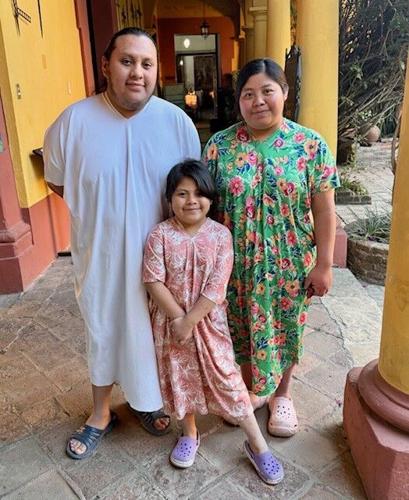
Chanpepen’s father and mother came to the courtyard with her. They were dressed in the traditional clothing worn by the Lacondan Mayan people — light tunics. The Lacondans wear this clothing along with sandals when they visit San Cristobal to sell their handicrafts (even during the chilly winter months).
I spoke with the butterfly’s parents and learned many things as she swooped and fluttered about the courtyard. Chanpepen was 6 years old, but she was diagnosed with leukemia when she was 3. The family had to travel 8 hours from her home to reach “Tuxtla,” where she was receiving 120 treatments designed to save her life. Chanpepen had received 84 treatments and still needed 36.
The butterfly’s treatments were being paid for 100% through Mexican health care (imagine that). What the family lacked were the expenses for limited medicines, and transportation and food expenses for their two weekly round-trip to Tuxtla. The family was staying at Na Bolom for free during her lengthy treatment.
Chanpepen’s family had moved to the Na Bolom facility 3 years prior to battle for their only child’s life. It was impossible to make the 8-hour one-way trip repeatedly, and they have not been home to see their family, nor have family members been able to travel to see them. Her father had to quit his job as a taxi driver, and her mother continues making wood spoons and bead jewelry to help cover the family’s costs. The father works as a nighttime security guard for Na Bolom.
As we spoke, Chanpepen made fluttery moves across the courtyard; she eventually settled in listening to her parents’ explanation of her plight and their ongoing fight to save her life. Chanpepen smiled at me. I bought the few wood items the family had and gave them money to cover half the cost of the expenses for her latest treatment. The cost was $150 dollars a week, which is a fortune in the Lacondan jungle where a day’s wages are approximately $10 dollars.
Chanpepen smiled at me again and reached into her parents’ meager pile of offerings. She selected a necklace and handed it to me as a gift without asking her parents for permission. Chanpepen came over and hugged me; this girl captured my heart.
I hope, through your generosity, to raise the funds needed to complete Chanpepen’s treatments. This butterfly now needs 34 additional weeks of treatment, which will take another year to complete. She is often nauseous and cannot have treatments when she is ill.
For anyone reading this column who donates $125 dollars, I will add $25 to cover a week’s treatments. Ask yourselves if giving $125 dollars will diminish your lifestyle? What is the value of saving a butterfly’s life —please help!
Contributions can be sent to my care at 99 Cedar Hills Drive, Pocatello, ID 83204. If you donate, please send me a confirmation at ace-one-consulting@live.com. I am in Mexico until late May and want to get the family substantial support before returning to Idaho’s spring weather. Please assure me it will be springtime. I will cover your donations as they come in and keep readers informed about progress. Thank you for considering whether to help Chanpepen.
Side note: if anyone reading this knows Chase Funk, his birthday was on March 17th. I was his Big Brother for over 10 years, but have lost contact with him — please tell him Jesse said, ‘hey punk, happy birthday! — let’s go shoot some pool when I get back in town.’ Chase — you can reach me at: 208-234-9292.

(0) comments
Welcome to the discussion.
Log In