

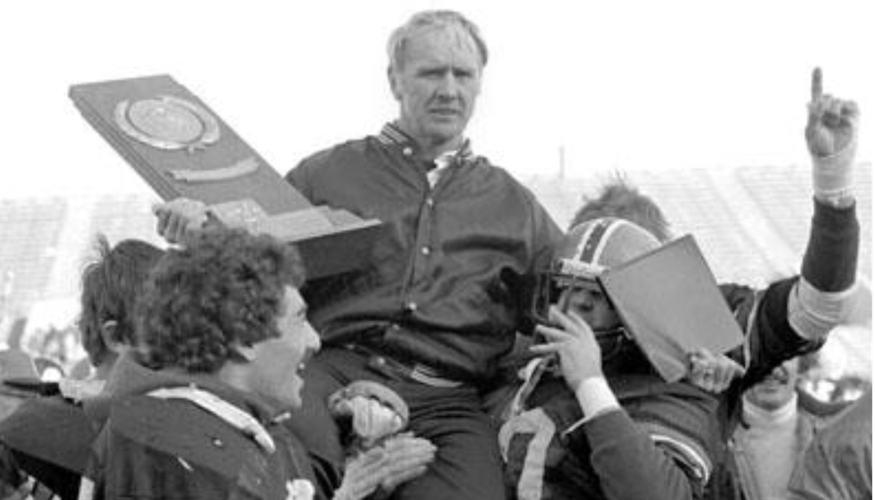

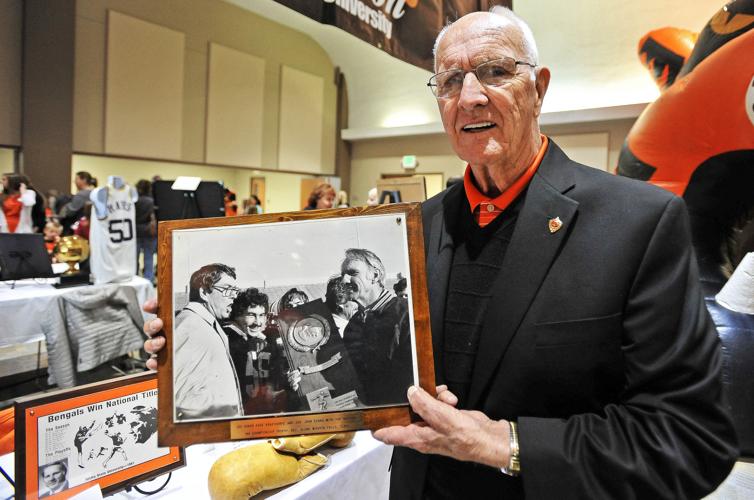
You can get a sense of the impact that Dave Kragthorpe had on the Idaho State football program from this simple fact — he was inducted into the school's prestigious Ring of Honor after having coached the Bengals for only three seasons.
What does not come so readily is the impact Kragthorpe had as a human being. For that, you need to hear the words of his former players, coaches and staff.
"He was a good man, I cared about him a lot," said former Bengal linebacker and longtime Skyline High School coach Scott Berger. "He was just a solid citizen. He was a straight shooter with you, fair, honest. You knew where you stood with him. That's what I really liked about him. I really respected him a lot."
"He's not only one of the best football coaches, but he's one of finest human beings I've ever known," said Glenn Alford, longtime ISU sports information director. "Of all the people I've worked with at ISU, I enjoyed him the most."
"I'm not sure any other head coach could have engineered the turnaround that occurred at ISU in the early 1980s like Dave did," said Dick Kaiser, who served as an assistant on Kragthorpe's Bengal staff. "His personality and professionalism just made it so easy to 'buy in' and go to work. I will be forever grateful that my family and I had the opportunity to get to know the Kragthorpes and be associated with such a first-class person."
"It was one of the greatest things that ever happened to me in my lifetime — the day he showed up at my house in San Diego to offer me a letter to come to Idaho State," said Mike Machurek, who was an all-American quarterback under Kragthorpe. "That might have been the best day of my life and it changed my life."
Kragthorpe, who coached Idaho State to its only national championship in football in 1981, died Sunday morning at the age of 93. He passed away in an assisted living facility in Montgomery, Texas, where he was living with his wife Barbara, near their grandson Christopher.
While he compiled a relatively modest 21-14 record over his three years as Bengal mentor, the impact he had on the football program, the athletic department and the community in the early 1980s will not soon be forgotten by those who jumped aboard the roller coaster that was ISU football during those years.
Idaho State football was in the depths of despair in 1979, in the midst of the nation's longest losing streak at 16 games, and finishing the season 0-11 under then coach Bud Hake. The few fans that were still showing up at what was then the ASISU Minidome were booing the team off the field as they lost to an 0-10 Weber State team in the last game of the season.
Athletic Director I.J. "Babe" Caccia had already made the decision that Hake was on his way out and, despite the irony that Caccia had been a "three-yards-and-a-cloud of dust" coach himself, he was determined to breathe some excitement into the Bengal offense.
At the time, LaVell Edward's Brigham Young University team was one of the few major college teams in the nation who were throwing the football with regularity. Kragthorpe was his offensive line mentor and assistant head coach, and had been interviewed by Utah State, his alma mater, and fellow Big Sky school Northern Arizona for their head coaching positions, but was passed over.
So when Caccia came to Provo that fall and offered Kragthorpe the ISU job, he figured it was now or never for the opportunity to become a head coach — despite the difficult circumstances he was inheriting in Pocatello.
"When I told people I was going to Idaho State, where they hadn't had a lot of success, a lot of people I worked with at BYU thought I was crazy," Kragthorpe said in an Idaho State Journal interview in 2006.
One of the people he worked with at BYU was Kaiser, who was working on his doctorate while coaching part-time for the Cougars. Kragthorpe offered Kaiser the opportunity to join his staff as a fulltime defensive coach in charge of the front seven. Kaiser turned him down initially because he still had a year to go to finish his doctorate, but Kragthorpe wouldn't take no for an answer.
"He again offered me the job with the agreement that I could finish my doctorate at BYU while coaching the Bengals," said Kaiser who recently retired after a long career as a coach and administrator in athletics. "So my first year at ISU I was coaching defense and taking graduate classes, plus working on my dissertation, besides coaching a first-year program. Not many head coaches would have provided an assistant, especially in his first year as a head coach and trying to break an inherited long losing streak, that kind of opportunity. I owe much of my next 41 years of my professional career to Dave being so accommodating."
The first chapter of the Kragthorpe era at ISU seemed to be following pretty much the same pattern as the bad, old days of Bengal football. While being more competitive under the junior college transfer Machurek at quarterback, ISU started off the 1980 season 1-4.
Then a strange evolution occurred. ISU shut out a bad Montana team for their first homecoming win in six seasons. Then they beat Western Montana as expected. Then, sparked by a blocked punt by linebacker Marvin Lewis — later a longtime head coach of the Cincinnati Bengals — ISU upset Nevada-Reno on the road.
ISU followed that with wins over Idaho and Weber State, and all of a sudden, the Bengals had a chance to get into the 1-AA playoffs with a win against Boise State to end the season. A school record crowd of 13,444 filled the Dome for that game, but BSU held off the Bengals 22-13 and the Broncos went on to win the national title.
Having turned around the Bengal program from 0-11 to 6-5, Kragthorpe stoked expectations in Southeastern Idaho like never before. With Machurek and much of that team returning in 1981, Bengal fans had high expectations. And they were really looking forward to the return game against the Broncos in Boise early in the season.
"If I went to the golf course, that's all people wanted to talk about," Kragthorpe recalled in that 2006 interview. "People wanted to talk about Boise State. We had played them a good game and had an opportunity to beat them. They went on to win the national championship and I think that buoyed people's hopes."
ISU wound up holding off BSU in Bronco Stadium and eventually won the national championship, finishing 12-1 that magical season.
Alford said the national title transformed everyone's mood on campus.
"My office was down on lower campus during the 1981 football season," recalled Alford, "and everybody that I came in contact with was happy. They were smiling — even people I knew who were not football fans were elevated by the 1981 football team. That was something I hadn't seen before — and I haven't seen since."
Kragthorpe was offered a job by Texas-El Paso before the playoffs began in 1981 but he turned it down, not wanting to interrupt what would become a national championship campaign. Nevada-Las Vegas approached him after the season, but he was totally uninterested in living in Las Vegas.
So he stuck around for another season, one that was not nearly as satisfying. The Bengals finished the next year 3-8 and when his alma mater called to offer him a position as athletic director, he was off to Utah State.
He later got back into the coaching profession, taking the head job at Oregon State, and served as an advisor and mentor to his son Steve, who coached in the NFL and at several major colleges before Parkinson's disease ended his career, and later his life in 2024.
But Kragthorpe and his wife Barbara maintained strong ties to Idaho State, attending a Bengal football game or two each season until his health would no longer permit it in recent years, and participating in fundraising efforts for the program.
"Even beyond the success on the field, he just loved living there (in Pocatello)," said his son Kurt, who later became sports editor of the Salt Lake Tribune, but was going to Utah State as a student during Kragthorpe's coaching stint at ISU. "You speak of 93 years, those three years (at ISU) were what — 3.1 percent of his life — but they occupied a much bigger percentage of the joy in his life. Idaho State would always have a special place for him."
And Kragthorpe will always have a special place in the hearts of all those in the ISU and Pocatello community who interacted with him during his time here — and in his return visits to the area.
"His interactions with everyone — he had those same interactions he had with me," said Alford. "He had those same interactions with the fans — with the $1,000 guys and with the $50 guys. He was the same — always pleasant, always respectful, always courteous, always interested in how things were going. People can see that. People aren't dumb. If someone takes a genuine interest in them, they respond to that."
Kragthorpe is survived by his wife Barbara and son Kurt and was preceded in death by his son Steve. Funeral arrangements have not been finalized.



(0) comments
Welcome to the discussion.
Log In