

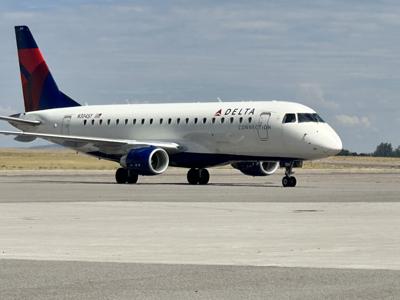
POCATELLO — How long will the Gate City continue to subsidize the cost of operating two daily flights to Salt Lake City if Delta Airlines is falling short of its revenue target by more than $215,000 each month?
That’s one question that government watchdog group P.A.G.E., or Pocatello for Accountable Governmental Entities, would like to have answered after recently sharing with the Idaho State Journal several financial documents that shed light on the current status of a minimum revenue guarantee between Pocatello and Delta Airlines.
P.A.G.E. obtained the documents after filing several record requests with the city and says the data contained within the financial reports is concerning, particularly “that the general public has not been kept up to date with relevant information that is within the public’s right-to-know,” says P.A.G.E. spokesperson and co-founder Heather Disselkoen.
This past August, the Pocatello City Council unanimously voted to approve a minimum revenue guarantee with Delta Airlines of up to $500,000 to maintain twice daily service between Pocatello and Salt Lake City between September 5, 2023, and March 5, 2024. Since March 2022, Pocatello has paid about $1.8 million in subsidies to maintain commercial flights at its airport.
When contacted for this article, a Delta Airlines spokesperson declined to comment.
Alan Evans, manager of the Pocatello Regional Airport, told the Council in August that a previous agreement between the city and SkyWest would be canceled and noted that SkyWest would still be flying the twice daily route on behalf of Delta. Further, Evans stated the goal was to get the flights to an 80 percent load factor.
According to the financial reports P.A.G.E. recently provided to the Journal, the city exceeded the $500,000 revenue guarantee within the first two months of the agreement.
Specifically, the reports state that for the month of September, the actual revenue generated from the daily flights was $365,000, which was $267,131 short of the minimum revenue amount of $632,678 that Delta needed to operate the flights.
For October, the actual revenue was short $268,628. November’s actual revenue was short $217,387 and December’s was short by $231,617.
“As a local accountability watchdog group, P.A.G.E. began monitoring the Delta monthly reports that detail the variance between total revenues earned and the minimum required revenue beginning in late November,” P.A.G.E. said in a statement provided to the Journal. “The first report under the new Delta contract for September documented one month revenue losses of $267,131 which exceeded 50 percent of the six-month $500,000 minimum revenue guarantee. After only four months of available records (September through December), the revenue losses totaling $984,764 have far exceeded the minimum revenue guarantee agreement amount.”
What this means for local taxpayers and the city remains uncertain, according to Kristy Heinz, the management assistant at the Pocatello Regional Airport.
“We have been in constant communication with Delta officials,” she said. “The six-month, $500,000 minimum revenue doesn’t end until March 5 and so Delta won’t bill us until after that period ends. At the end of that six month period, they will invoice us for the portion of the revenue guarantee that was due.”
Heinz continued, “Delta has not sent any additional requests for another minimum revenue guarantee and we haven’t taken anything to the City Council because there hasn’t been any changes to the agreement that will reach conclusion on March 5.”
Heinz said the minimum revenue guarantee between Delta and Pocatello is not unique, adding that similarly sized airports such as the ones in Twin Falls and Lewiston also entered into similar agreements at the same time as Pocatello and that Idaho Falls has historically entered into minimum revenue guarantees with airlines in the past.
“Most of the regional airports are paying minimum revenue guarantees,” she said “These guarantees are in place to help mitigate costs for the airlines, but most airlines know that they are probably going to lose money during the initial ramp-up of new services, which is something we are working through right now.”
The minimum revenue guarantee between Pocatello and Delta became effective at the same time that Delta announced it would provide twice-daily roundtrip flights from Pocatello to Salt Lake City and do so with planes that offer 70 seats instead of 50, of which 12 are first class seats and twenty are “Comfort Plus” seats with a little extra room for passenger comfort.
Evans told the Journal this past September that the goal was to get the load factors for each flight to 80 percent, common figures before the COVID-19 pandemic and a necessary benchmark in the pursuit of landing any other airlines or flights to other cities in the future.
“That’s what it’s going to take to entice another airline to come in,” Evans told the Journal in September. “They’re going to need to see that people are using what we have. In (2019) we were poised to put some service into Denver … and then COVID hit. So I’m hoping to get back to that point. Right now we’re kind of playing catch-up.”
Since September, however, the load factor of flights between Pocatello to Salt Lake City has only reached or exceeded the 80 percent target 10.2 percent of the time, or during 48 of 471 flights.
On average, the load factor for the month of September was 44 percent. That figure increased to 52 percent and then 56 percent for the months of October and November, respectively, but then dropped to 54 percent for the month of December.
Despite the figures, Heinz said that she is encouraged by the numbers, particularly because “there was not a lot of time between when Delta said we would be getting an additional flight and when it first started.”
“We are in the ramp-up phase still,” she said. “By the time we learned of the additional flight I think most people had already booked their travel and weren’t able to take advantage of that additional flight for the first few months,” she said. “Now that we’re several months past that we expect our spring and summer load factor numbers to increase.”
Additionally, Heinz stated that the load factors over the past four months hovering in the 40-60 percent range are similar to the same load factors before the second flight was added, which is another positive trend.
“Since the start of the additional service we have doubled our number of passengers,” she said. “We went from one flight to two and added more seats to each flight and are still in the 40-60 percent range. We’re excited about that and think it’s a good sign that we have been able to fill the two flights just as well as we were filling the one flight.”
Anecdotally, members of the Pocatello City Council say they are seeing increased usage of the commercial flights out of Pocatello. Council member Brent Nichols during a work session this week said that when he flew out of Pocatello he observed the flight to be about 90 percent full.
Council President Linda Leeuwrik stated that she has seen posts on social media about more people deciding to fly out of Pocatello, citing the convenience factor and free parking as the major incentives.
According to Larry Bell, a member of the Pocatello Regional Airport Commission, the airport provides $184 million in economic impact and is responsible for the creation of over 1,000 local jobs.
“It’s a part of the identity of the city of Pocatello,” he said during the work session. “We really need a viable functioning airport, which we have right now.”
P.A.G.E. is not so convinced of the airport’s impact on economic development and how commercial flights are factored into that determination. For now, several questions about the future of commercial flights loom large for the local government watchdog group.
“Can anyone provide a list of economic development projects directly resulting from simply having passenger flights into Pocatello?” P.A.G.E. asks. “How long can the city continue to afford to subsidize a service that only a segment of the city’s population uses? Should this cost be borne solely by the city, or should other government entities and private business sectors benefiting from the service be asked to contribute until it can become sustainable?”
P.A.G.E. added. “Those questions and others should be considered and debated by the community at-large before any new minimum revenue guarantee contracts are signed.”
Whether or not these questions will be addressed when the minimum revenue guarantee expires next month is left to be seen.


(6) comments
I see the points made by both Guest and Best, but I am willing with my tax dollars to try and keep Poky airport open. One huge reason is when businesses or corporations look to settle, they want near by air travel. I hope we can give it another year or two to see how this pans out. Why does it take the transit bus 3.5 hours to drive 150 miles? Just wondering.
Because the bus makes some stops inbetween.
https://saltlakeexpress.com/destinations/
https://webstore.saltlakeexpress.com
In response to guest8339268de3f1703217e64993’s post. Several points:
(1) Driving time from Idaho Falls to the SLC is 4 hrs vs 3 hrs from Pocatello to SLC. So it takes them longer to get to the major airline hub.
(2) The population of Idaho Falls-Ammon-Rigby-Rexburg area is bigger then one of Pocatello-Chubbuck-American Falls. So it makes it easier to sustain the flights.
(3) Idaho Falls “have grown more than Pocatello” because of it’s proximity to the INL. Commute time from to INL form Pocatello is much longer then from Idaho Falls or Blackfoot. So the truth is that the INL new comer workers prefer to settle in the Idaho Falls. Recently the Federal Government is pouring more money into it’s various INL projects and hiring more people. So in turn, the growing population payed by the Federal payroll is spending money in the area, “attracting businesses” in service sector to support them. On the other hand, the new FBI data center in Pocatello had not brought that many jobs to the area.
(3) In terms of “beautification”. Idaho Falls has a nice connected green way trail system along the Snake river. On the other hand, Pocatello Greenway is patchy and not connected. It is time to build a greenway path along the Portneuf canal and connect the rest of Pocatello trail system together. This “beautification” projects will improve quality of life here in Pocatello, attracting new well payed “telecommuter” to come to Pocatello. So I think, the subsidy money currently going to the airline and the airport would be better spend on the Green way to benefit the local population.
The bottom line is that the “airport growth” idea is simply not sustainable.
End the subsidies. Stop the airline corporate welfare. Do not waste our hard earned tax dollars.
We do not need to pay millions of dollars for this boondoggle!
I would like to see more support given to the efforts of keeping our airport open! Don't try to tear down the efforts of our city to try and support an airport. Idaho Falls have a very supportive, progressive and positive attitude in so many areas such as attracting businesses and beautification and that is why they have grown more than Pocatello.
I support every effort the city of Pocatello has given to help keep and maintain and grow our airport!
Keep up the good work.
We are all using Salt Lake express shuttle to get to and from the SLC airport. The bus is safe, fast, clean, reliable, and not expansive. The ticket is about $60 bucks one way, and it takes about 3 hours and 10 minutes door-to-door to get there. The shuttle departs from the Pocatello Red Lion hotel parking lot or at the new PRT transit depot. They have 6 convenient departure times daily. And it does not require any subsidies. Please, stop wasting our tax payer money. Get rid of unnecessary commercial flights at the PIH. Shut down the airline corporate welfare. We do not need to pay millions of dollars for this boondoggle!
Welcome to the discussion.
Log In