


POCATELLO — With the rise of AI data centers sweeping across the nation, Bannock County officials are beginning to lay a legal framework in anticipation of incoming projects as city representatives continue their proceedings for a contested permitting challenge nearing a key vote.
The arrival of AI in the modern world was swift and transformative. As people continue to discuss moral dilemmas and ethical ramifications, the state of Idaho is moving quickly to lay legal foundations that will provide the best outcomes for the state and its residents as technology companies embark on AI-centered projects.
Bannock County Commissioner Jeff Hough is organizing a work group that will bring together officials from Power, Oneida, Franklin and Caribou counties to draft model rules for how local governments handle large AI data center projects.
The effort comes as Bannock County's temporary moratorium on new data centers, which applies only to unincorporated parts of the county, leaves the surrounding region without any local ordinances specifically addressing the facilities.
"Everybody's exposed, except for Bannock County, because we have the moratorium," Hough said. "Trying to be proactive is the main thing you can do."
Hough said the group is intended to function less like a public committee and more like a technical work group that will study energy demands, environmental effects and state tax law before handing each community a skeleton ordinance to adapt locally.Public hearings would follow once individual counties and cities begin drafting their own rules, likely starting in January, Hough said.
"The purpose of the committee is to educate us and help us come up with a draft document that each of the communities can then take back to their area and create an ordinance that works for them," Hough said.
Hough said he has invited state Sen. Jim Guthrie and state Rep. Richard Cheatum to early sessions so lawmakers understand the pressures facing local governments before the next legislative session.
Idaho law currently exempts much of the server equipment inside these facilities from property taxation. Hough said he wants legislators to revisit that legal precedent.
Additionally, Hough said he has invited a wide array of professionals and officials to the work group, including city representatives from Pocatello and Chubbuck, Idaho State University experts and technology specialists.
Permitting AI data centers could provide a boon to the cities and towns within the Gem State. Local governments could leverage conditional use permits and community participation agreements to require AI tech companies and their projects to fund infrastructure, schools or emergency services in exchange for approval.
"You can ask for money for your school district on an ongoing basis," Hough said. "You can ask for money for your emergency services units. There's a lot of structural things for your community that these developers are willing to look at and consider."
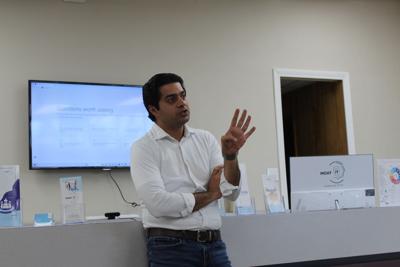
Ali Khan, a Pocatello technology executive who will serve on Hough's new work group, has spent recent weeks briefing local audiences on the technical differences between AI data centers and the legacy, water-cooled facilities that store email and photos.
Khan said newer AI computing racks run too hot to cool with outside air and instead rely on closed-loop coolant or immersion systems that recycle the same fluid rather than consuming fresh water.
Khan referenced a state law that took effect July 1, restricting water use by data centers, which describes violations as both a criminal and civil matter. Khan said the AI facility proposed for 1800 River Parkway, the roughly 59-acre site once home to the Hoku plant, was likely chosen because the site already has substantial power infrastructure in place, reducing the need for new transmission lines.
Khan estimated a fully grid-powered version of the project could cost the developer more than $70 million a year in electricity, which he said makes on-site gas generation a likely alternative. Khan also urged local governments to write specific noise-pollution standards into any future permits, since Idaho currently has none.
"We should set a minimum noise level, a minimum humming level, a maximum water requirement and a maximum electricity dependency on the grid," Khan said. "That should all be part of the law."
On the City of Pocatello side, the fight over the River Parkway proposal continues amid often contentious public backlash.
The proposal comes from Gilbert, Arizona-based Lex Developments LLC and its representative, Gus Schultz, who is seeking to build a large-scale AI data center campus on the site of the former Hoku polysilicon plant — a $700 million facility backed by Chinese investors that was abandoned mid-construction in 2012 and went bankrupt in 2013 with roughly $1 billion in debts, never having produced a single product.
Lex Developments sought a conditional use permit through Pocatello's planning process after city staff determined the proposed use was not explicitly addressed in existing code. A hearing examiner denied that permit, city Assistant Planner Jennifer Flynn said, citing the need for more substantial information about the project's environmental effects.
Lex Developments appealed that decision. The Pocatello City Council denied the appeal July 16 in a 4-1 vote, with the applicant formally notified of that denial Aug. 7.
Schultz, who has vowed to pursue the matter in court, has since filed for reconsideration, with a hearing expected sometime in September.
Flynn said the council's options at that hearing are limited to affirming the denial, denying the appeal outright or modifying the decision, which could include attaching new conditions to any approval.
If the council upholds the denial and Lex Developments does not pursue the matter in court, the company would need to wait a year before reapplying, Flynn said.
Lex Developments could still pursue legal action in the courts. If a judge finds that the city did not follow proper procedure, the project could move forward under the zoning code that existed when Lex Developments first applied, rather than any future ordinance the city might adopt.
Flynn said city officials are actively discussing how to handle future data center proposals, either through a moratorium similar to the county's or by amending the zoning title that currently allows staff discretion over undefined land uses.
No formal decision has been made.
"I think it's fair to say we're putting a lot of consideration into how to handle data centers in the future," Flynn said.
With no ordinance yet in place at the city or county level, the outcome of the River Parkway proposal and Hough's work group could have significant ramifications for the future of AI data centers in the Gem State.
The dawn of AI is here in Idaho, and the future will be defined by decisions made over the next few years.


(0) comments
Welcome to the discussion.
Log In