

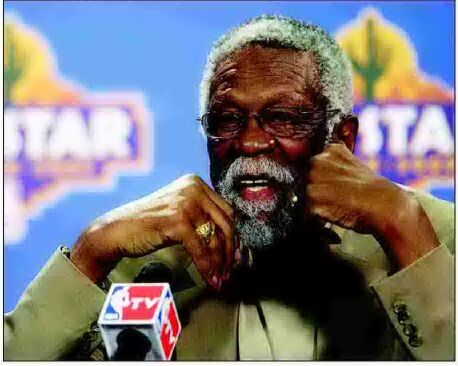
BOSTON (AP) — Bill Russell redefined how basketball is played, and then he changed the way sports are viewed in a racially divided country.
The most prolific winner in NBA history, Russell marched with Martin Luther King Jr., stood with Muhammad Ali and received the Presidential Medal of Freedom from President Barack Obama. The centerpiece of the Boston Celtics dynasty that won 11 championships in 13 years, Russell earned his last two NBA titles as a player-coach — the first Black coach in any major U.S. sport.
Russell died Sunday at the age of 88, with his wife, Jeannine, at his side, his family said in a statement posted on social media. No cause of death was immediately available; Russell, who had been living in the Seattle area, was not well enough to present the NBA Finals MVP trophy in June due to a long illness.
"We hope each of us can find a new way to act or speak up with Bill's uncompromising, dignified and always constructive commitment to principle," the family said. "That would be one last, and lasting, win for our beloved #6."
A Hall of Famer, five time Most Valuable Player and 12-time All-Star, Russell in 1980 was voted the greatest player in the NBA history by basketball writers. He remains the sport's most decorated champion — he also won two college titles and an Olympic gold medal — and an archetype of selflessness who won with defense and rebounding while others racked up gaudy scoring totals.
Often, that meant Wilt Chamberlain, the only worthy rival of Russell's era and his prime competition for rebounds, MVP trophies and barroom arguments about who was better. Chamberlain, who died in 1999 at 63, had twice as many points, four MVP trophies of his own and is the only person in league history to grab more rebounds than Russell — 23,924 to 21,620.
But Russell dominated in the only stat he cared about: 11 championships to two.
"Bill Russell was the greatest champion in all of team sports," NBA Commissioner Adam Silver said. More importantly, he added: "Bill stood for something much bigger than sports: the values of equality, respect and inclusion that he stamped into the DNA of our league."
In a statement released by the White House, President Joe Biden praised Russell for his lifelong work in civil right as well as in sports, and called him "a towering champion for freedom, equality, and justice."
"Bill Russell is one of the greatest athletes in our history — an all-time champion of champions, and a good man and great American who did everything he could to deliver the promise of America for all Americans," Biden said.
Reaction poured in Sunday, from Obama to Michael Jordan, from Magic Johnson to Boston's Mayor, Michelle Wu.
"Today, we lost a giant," Obama said. "As tall as Bill Russell stood, his legacy rises far higher — both as a player and as a person. Perhaps more than anyone else, Bill knew what it took to win and what it took to lead."
A Louisiana native, Russell also left a lasting mark as a Black athlete in a city — and country — where race is often a flash point. He was at the March on Washington in 1963, when King gave his "I Have a Dream" speech, and he backed Ali when the boxer was pilloried for refusing induction into the military draft.
In 2011, Obama awarded Russell the Medal of Freedom alongside Congressman John Lewis, billionaire investor Warren Buffett, then-German Chancellor Angela Merkel and baseball great Stan Musial.
"To be the greatest champion in your sport, to revolutionize the way the game is played, and to be a societal leader all at once seems unthinkable," the Celtics said on Sunday. "But that is who Bill Russell was."
Russell said that when he was growing up in the segregated South and later California his parents instilled in him the calm confidence that allowed him to brush off racist taunts.
"Years later, people asked me what I had to go through," Russell said in 2008. "Unfortunately, or fortunately, I've never been through anything. From my first moment of being alive was the notion that my mother and father loved me." It was Russell's mother who would tell him to disregard comments from those who might see him playing in the yard.
"Whatever they say, good or bad, they don't know you," he recalled her saying. "They're wrestling with their own demons."
But it was Jackie Robinson who gave Russell a road map for dealing with racism in his sport: "Jackie was a hero to us. He always conducted himself as a man. He showed me the way to be a man in professional sports."


(0) comments
Welcome to the discussion.
Log In