

This is actually the third column on changes at Kathryn Albertson Park, but the second on expected/possible changes in bird occurrence over future decades. Last week I dealt with species where change seems reasonably predictable. We’re now getting into species where I’m going to do more fact-based reasoning and extrapolation, aka guessing. Data are from eBird, and I define winter as December, January, February. The other three seasons follow.
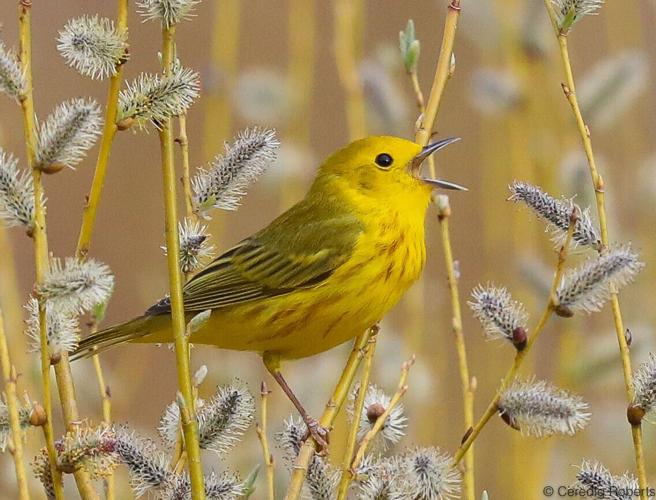
The northern yellow warbler (previously, yellow warbler) loves shrubby riparian areas. Once the willows take off in the treatment area, this species is going to love it. Past occurrences (% of eBird checklists with the species) are winter 0%, spring 28%, summer 65%, and fall 2%. This species winters in Central America and south, so winter percentage is not going to change any time soon. But spring and summer numbers should increase measurably.
Both sharp-shinned and Cooper’s hawks might find the new area more to their liking. The Russian olives were very dense, and I think they’ll have better luck hunting the more open habitat. Sharpy occurrences were 7%, 3%, 0% and 5% while Coops were 10%, 26%, 26% and 17%.
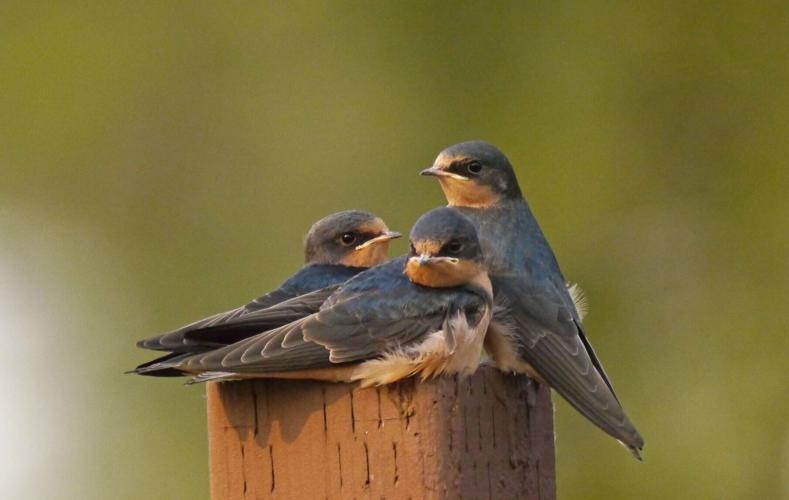
None of the swallows recorded in KAP — bank, tree, violet-green, northern rough-winged, barn or cliff — is very common. The largest numbers are for the barn swallow in spring (9%) and summer (32%). I expect reports of all swallows to increase, especially during spring migration, because they’ll like to forage in the open habitat. Barn swallows nest in the park, so their numbers will probably increase in summer as well.
Last week, I mentioned how I believe willow flycatchers will like the new habitat, especially once willows become taller. Other flycatchers will tick up a bit as well. More open habitat with scattered perches should help. Spring migration will show the most obvious increases.
The northern house wren is a puzzle for me. The dense shrubs all over KAP should be good for them, but I detect Bewick’s wrens much more often. An increase in shrubs should entice both wrens. Because they both sing loud, distinctive songs, we’ll be able to track any changes in their occurrence despite the fact that they are both pretty skulky. Occurrences for the house wren has been 0%, 1%, 3% and 1% while that for Bewick’s wren was 23%, 22%, 26% and 30%.
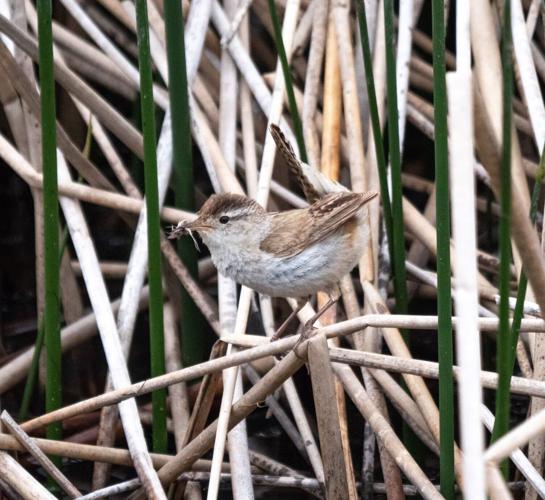
Both Pacific and marsh wren use of KAP is close to zero in all seasons. But like their more common relatives, more shrubs should be attractive. Marsh wrens love cattail marshes. So once cattails expand, I hope we’ll get a pair of those gorgeous little wrens with their crazy vocals.
Calliope hummingbirds, fox sparrows and Wilson’s warblers like shrubby riparian areas at higher elevations. I wouldn’t expect them to start breeding in KAP, but they might stop by more often during migration. Wilson’s warbler has been reported on 1% of summer checklists. I’d guess those were probably non-breeding birds, but this is another one to keep an eye on.
Other marsh birds with very low occurrence might increase slightly. These include Virginia rail, sora and Wilson’s snipe. But once the cattails take over, those odds will go back down. This spring will probably be the best opportunity to see them.
Brown-headed cowbirds lay their eggs in the nests of other birds. They are more common in areas with more species and more nests. It will be interesting to see if they increase in spring and summer as they display and search for nests. Cowbirds have no interest in KAP in winter or fall (0%, 22%, 23%, 0%).
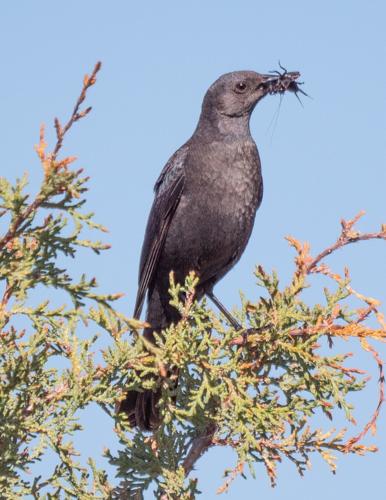
Brewer’s blackbird adorned the cover of our Field Guide to Boise’s Birds, even though it’s almost never seen in Boise parks. Their occurrence has been 2% in spring and summer and only 1% in fall. But they love wet patches with scattered tall shrubs or small trees. I would not be surprised to see them more often in spring, even if they don’t hang around to nest. The small junipers remaining in the treatment area should be just right for them.
Other species that like shrubs and move through during migration and mostly nest higher in the hills or mountains will also be worth watching. These include the orange-crowned warbler, Nashville warbler, common yellowthroat and lazuli bunting.
I could go on, but the soup has already gotten a bit thin. Irrespective of what I think, there are enough birders in KAP that we will know the effects of the removal of Russian olives. Also important are the eBird checklists coming in from other area parks, which will serve as a controls for changes in KAP.
For me, it will be especially fun to see if there are changes in nesting species. eBird has a set of “breeding and behavior codes” available for each species you add to a checklist. These provide important additional details, and I always use them when appropriate.
There are 23 of these codes, and several apply to evidence of nesting. Occupied nest (ON), Nest with Eggs (NE), and Nest with Young (NY) area obvious evidence of “confirmed” nesting. But I want to point out a few other indicators of nesting.
Carrying Nesting Material (CN) is considered to be “confirmed/probable” evidence. Any time a bird is carrying a bit of grass in its beak or a stick in its feet, they’re likely heading for a nest. But some young birds, e.g., raptors, will play with sticks. That’s why this behavior is not a guarantee of nest building across all species.
Nest Building (NB) is also only “confirmed/probable” because some species, e.g., some wrens, build dummy nests that will not become real nests. For species around here, note the location of the possible nest and come back later to see if it’s occupied. Remember not to walk to or by nests, but rather to observe at a distance. Predators like skunks and raccoons follow human scent trails because there is so often food to be found. If you accidentally find a nest while walking through some habitat, keep going. Don’t turn around. That way, a potential predator will hopefully keep following your path until they are well away from the nest site.
One last behavior I like is Carrying Food (CF). You can see a lot of birds carrying food during the breeding season once you start watching for it. I’m always amazed when I see a bird with a beak full of insects. Imagine trying to hold bugs in your mouth while trying to catch yet more. Better yet, try it!



(0) comments
Welcome to the discussion.
Log In