

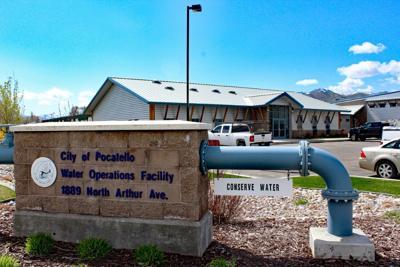

POCATELLO — The city on Thursday inactivated a culinary well about eight months removed from Idaho State University researchers presenting a study to the City Council that estimated the well’s rising nitrate levels could exceed safe standards within the next four to 20 years.
Pocatello announced it shut down well No. 2, located near Ross Park, on Thursday after water department staff received notice of a sample with nitrate levels of 11.69 milligrams per liter. The standard, or maximum contaminant level, for nitrate is 10 milligrams per liter.
“Upon notification of exceeding the standard on Oct. 14, 2021, a confirmation sample was taken and Well No. 2 was inactivated,” the city said in a Friday news release. “Well No. 2 no longer provides water to the distribution system. ... Alternative water sources will continue to provide safe drinking water to residents for the foreseeable future. Residents do not need to seek alternative water or take other corrective actions.”
Justin Armstrong, the Pocatello water superintendent, told the Idaho State Journal during a Friday phone call that the city had been testing the nitrate levels at this well quarterly instead of annually after concentrations there had risen to more than half of the allowable standard (over 5 milligrams per liter).
After receiving the report of nitrate levels exceeding the threshold, Armstrong said the well was inactivated and a sample of the water from remaining sources was taken, which showed a safe nitrate level of 5.04 milligrams per liter.
Aside from Well No 2, Armstrong said the city’s remaining 16 culinary wells, of which the city blends the water sources together before delivering it to residents, currently meet safe drinking water standards.
Armstrong said this is the first time nitrate levels have exceeded safe levels inside Well No. 2, which was initially drilled in 1926 and is one of the city’s smaller and oldest wells. The well produces about 1,000 gallons of water per minute while the city’s largest wells produce over 2,800 gallons of water per minute. He also said he wanted to reassure residents that the city’s water supply is currently safe to drink.
Though the city was not anticipating Well No. 2 would reach unsafe nitrate levels in a matter of months following a recent study from ISU researchers, Hannah Sanger, the city’s Science and Environment Division manager, said the city has been preparing for this occurrence.
“It’s certainly sooner than we expected,” Sanger said. “But we had already started planning for the re-drilling of this well following ISU’s study. We are very grateful that ISU did complete this study with us last year so that we could be prepared to move forward.”
The Journal in February reported on the study, which the city subcontracted to complete with Sarah Godsey, an ISU associate professor of geosciences, and ISU graduate student Michael Ferraro. The study involved researchers compiling existing water-quality data from several sources for analysis. The Idaho Department of Environmental Quality awarded the city a $10,000 Source Water Protection Program grant to fund the project.
“We were looking at all of the water quality data for the area, compiling it all together and looking for patterns in space and trends over time to give the city an idea of how to proceed forward,” Godsey told the Journal during a Friday phone interview. “Some of the key findings were that no active wells at the time were above the threshold for health concerns for nitrate. Although, we did find that some wells had a worsening trend, some were stable and some were actually improving.”
The study, presented to the Pocatello City Council in February, found that at the current rate of increase, nitrate in Well No. 2 could exceed standards within the next four to 20 years. Jenna Dohman, the city’s environmental technician and a former student of Godsey’s at ISU, told the Journal in February that the city created plans to either dig the well deeper or drill in a new location within five years. City staff estimated in February that drilling a new well would cost about $1.5 million. Armstrong on Friday confirmed the city is still exploring whether to treat or simply replace the well.
“We will explore alternative options to either treat this well or redrill it in a different location and a different depth,” he said, adding, “but in the meantime, we’ll continue to provide safe drinking water through our alternative sources.”
In addition to the concerns regarding Well No. 2, the study also concluded homes on septic tanks in the South Fifth Avenue area south of the city pose the most imminent pollution threat to municipal wells, which was contrary to previous warnings from local officials that the aging septic systems in the city’s Johnny Creek neighborhood were mostly to blame.
“One finding that was surprising to me after always hearing that Johnny Creek was a main source of contamination was that we found there were alternate sources of contamination,” Godsey said. “In particular there was contamination from the eastern aquifer along South Fifth avenue that was passing through the Basalt rock to the municipal wells along the western side of Ross Park.”
Godsey continued, “This summer we did some geo-physical work that let us image the subsurface near the AMI trail. We were able to identify some plausible pathways in the shallow subsurface that looked like it could offer ways for water to move from the eastern aquifer to the Ross Park area and into the municipal wells.”
Considering the information gleaned from the study presented to the City Council in February and the additional field work this summer, Godsey said she encourages anyone living outside of city limits but near the South Fifth area to test their private wells for possible nitrate contamination.
“When you see a little spike or accelerated levels, that can be concerning,” Godsey said. “The city is doing their job testing and inactivating the well near Ross Park, but for any private wells the onus is on the landowner. If I were living in that area, I would absolutely be testing the water.”
While the situation has been resolved in the short-term, work still continues to study and understand the region’s groundwater supply and what actions must be taken to preserve that supply.
Allan Johnson, a regional engineering manager for the Pocatello DEQ, said he has attended several meetings for a technical advisory committee of experts and stakeholders that Bannock County first formed in 2010 and recently revived this year. The original committee’s work helped the city develop a stormwater design manual, as well as specific plans for sewering the Johnny Creek neighborhood. The newly formed committee is primarily studying the impacts to the area’s groundwater supply from septic tanks.
“Pocatello, Chubbuck, Bannock County and Inkom have been meeting to form a working committee to prevent this from happening to other municipal and private wells by implementing policies that will limit septic tank pollution in the future,” Sanger said. “We’re confident that we’re on the right path.”

(0) comments
Welcome to the discussion.
Log In