

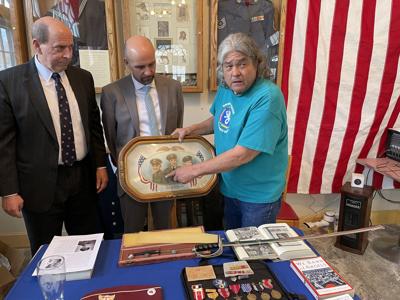
POCATELLO — Stanley Lopez landed the score of a lifetime when he paid just $750 for a pair of U.S. Air Force dress swords once owned by World War II-era military legends.
The swords are such treasures, in fact, that Lopez and his wife, Kathryn Lopez-Luker, who works at the Marshall Public Library, decided one of them should be shared with the public. They’re loaning a sword belonging to Lt. Gen. Hubert Reilly Harmon — remembered as the Father of the Air Force Academy — to be displayed at the U.S. Air Force Academy in Colorado Springs, Colorado.
The other sword was owned by Harmon’s brother, Lt. Gen. Millard F. Harmon, who was among the top five highest-ranking Americans killed during WWII.
On March 11 at the Bannock County Veterans Memorial Building, 300 N. Johnson Ave., Stanley made a ceremonial presentation of the sword to Dr. Gregory Wickern and Dr. Shayne Stokes, who are both retired U.S. Air Force colonels. Lopez will soon deliver the sword in person to be displayed at the academy in Colorado Springs on an 18-month loan.
“It’s in my opinion something that belongs to the American people. I don’t consider it a personal possession and my hope is it will be able to go on permanent display at the Air Force Academy,” Stanley said.
The swords have developed personal significance to Stanley because he purchased them for his collection of military medals, photographs and memorabilia honoring his father and uncles, who all served their country at wartime.
His father, Rudolph Lopez, of the San Luis Valley in southern Colorado, was a member of the U.S. Army’s 59th Coast Artillery during WWII. He fought on the island of Corregidor in the Philippines, which the Japanese attacked hours after the bombing of Pearl Harbor. Corregidor fell to the Japanese on May 6, 1942.
Stanley explained Corregidor was an important battle because the resistance disrupted the Japanese conquest timetable.
Rudolph, however, had to endure 42 months as a prisoner of war.
“They starved him, tortured him and beat him,” Stanley said. “He had a variety of diseases he picked up.”
Stanley said Rudolph was also subjected to a “hell ship journey.” The Japanese packed American POWs into an antique cargo ship, where they remained for a long period without food or water.
Rudolph joined the Army Air Corps after being liberated from Japan and made his career with the U.S. Air Force. Rudolph was stationed at Lowry Air Force Base when Lt. Gen. Hubert Reilly Harmon presided there over the Air Force Academy’s first graduating class. The academy later moved to Colorado Springs.
His father’s younger brother Alex was 16 when he ran away to join the Army’s 1st Armored Division and serve in the war. Alex was 17 when he was killed during the Battle of Anzio in Italy.
Rudolph’s oldest brother, Raymond, served in several WWII campaigns with the U.S. Army’s 43rd Infantry Division, known as Winged Victory, and was highly decorated.
The youngest of the brothers, Robert, served with the U.S. Army’s 3rd Infantry Division in the Korean War. Robert was wounded in combat and honored with the Purple Heart. He’s now 92 and lives in Burley.
Stanley purchased the swords a year and a half ago from a Harmon family member’s estate sale. The swords were a gift to the brothers from their father for their graduation from West Point, Stanley said.
“I started looking up the history of these guys and I thought, ‘These are very historical items. Let’s get them,’” Stanley said.
During WWII, Hubert Reilly Harmon was appointed deputy commander for the Air Forces of the South Pacific in 1943 and was named commander of the 6th Air Force in June 1944.
Harmon became the first superintendent of the U.S. Air Force Academy on Aug. 14, 1954.
Lt. Gen. Millard F. Harmon had 30 years of military combat and command experience prior to his service in WWII. He’d flown in the search for Mexican revolutionary Poncho Villa, as well as in World War I.
In December 1941, Millard F. Harmon was assigned to be acting commanding general of the Air Force Combat Command and then became chief of the Air Staff, Army Air Forces. In July 1942, he was appointed commanding general of U.S. Army Forces in the South Pacific.
In 1945, just before the war’s end, his plane disappeared and was never found.
Wickern and Stokes, who accepted the sword during the recent ceremony, operate Asthma and Allergy of Idaho and treat Stanley at their Burley clinic. Stokes explained he connected Stanley to the right people at the Air Force Academy regarding the loan upon learning of the sword.
“They already have a lot of Gen. Harmon’s military items and they were very interested in his personal dress sword,” Stokes said. “He’s a significant figure in U.S. Air Force History.”
Wickern said he and Stokes both appreciate the honor of receiving the sword on behalf of the Air Force Academy.
“There aren’t many people who are taking the efforts that you are to go ahead and preserve — outside of a few select formal museums — the military history that this country owes a great deal of debt to,” Wickern said during the presentation. “I want to thank you and compliment you for your dedication to go ahead and make sure these types of memories do not become forgotten memories.”

(0) comments
Welcome to the discussion.
Log In