

Tisha Coleman has lived in close-knit Linn County, Kansas, for 42 years and never felt so alone.
As the public health administrator, she’s struggled every day of the coronavirus pandemic to keep her rural county along the Missouri border safe. In this community with no hospital, she’s failed to persuade her neighbors to wear masks and take precautions against COVID-19, even as cases rise. In return, she’s been harassed, sued, vilified and called a Democrat, an insult in her circles.
Even her husband hasn’t listened to her, refusing to require customers to wear masks at the family’s hardware store in Mound City.
“People have shown their true colors,” Coleman said. “I’m sure that I’ve lost some friends over this situation.”
By November, the months of fighting over masks and quarantines were already wearing her down. Then she got COVID-19, likely from her husband, who she thinks picked it up at the hardware store.
Her mother got it, too, and died Sunday, 11 days after she was put on a ventilator.
Across the United States, state and local public health officials such as Coleman have found themselves at the center of a political storm as they combat the worst pandemic in a century. With the federal response fractured, the usually invisible army of workers charged with preventing the spread of infectious diseases has become a public punching bag. Their expertise on how to fight the coronavirus is often disregarded.

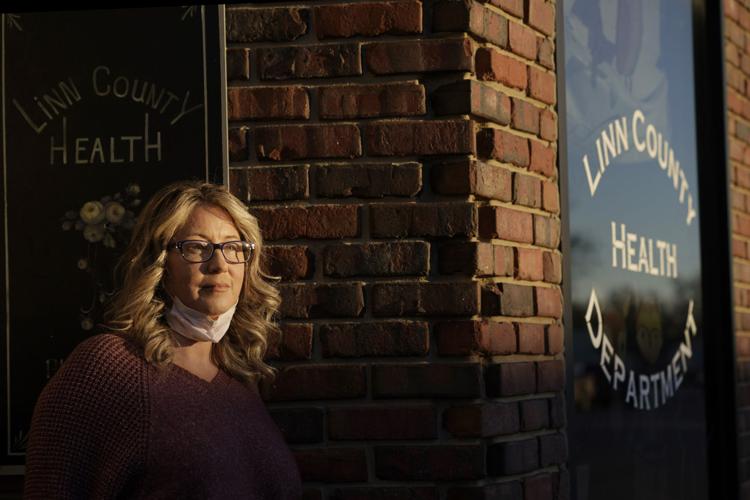
Tisha Coleman, public health administrator for Linn County, stands in front of her office on Dec. 7 in Pleasanton, Kansas. Across the United States, state and local public health officials such as Coleman have found themselves at the center of a political storm as they combat the worst pandemic in a century.
Some have become the target of far-right activists, conservative groups and anti-vaccination extremists who have coalesced around common goals: fighting mask orders, quarantines and contact tracing with protests, threats and personal attacks.
The backlash has moved beyond the angry fringe. In the courts, public health powers are being undermined. Lawmakers in at least 24 states have crafted legislation to weaken public health powers, which could make it more difficult for communities to respond to other health emergencies in the future.
“What we’ve taken for granted for 100 years in public health is now very much in doubt,” said Lawrence Gostin, an expert in public health law at Georgetown University in Washington, D.C.
It is a further erosion of the nation’s already fragile public health infrastructure. At least 181 state and local public health leaders in 38 states have resigned, retired or been fired since April 1, according to an ongoing investigation by The Associated Press and KHN. According to experts, this is the largest exodus of public health leaders in American history. An untold number of lower-level staffers have also left.
“I’ve never seen or studied a pandemic that has been as politicized, as vitriolic and as challenged as this one, and I’ve studied a lot of epidemics,” said Dr. Howard Markel, a medical historian at the University of Michigan. “All of that has been very demoralizing for the men and women who don’t make a great deal of money, don’t get a lot of fame, but work 24/7.”
One in 8 Americans — 40 million people — lives in a community that has lost its local public health department leader during the pandemic. Top public health officials in 20 states have left state-level departments, including in North Dakota, which has lost three state health officers since May, one after another.
Many of the state and local officials left due to political blowback or pandemic pressure. Some departed to take higher-profile positions or due to health concerns. Others were fired for poor performance. Dozens retired.
KHN and AP reached out to public health workers and experts in every state and the National Association of County and City Health Officials; examined public records and news reports; and interviewed hundreds to gather the list.
Collectively, the loss of expertise and experience has created a leadership vacuum in the profession, public health experts say. Many health departments are in flux as the nation rolls out the largest vaccination campaign in its history and faces what are expected to be the worst months of the pandemic.
“We don’t have a long line of people outside of the door who want those jobs,” said Dr. Gianfranco Pezzino, health officer in Shawnee County, Kansas, who had decided to retire from his job at the end of the year because, he said, he’s burned out. “It’s a huge loss that will be felt probably for generations to come.”
But Pezzino did not even make it to Dec. 31. On Monday, after county commissioners loosened restrictions, he immediately stepped down.
EXISTING PROBLEMS
The departures accelerate problems that had already weakened the nation’s public health system. AP and KHN reported that per capita spending for state public health departments had dropped by 16 percent, and for local health departments by 18 percent, since 2010. At least 38,000 state and local public health jobs have disappeared since the 2008 recession.
Those diminishing resources were already prompting high turnover. Before the pandemic, nearly half of public health workers said in a survey they planned to retire or leave in the next five years. The top reason given was low pay.
Such reduced staffing in departments that have the power and responsibility to manage everything from water inspections to childhood immunizations left public health workforces ill-equipped when COVID-19 arrived. Then, when pandemic shutdowns reduced tax revenues, some state and local governments cut their public health workforces further.“Now we’re at this moment where we need this knowledge and leadership the most, everything has come together to cause that brain drain,” said Chrissie Juliano, executive director of the Big Cities Health Coalition, which represents leaders of more than two dozen public health departments.
POLITICS AS PUBLIC HEALTH POISON
Public health experts broadly agree that masks are a simple and cost-effective way to reduce the spread of COVID-19 and save lives and livelihoods. Scientists say that physical distancing and curtailing indoor activities can also help.

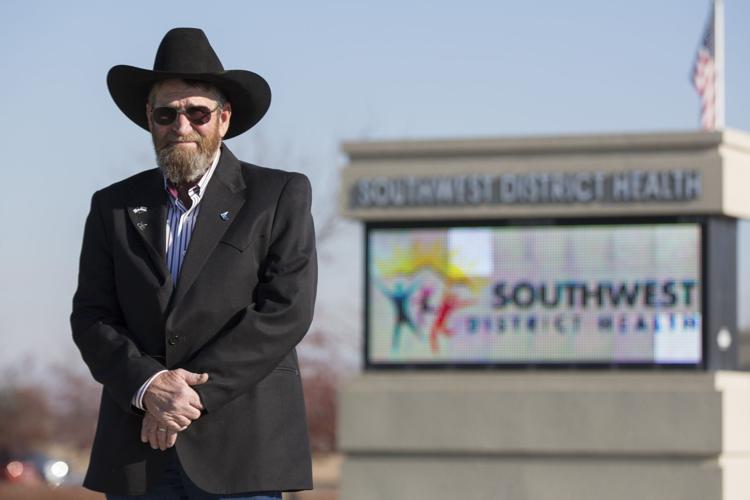
Kelly Aberasturi, vice-chair commissioner of the board of Southwest District Health, stands outside the SWDH office in Caldwell on Nov. 24. Aberasturi doesn’t support mask mandates, but he did back the board’s unanimous recommendation that people in the community wear masks. He said people who believe even a recommendation goes too far have threatened to protest at his house.
But with the pandemic coinciding with a divisive presidential election, simple acts such as wearing a mask morphed into political statements, with some on the right saying such requirements stomped on individual freedom.
During the 2020 campaign, President Donald Trump ridiculed Democratic challenger Joe Biden for wearing a mask and egged on armed people who stormed Michigan’s Capitol to protest coronavirus restrictions by tweeting “LIBERATE MICHIGAN!”
The politicization has put some local governments at odds with their own health officials.
In California, near Lake Tahoe, the Placer County Board of Supervisors voted to end a local health emergency and declared support for a widely discredited “herd immunity” strategy, which would let the virus spread. The idea is endorsed by many conservatives, including former Trump adviser Dr. Scott Atlas, as a way to keep the economy running, but it has been denounced by public health experts who say millions more people will unnecessarily suffer and die. The supervisors also endorsed a false conspiracy theory claiming many COVID-19 deaths are not actually from COVID-19.
The meeting occurred just days after the county public health officer, Dr. Aimee Sisson, explained to the board the rigorous standards used for counting COVID-19 deaths. Sisson quit the next day.
In Idaho, protests against public health measures are intensifying. Hundreds of protesters, some armed, swarmed health district offices and health board members’ homes in Boise on Dec. 8, screaming and blaring air horns. They included members of the anti-vaccination group Health Freedom Idaho.
Dr. Peter Hotez, dean of the National School of Tropical Medicine at Baylor College of Medicine, has tracked the anti-vaccine movement. He said it has linked up with political extremists on the right and taken on a larger anti-science role, pushing back against other public health measures such as contact tracing and physical distancing.Members of a group called the Freedom Angels in California, which sprung up in 2019 around a state law to tighten vaccine requirements, have been organizing protests at health departments, posing with guns and calling themselves a militia on the group’s Facebook page.
The latest Idaho protests came after a July skirmish in which Ammon Bundy shoved a public health employee who tried to stop him and his maskless supporters from entering a health meeting.
Bundy, whose family led armed standoffs against federal agents in 2014 and 2016, has become an icon for paramilitary groups and right-wing extremists, most recently forming a multistate network called People’s Rights that has organized protests against public health measures.
“We don’t believe they have a right to tell us that we have to put a manmade filter over our face to go outside,” Bundy said. “It’s not about, you know, the mandates or the mask. It’s about them not having that right to do it.”

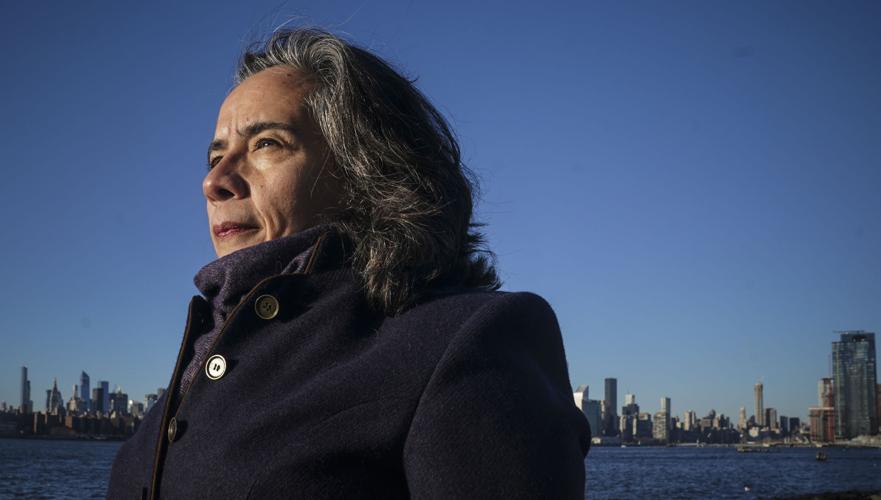
Dr. Oxiris Barbot, a pediatrician and former health commissioner for New York City during the coronavirus outbreak, poses for a portrait in the Brooklyn borough of New York on Dec. 7. Barbot left her job as commissioner in August amid a clash with Democratic Mayor Bill de Blasio. During the height of the pandemic, the mayor empowered the city’s hospital system to lead the fight against COVID-19, passing over her highly regarded department.
Kelly Aberasturi, vice chair for the Southwest District Health, which covers six counties, said the worker Bundy shoved was “just trying to do his job.”
Aberasturi, a self-described “extremist” right-wing Republican, said he, too, has been subjected to the backlash. Aberasturi doesn’t support mask mandates, but he did back the board’s recommendation that people in the community wear masks. He said people who believe even a recommendation goes too far have threatened to protest at his house.

(0) comments
Welcome to the discussion.
Log In