

BOISE — Idaho’s statewide spike in coronavirus infections isn’t coming from classrooms or grocery stores, top state officials said Tuesday.
“It’s really in those social settings — it’s sporting events, it’s going to church, it’s community events, it’s being in a car with people that aren’t in your household,” said Dave Jeppesen, director of the Idaho Department of Health & Welfare. “It’s the family gathering or the wedding or the funeral.”
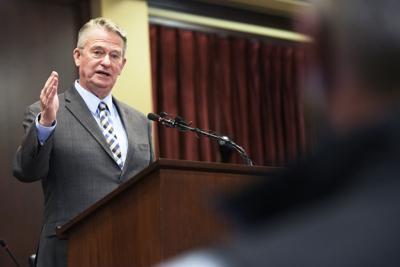
That’s why Gov. Brad Little’s new modified Stage 3 order, which imposed new limits on gatherings statewide starting Tuesday morning just after midnight, is pointed squarely at those gatherings, Jeppesen and Little said during a statewide tele-town hall with AARP Idaho on Tuesday.
“I think what happens there is we tend to be familiar at those events and we tend to forget to follow those couple simple things,” Jeppesen said. “And we end up sitting closer than six feet, without face coverings. And that’s where that happens.”
“We can still do those things, but they have to be done safely,” he said. “And particularly when it’s familiar, when it’s friends and family, it’s really easy to let your guard down.”The new statewide public health order includes both mandatory and recommended provisions aimed at gatherings, along with a mask mandate for anyone entering a long-term care facility who’s not a resident, while still allowing visitors. Indoor gatherings of more than 50 people are prohibited; outdoor gatherings are limited to 25% of the venue’s capacity. It exempts schools of all types and religious and political activities from the definition of “gathering.”
“Our weak link has been these gatherings, and that’s why that was the biggest part of moving to Stage 3,” Little said.
Several callers from around the state pressed the governor hard on why he didn’t impose a statewide mask mandate.
“Why aren’t you really willing to protect the people of Idaho?” asked Julie from Lenore.
Bob in Sagle said, “You abdicate your responsibility to the locals, and the locals just don’t care.”
Mark in Pocatello said, “You keep asking people, ‘Wear a mask, social distance, yada, yada, yada.’ They’re not listening. You’re the adult in the room. What is the tipping point? At what point do you say, ‘OK, kids, now we’re going to tell you what to do? … Things are just getting worse.”
Little responded, “We are that tipping point,” and said it has to do with overwhelming the state’s health care capacity. With hospitals in multiple regions of the state near or at capacity due to COVID-19, they’re at risk of being unable to care for Idahoans with everything from cancer to an emergency birth to a car accident, he said. Little called that capacity question “our north star, our guiding light” in all the state’s decisions on managing the pandemic.
He also reiterated that he believes compliance is better with local, rather than statewide, orders.
“Having the mandate is one thing, having people comply with it is totally different,” the governor said. “And what we want is people doing the right thing, mandate or no mandate.”
“It’s kind of a philosophical position of mine,” he said, and noted, “We do not have a statewide health care police force.”
At a press conference a day earlier at which he unveiled the new public health order, Little said, “I’m not denying that there are going to be some people that’ll be deniers to the bitter end, but I don’t need to have 100% compliance. I need to have much higher compliance than I have today.”
He noted that just over half the state population already is under a locally imposed mask order; areas with mask mandates include counties and cities from eastern Idaho to the North Idaho Panhandle, including Boise and Ada County. While the Panhandle Health District last week lifted a mask order in Kootenai County, the Coeur d’Alene City Council on Monday reinstated it for the county’s largest city.
Violations of the mandatory provisions of the new public health order are considered “an imminent threat to public health” and punishable as misdemeanor crimes. Those are the provisions that say “shall” or “must.”
“They’re enforceable,” the governor said.
The recommendations, including wearing face coverings in public and offering telework or other accommodations for vulnerable employees, say “should” in the order rather than “shall.”
“Those are recommendations — I’d say strong recommendations,” Jeppesen said. “It’s really quite simple,” he said. “It’s wearing a face covering, it’s washing your hands. And in the new Stage 3 order is a requirement, that says it’s required that for non-household members you have six feet of space between them. The reason for that is we know six feet of space works, it slows down the transmission.”
The order states, “Individuals not residing within the same household shall maintain at least six-foot physical distancing from other individuals whenever possible.”
Jeppesen said that “whenever possible” language recognizes that there are times when it won’t be possible to comply with the requirement, in situations such as a caregiver providing care to a patient in a long-term care facility, or a police officer making an arrest.
The order says individuals “should” wash or sanitize hands, cover coughs or sneezes, clean surfaces and avoid handshaking, stay home if sick, and “wear face coverings while in public, especially when six-foot distancing is not always possible,” such as inside businesses.
“A lot of it is awareness,” Little said, “And that’s why we’re thankful for this call.”
It was the 25th hourlong, statewide call-in the governor has held with AARP Idaho since the start of the pandemic; the calls started weekly, and currently are being held every other week. AARP is a nonpartisan organization that promotes the well-being of older Americans; it has nearly 186,000 members in Idaho.
A caller named Kathy from Meridian said she attended a wedding where she and her husband both wore masks, and had a conversation from about 8 feet apart from other masked attendees, including two who later developed COVID-19.
“I’m happy to say we didn’t get it,” she said.
Betty from Nampa told the governor and Jeppesen she’s immune-compromised, and stayed in the car to watch at a recent graveside funeral service because she saw other attendees taking off their masks.
“It scares me,” she said.
“You just described exactly what we see over and over around the state,” Jeppesen told her. “People show up at a funeral and you want to take your mask off and socialize. … That is the most critical place to minimize those transmissible moments. It’s going to take all of us to remind each other to wear our face masks and maintain six feet of distance.”
“It can be done safely,” he said. “But everybody has to follow those simple precautions. That is so critical, and really the point of the Stage 3 order, is to make sure those gatherings are safe.”


(0) comments
Welcome to the discussion.
Log In