

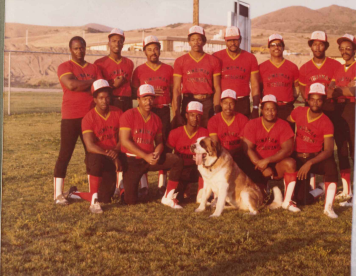
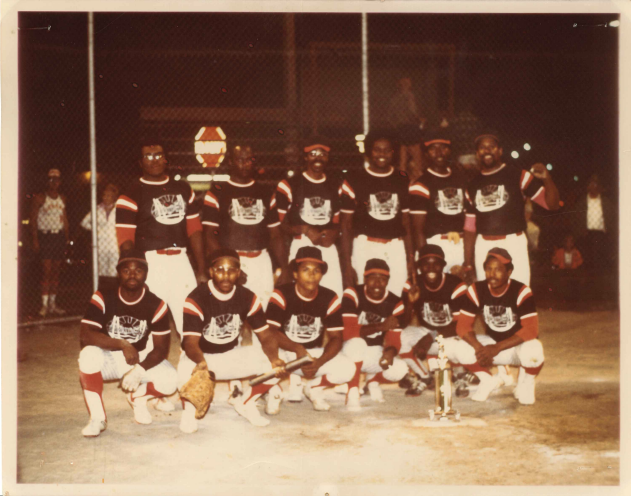
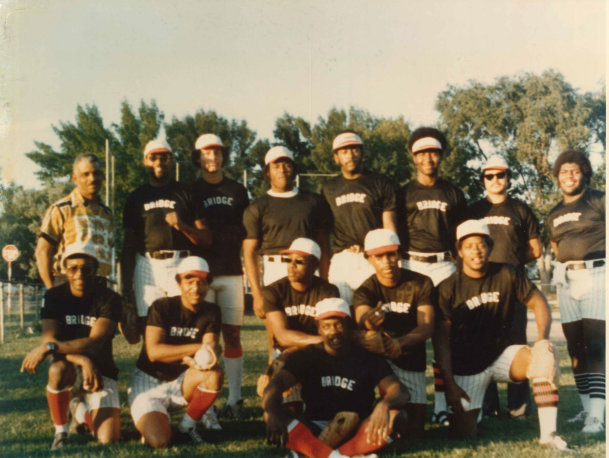
Most members of Pocatello’s first all-African American softball team had never played slow-pitch softball and some had only recently heard of it before taking the field for the 1973 city league season-opener. Three months later, The Bridge was the city B League champion and four years later after qualifying as district champion it played in the Idaho Class A State Championship.
The Gate City Grays will honor this pioneering squad at the Grays’ Saturday game with Anaheim, California. Gates open for the game at 6:30 p.m. at Halliwell Park.
A number of former players of The Bridge will be introduced in pregame ceremonies and will throw out the first pitch.
Robbie Robertson played fast-pitch softball in the U.S. Air Force and when he settled in Pocatello he played in the fledgling slow-pitch league co-founded by Bob Zausch and the late John Scott in 1971. Initially, he was the league’s only Black player. Robertson wanted to field a team with other African Americans and approached Zausch, a Caucasian.
Robertson told Zausch it would be an all-Black team and says Zausch’s response was, “Who cares?”
“We were excited,” Zausch recalls, “and thought it was really neat. We were happy to see them because they were unique.”
Zausch also recalls The Bridge being tough from the get-go.
“It took a real good effort to beat them,” he said.
Robertson says he got the idea from the Pocatello Sluggers, Pocatello’s all-Black baseball team of the late 1940s and early ’50s. A transplant from West Virginia who settled in Pocatello after his military hitch, Robertson never saw the Sluggers play. But he knew Ike Stokes, a member of the Sluggers, and talked with him, John Purce and Cleophus Doster, owners of the tavern, The Bridge, about sponsoring a slow-pitch team. According to Robertson, they said, “What’s that?”
Stokes soon became a fan. He never missed a game. Many in Pocatello’s Black community never missed a game.
“Tydeman Field’s bleachers were full,” Robertson says. “We even made friends with the umpires.”
The Bridge was quickly and seamlessly accepted into the Poky league.
“There was never any problem with color,” Robertson says, “except when we started beating everyone’s butt. They put us in the B League and we were beating everyone by 10 or 12 runs and won the (championship) trophy. The other teams said you had to put them in the A League.”
That happened the next year.
“Our second year, we started traveling,” Robertson says. “We went to Salt Lake City, Twin Falls, Sun Valley. We played McUs (of Boise) — they beat us 14-12 and went on to nationals. We played a Salt Lake team with Ron Boone (all-time great ISU basketball player and many-year NBA fixture). We never had any trouble other than when we showed up and were all-Black, and they’d never seen an all-Black team.”
So how do you field a team when the athletes you are recruiting have mostly never heard of or played the sport, slow-pitch softball?
“It was not that hard,” says Robertson. “Most of our players were athletes and most had played youth baseball. They hadn’t played for a while but everyone caught on real quick. They liked having a roving fielder. Everyone wanted to play rover.”
The Bridge’s first-year roster is dotted with familiar names, locals who stayed in Southeast Idaho or athletes recruited by Idaho State University, many of whom made Pocatello their home. The group includes pitcher/outfielder Ken Monroe, pitcher Michael Purce, catcher Jim Robinson, first baseman Buddy Frazier, infielders Sam Duke, Al Gibson and Robertson and outfielders Butch Griggs, Tony Monroe, Sonny Warren, Ron Stokes, Roscoe Hill and Royce Hill.
The new few years saw the addition of Homer Watkins, Franklin King, DeWitt Walton, Melvin Taylor and Paul Wilson.
Just how formidable was that Bridge collection of mashers? Some yellowing Idaho State Journal newspaper clippings from Ken Monroe’s scrapbook are informative.
One says, “The Bridge’s forte is power. Pitcher Ken Monroe pounded nine home runs in six pre-season tourney games, and first baseman Buddy Frazier was a close second. In all, The Bridge hit nearly three dozen homers in the tournament.”
Another, from a tournament wrap-up: “The Bridge had its heroes, led by massive catcher Homer Watkins, who drilled six round-trippers in two days of play. Right fielder Royce Hill batted over .500 with three home runs, and pitcher Ken Monroe was all over the field defensively.”
And: “Homer Watkins and Kenny Monroe each blasted two home runs and Royce Hill added another as The Bridge outslugged D&J Diesel 34-21.” Thirty-four runs in one game!
Dan Zausch, Bob’s son, who basically grew up with slow pitch at Tydeman Field watching his Dad pitch for Ted’s Chrysler, pointed out there was a house across the street behind Tydeman’s left field fence. Reaching it would be quite a poke.
“Homer Watkins often bombed it off the pink house across the street,” Dan Zausch said.
Watkins, deceased before his time, was recruited to play basketball at Idaho State College and made Pocatello his home. More on him in a bit. Ken Monroe attended Pocatello High School, played football and put the shot for ISU, and is now president of the NAACP’s Pocatello Branch. Frazier, a basketball and sprint star for ISU and a member of the school’s Sports Hall of Fame, is retired after a long career as director of ISU’s Office of Affirmative Action. Slugging catcher Robinson, known to his teammates and almost everyone else as “Big Jim,” was recruited from Ohio to play football at ISU. He made his home in Pocatello and was the favorite teacher of this writer’s daughter at Franklin Middle School.
Robertson recalls the year when The Bridge played in the Salt Lake City Firecracker Tournament at a beautiful multi-field softball complex. “Homer said, ‘We’ve got to get one of these.’ He talked to some people and it happened.”
“It” is Homer Watkins Softball Complex, first dedicated by the Pocatello Slow Pitch Softball Association, the multi-field complex that is home to Pocatello slow-pitch softball.
“We renamed NOP Park for Homer Watkins,” Bob Zausch says. “It was built by volunteers and turned over to the city later. We were a stand-alone organization not run by the city. We handled all the expenses and they supplied the field.”
Robertson concluded his comments with “The Bridge became a household name here. We became a good team, one of the best in the state. We all wanted to have fun.”
Winning is a lot of fun.

(0) comments
Welcome to the discussion.
Log In