

For years, Rocky Point has been a dangerous stretch of highway for both wildlife and motorists.
Located on U.S. Highway 30 south of Montpelier, the 20-mile corridor has averaged about 100 mule deer deaths each year. Seventy percent of those collisions have occurred within a five-mile stretch at Rocky Point, making it one of the most significant wildlife-mortality areas in Idaho.

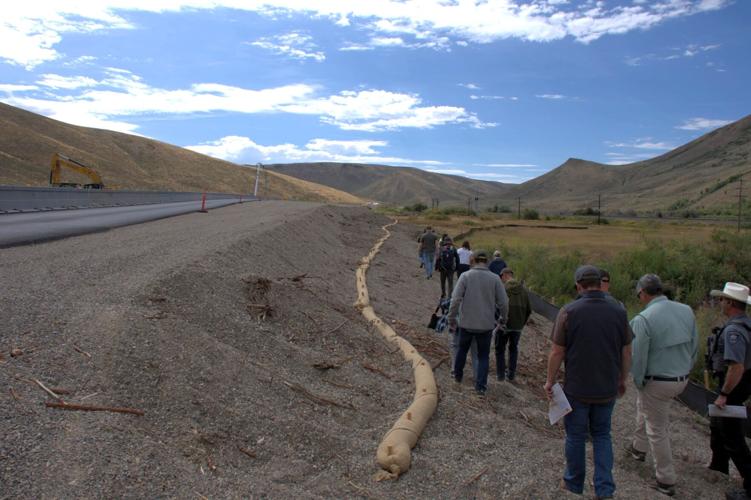
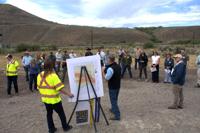
Members and officials from state and federal agencies and conservation groups walk to the presentation site during an Aug. 18 tour of the Rocky Point Wildlife Crossing Project.
Now, after years of data collection, planning and cooperation among state and federal agencies, conservation groups, landowners and local leaders, a project designed to change that is nearing completion.
The Rocky Point Wildlife Crossing Project is scheduled to be completed in October.
On Tuesday, Aug. 18, approximately two dozen people gathered at the project site for a tour organized by Jeff Abrams of the Idaho Conservation League and Matt Lucia of the Greater Yellowstone Coalition. The group included representatives from the Idaho Transportation Department, Idaho Fish and Game, conservation organizations, local landowners and local government.
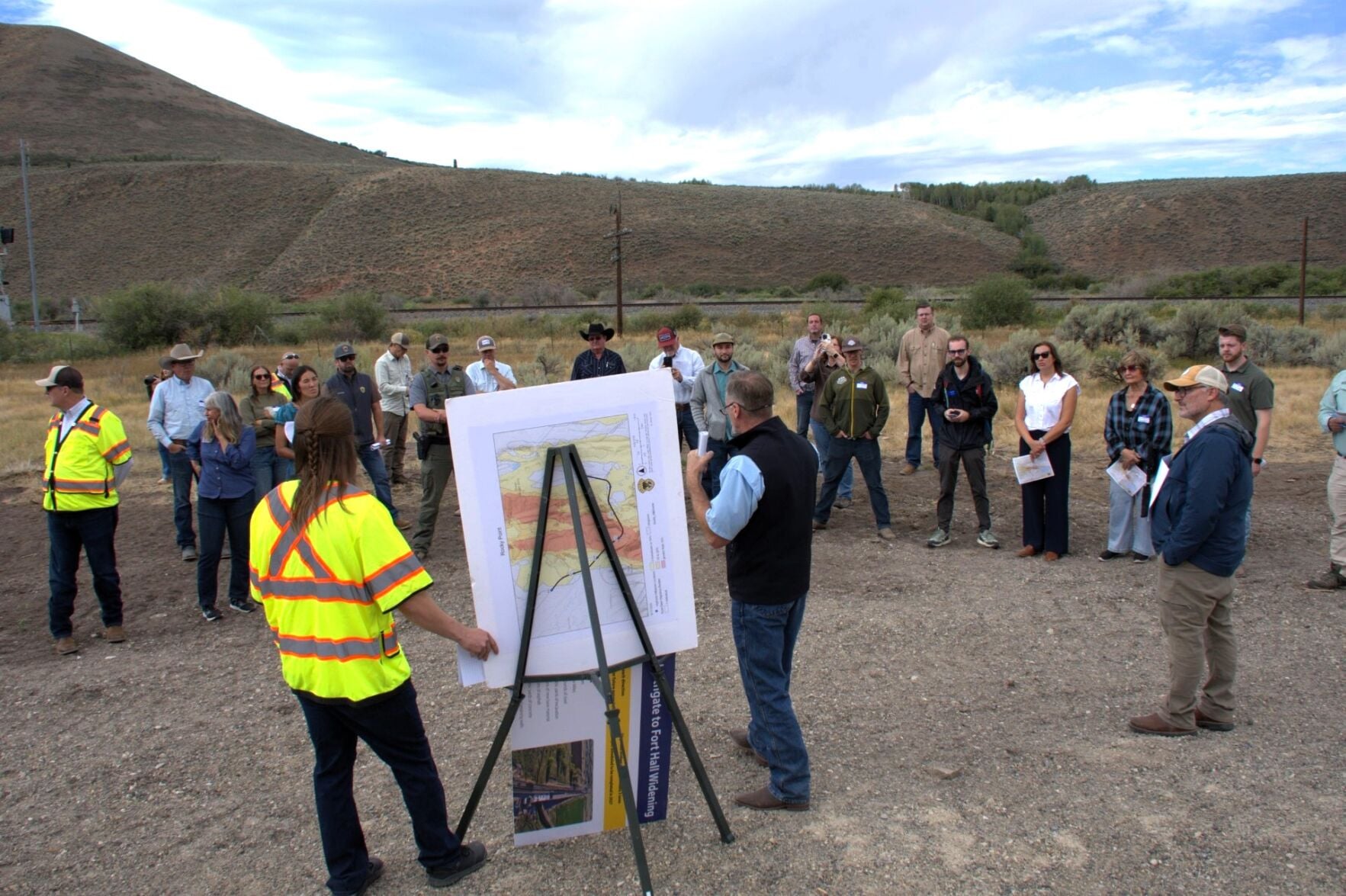
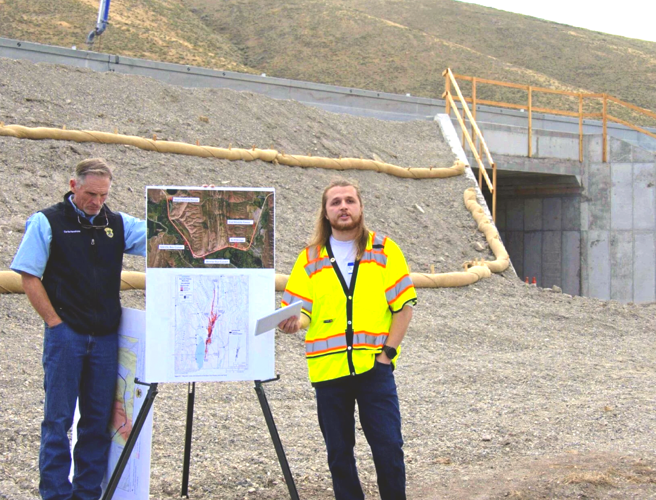
Curtis Hendricks of Idaho Fish and Game, front right, explains mule deer migration routes through the Rocky Point corridor to attendees during the Aug. 18 tour.
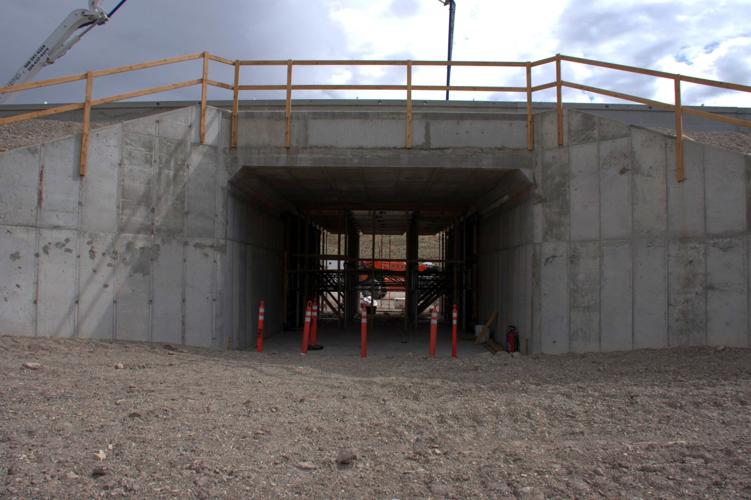
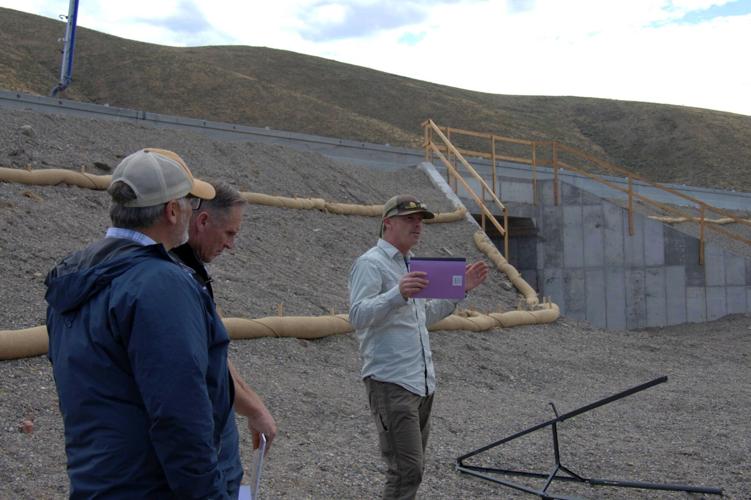
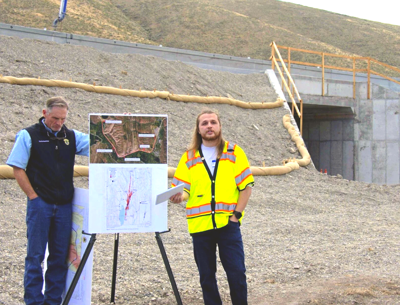
The tour provided an up-close look at one of three wildlife underpasses being constructed beneath U.S. 30 and gave attendees a better understanding of the scope of the project.
Approximately 5,000 deer use the Rocky Point area as a migration corridor twice each year, traveling between summer and winter ranges. The highway cuts directly through that route, creating a dangerous barrier during those migrations.
Curtis Hendricks of Idaho Fish and Game explained that Rocky Point accounts for roughly four to five percent of all highway wildlife mortality in the state.
"What does the death of 100 deer look like?" Hendricks asked. "It might not mean much to a large herd, but when you multiply that by three, five, or even 10 years, we're looking at thousands of deer."
Those losses come on top of the natural mortality experienced by the herd.
Mule deer are also creatures of habit when it comes to migration. Hendricks explained that they often follow routes used by generations before them.
"They're not very flexible," he said. "They use the same routes that their ancestors used a hundred years ago."
That makes development and busy highways particularly challenging.
"We're not here (at Rocky Point) by accident," Hendricks said. "We've talked to landowners who know the animals, we have GPS data that shows where the deer travel in their migrations, and we have roadkill data. Rocky Point has been in the top three in the state for the number of roadkill animals, so this is where we needed to focus our efforts."
The number of collisions also affects more than wildlife.

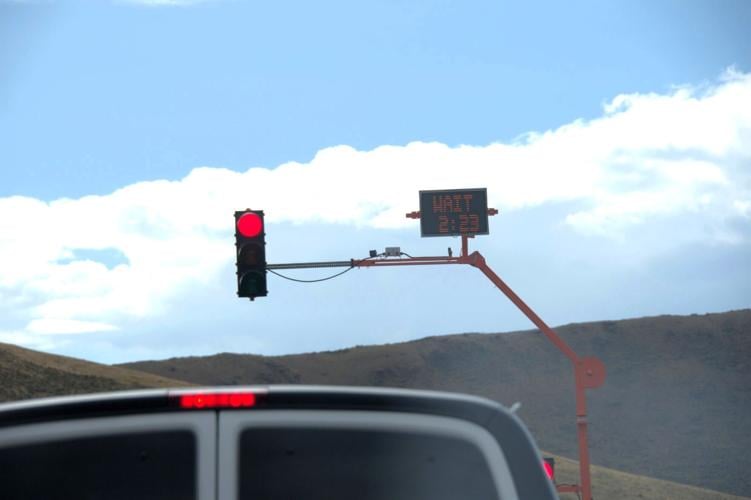
A temporary traffic signal counts down the wait time for drivers passing through ongoing construction along U.S. Highway 30 at Rocky Point.
With more than 1,200 vehicles traveling through the Rocky Point corridor each day, collisions create a safety concern for motorists and contribute to higher vehicle insurance costs for local residents.
Randall Pitchford of Farm Bureau Insurance explained that insurance rates in Bear Lake County are higher than in places such as Boise, and the number of vehicles damaged in the Rocky Point area is one factor.
Bo Frasure of ITD described what the area looked like before construction began.
"This was basically a bone yard from all of the carcasses," he said. "We buried so many bones and carcasses before we started working."
The solution is a $20.9 million project funded through the federal Wildlife Crossings Pilot Program, a competitive grant program designed to reduce wildlife-vehicle collisions. Although the project received $20.9 million in grant funding, construction came in significantly under budget at approximately $14 million. The remaining funds will be returned for use on other wildlife-crossing projects.

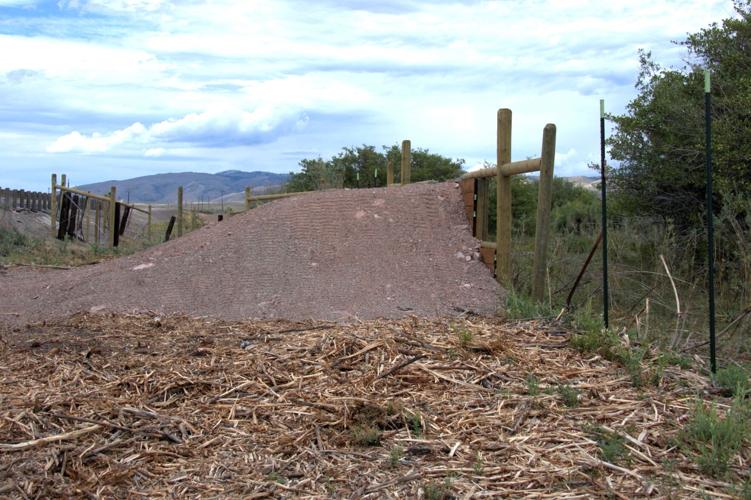
One of the project's 28 wildlife "jump-outs" is built into the roadside embankment along the five-mile stretch, giving animals that wander onto the highway a way to escape back over the fencing.
The project includes three wildlife underpasses, approximately six miles of eight-foot-high fencing and 28 "jump-outs," which provide animals that accidentally get onto the highway with a way to escape.
"We put in two large concrete box culverts under the road as well as one that is an actual bridge," explained Scott Redding of ITD. "All three encompass a path that safely funnels the animals under the highway."
The locations of the crossings were not chosen at random.
A combination of GPS tracking data, roadkill information and knowledge from local landowners helped identify the areas where the structures could have the greatest impact.
The fencing will help guide migrating animals toward the crossings rather than allowing them to wander onto the highway.

One of three wildlife underpasses being built beneath U.S. Highway 30 nears completion as part of the Rocky Point Wildlife Crossing Project.
But even the best fencing cannot guarantee that an animal will never get onto the road. That is where the jump-outs come in.
"The jump-outs are spaced to entice any animals on the highway to get off the highway," Redding said. "Basically, we want to invite the animals to the crossings, but if they get in, there are lots of places to jump out."
As construction moves toward completion, crews will finish installing poles and connecting the fencing system so the entire corridor works together.
The project represents years of cooperation among organizations with different missions but a common interest in finding a solution.
Wildlife conservation easements have also played an important role. Through these voluntary agreements, landowners retain ownership of their property while agreeing to limit future development in order to protect wildlife habitat and migration corridors.
In 2019, the Greater Yellowstone Coalition donated $150,000 and worked with Idaho Fish and Game to help purchase conservation easements in the Rocky Point area.
The result is a project that not only addresses wildlife mortality but also aims to make the highway safer for the people who travel it every day.
"This is quite a victory, especially in today's political culture," said Rob Thornberry of the Theodore Roosevelt Conservation Partnership, a nonprofit organization that works to preserve hunting and fishing traditions.
"You were able to identify a problem, work together to come up with a solution, and then make it work. This is something to be proud of."
Thornberry pointed to other wildlife crossings as evidence that the approach can work.
He noted that a wildlife crossing constructed about 15 years ago north of Pinedale, Wyoming, resulted in a 100 percent decrease in wildlife fatality incidents in that area.
"This has proven to be successful," Thornberry said. "If we reduce collisions by even 80 percent, that will have a huge impact for everyone."
The Rocky Point project is the result of nearly a decade of gathering information, identifying the problem and developing a solution.

Jeff Abrams of the Idaho Conservation League, right, explains the benefits of the Rocky Point Wildlife Crossing Project to attendees during an Aug. 18 site tour.
Abrams said the project demonstrates the value of using long-term data and lessons learned from other communities.
"This is just one example of fixing things using long-term case studies to show us what to do," Abrams said. "We have case studies from Wyoming and northern Idaho that show us that these wildlife crossings work."
Bear Lake County Commissioner Wynn Olsen said the community will not see the full benefit immediately, but the long-term impact could be significant.
"It'll be three to four years down the road before we see the benefits for Bear Lake, but it'll be huge," Olsen said.
When the project is completed this fall, the hope is that thousands of migrating animals will have a safer way across a highway that has been a deadly obstacle for generations.
And for the people who travel U.S. 30, the goal is equally straightforward: fewer deer on the highway, fewer collisions and a safer journey through Rocky Point.


(0) comments
Welcome to the discussion.
Log In