

BLACKFOOT — What do you get when you add Independence High School Math Teacher Shelley Nash and her algebra students to the Idaho Transportation Department’s Crash Data Dashboard and the “Do the Math, Save a Life” curriculum? Now, add to that total the listening ears of Blackfoot City’s Transportation Committee.
The answer? Respect, and suggestions for improving the safety at seven intersections in the city of Blackfoot.
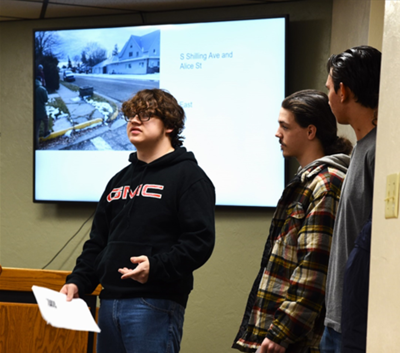
This equation was utilized two times last week. The first time was when two members of the city’s transportation committee, Chairman Curtis Cannon, and LaVar Davidson from the Blackfoot streets and sanitation department, assisted in grading the student’s final safety presentations at Independence High School. The second time was the next day when the students came to City Hall to give presentations before the full transportation committee.
This committee includes seven volunteer community and business leaders, and city leaders such as Mayor Marc Carroll, City Council member Debbie Barlow, Police Chief Gordon Croft and Street and Sanitation Superintendent Scott Murphy. Not only was Chief Croft and Superintendent Murphy asking questions — they were also taking notes. Their respect for the students was obvious and well-earned.
This win-win outcome all started when Nash attended an Idaho Council of Teachers of Mathematics Conference last August. There, she learned of the badging approach to education and of ITD’s locally written “Do the Math, Save a Life” curriculum.
Inspired, she got busy and learned the badge system last fall and implemented it for the first time this term by teaching two data modeling badges to her algebra students. In education lingo, a badge is larger than a standard, but smaller than a credit unit.
Idaho is one of three states that are piloting this new badging approach to education created by the non-profit XQ Institute. Within the state there are 10 schools taking on that challenge, seven of which are in Eastern Idaho. The day after their presentations, the students were awarded the Modeling with One Variable Data Badge and the Modeling with Two Variable Data Badge. They are the first students in the nation to earn a badge — and they earned two.
Badges are designed to anchor learning to real world situations. In Nash’s classroom, this translated to the question: “How can we make roads safer in Blackfoot?”
Her 15 students took on the challenge, formed teams, learned how to use internet databases, learned from industry experts, debated the data and visited the questionable intersections to observe firsthand the road structures, traffic flow and congestion, pedestrians, signage and visual obstructions.
Along the way, they learned about one- and two-variable data and how to interpret them accurately — covering such math concepts as mean, median, mode, standard deviation, scatterplots, residuals, data biases, ethics and the difference between categorical and quantitative data.
In the process, they learned the traffic industry lingo and were able to effectively respond to the committee’s questions and communicate their data and suggestions professionally. They also sharpened their research skills and critical analysis abilities, and how to concisely communicate their findings — something not all professionals have learned. Their presentations included clear data charts and images, sometimes with added informational captions.
Chairman Cannon also noted that in the midst of all this learning, some of the students found or expressed passions. For instance, Denver related for the committee his experience helping his cousin recover from being hit while crossing a busy street in Idaho Falls. Safe streets have become important to him. For his teammate, Augustin, he discovered a passion for building bridges.
After studying the crash dashboard and including their own experience navigating Blackfoot’s streets, the students identified seven problematic intersections.
These include Alice at both University and Shilling; Walker and York; Rich Lane, Highland and Highway 91; Collins and Highway 26; and West Bridge Street intersections at both Parkway Drive and Meridian. If you happened to see students taking pictures or counting cars at those locations, you saw Nash’s students in action.
The presentations at City Hall quickly shifted to discussions of the solutions that were suggested. Chief Croft explained about the sight triangles they have to enforce, and Superintendent Murphy explained how much authority they have to trim back trees to make sure signs and traffic can be seen. How a new safety ordinance might be crafted was also outlined. The ensuing dialogue between the committee, Nash and the students became a productive, solution brainstorming session.
In conclusion, Mayor Carroll asked for a list of each of the intersections studied with the proposed safety solutions. With his team of experts, he is going to consider each one and see which ones the city can implement. And, if one can’t be done, he will explain why — most likely due to state laws or lack of authority over the highways. Once he has done his homework, he will meet again with the students at Independence High School to present his findings.
Two questions remain: Will the Mayor’s presentation be as visually informative as the presentations of the traffic experts of Independence High School? And, what Blackfoot problem will Nash’s students take on next?

(0) comments
Welcome to the discussion.
Log In