

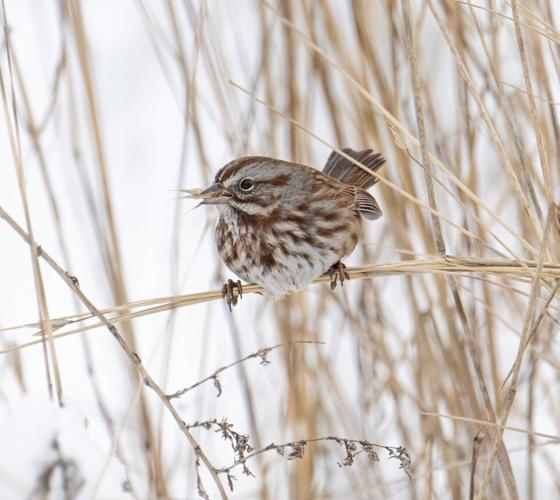
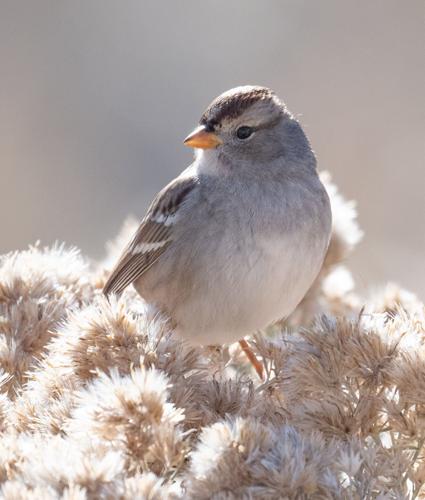
A few weeks ago, I wrote about the nutrient content of several types of wild fruit and how birds depend on them over the winter in the Treasure Valley. Another important source of nutrition for many species is seeds.
The problems in identifying seeds are at least two-fold. First, many seeds, especially those of grasses, are tiny. But it’s not just grasses. Consider poppy seeds. Better yet, ponder the seeds of the mustards, so tiny they made it into the Bible in an analogy about faith.
Second, seeds get scattered all over the place. Sparrows picking up seeds from the ground may be foraging some distance from the mother plant. These challenges make it unlikely you can figure out what’s being picked up by birds while looking through your binoculars, even if you spent $3,000 on those optics. Maybe you can sue Zeiss.
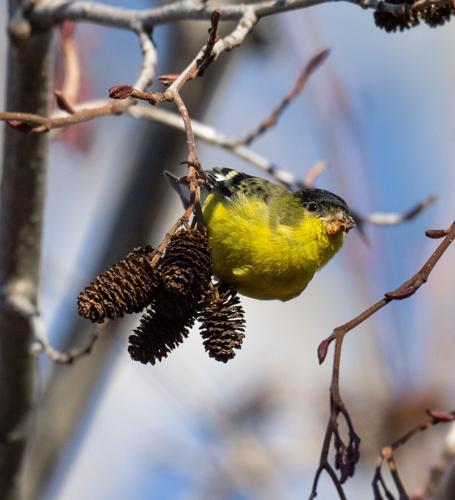
The best situation is when birds are sitting on a plant and eating its seeds. Wild sunflowers are easy. White alder, purple loosestrife and chicory are easy. Conifers are easy, if you know your conifers. Maples, ashes and thistles are pretty easy, if you don’t fret too much about exactly which species you’re looking at.
Our knowledge of seed nutrition begins with those we buy in a bag for our feeders. No worries about identification. I buy black oil sunflower seeds in the biggest bag I can find. Second in line are thistle seeds. I don’t buy seed mixes with ingredients like millet, milo and corn, which most birds don’t eat. To my amazement, peanuts are also seeds (not roots or tubers or rhizomes). And, while we’re here, thank you Jimmy Carter.
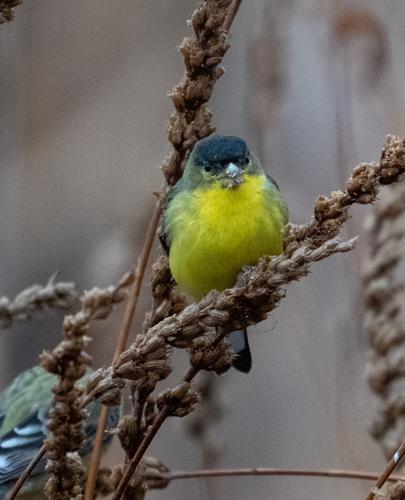
Finches are the most famous seed eaters. Sparrows seem to explore the ground for seeds during every waking hour. We see house finches and goldfinches taking seeds from seed heads above ground level. Pine grosbeaks, evening grosbeaks, red crossbills, pine siskins and Cassin’s finches probe cones in the tops of coniferous trees for available seeds.
Humans eat a lot of grass seeds too. For us, wheat, oats, rye, rice, corn and barley are most common. More adventuresome cooks use spelt, Khorasan wheat, einkorn wheat and teff. Among forbs, we now use quinoa, amaranth, buckwheat and chia. I’ve never been keen on buckwheat pancakes, no matter how much butter and maple syrup I apply. But quinoa is now a regular food on our table, even if I’m the only one to eat it.
So, what’s in those seeds? Starting at the top, sunflower seeds have significant amounts of fat, protein, carbohydrates, fiber, vitamin E, niacin, vitamin B6, folate, pantothenic acid, iron, magnesium, zinc, copper, manganese and selenium. Yikes! No wonder baseball fans have such athletic bodies.
It seems if you only had one food, this is it. Forget stocking your survival bunker with baked beans. Barrels of sunflower seeds and water should do the trick. Plus, spitting out the shells will give you something to do.
How about thistle? There are 62 species of native thistles in North America. I can’t find how many species we have in Idaho, but it’s safe to say they have a bad reputation. Despite their gorgeous purple flowers and popularity among bees and butterflies, invasives like Canada thistle and Scotch thistle (blame the immigrants?) have put them on the outs.
But thistle seeds are also nutrient bombs. They contain 35% fat and 20% protein, as well as significant quantities of iron, magnesium, potassium, sodium, zinc, and the antioxidants pectolinarin and linarin. Thistle seeds are famously small and hard, and not used by many species. If you have a thistle feeder in your yard, you’ll probably mostly see pine siskins and goldfinches on it. Juncos dabble, but that’s about it.
If you are a human, you might want to try milk thistle (an introduced species) seed tea. Or sprinkle the slightly bitter seeds on your arugula-kale salad, for a concoction that likely will keep pesky dinner guests away in the future.
Grass seeds — wheat, oat, rye, barley — have roughly similar amounts of protein, carbohydrates, fiber, vitamins and minerals. Wild species, such as wheatgrass, ryegrass, fescue, junegrass and stipas, are in the same ballpark. Even the seeds of noxious invasives like cheatgrass have significant carbohydrates. But those of one of the most noxious grasses out there — medusahead (Taeniatherum caput-medusae) — have so much silica they are essentially indigestible. And if you’ve hiked through a patch of cheatgrass and medusahead with exposed socks, you’re probably still cursing.
Hopefully, everyone knows the incredible taste of pinyon pine nuts. They’re expensive, but like lobster tails, sometimes you just say, to heck with it — I’m buying some. Pine nuts also supply significant quantities of amino acids, vitamin A, thiamin, riboflavin, niacin and phosphorus. Ponderosa pine nuts are similar. Humans don’t eat them as much because they are hard to extract in quantities from the cones.
Engelmann spruce seeds contain calcium, potassium, magnesium and phosphorus. They’re relatively low in protein and carbohydrates. The common sidekick of Engelmann spruce — subalpine fir — has seeds that apparently have not been analyzed. But the cones can be ground into a powder and mixed with fat to make a “confection.” Sounds like a nice compliment to the thistle-arugula-kale salad.
Maple seeds contain around 25% protein, 3% oil, a variety of vitamins and amino acids and an especially high level of beta-carotene. Ash tree seeds are high in carbohydrates, but have only minor amounts of protein, fiber, glucose and sucrose, as well as flavonoids, terpenoids and carotenoids.
Chicory seeds have potassium, calcium, magnesium, selenium and zinc. You may know chicory coffee is made by roasting, grinding and brewing the roots of the plant. Its flavor is described as earthy and nutty. I’ve not had this myself, but need to add it to my shopping list, along with juniper berries for my Norwegian pork ribs. I’m getting a vision for a meal my friends won’t soon forget.
The bottom line is, as with the fruits birds eat in winter, different seeds have different combinations of nutrients. It’s no wonder birds will abandon a plant full of food and move on to another plant for something a little different.
English poet William Cowper (1731–1800) wrote, “Variety’s the very spice of life.” Going back farther, Euripides (485–406 BC) wrote, “a change is always nice.” Farther back yet, birds (150 million years BP) thought, “I’ve had enough ginkgo. Time for some dawn redwood.”



(0) comments
Welcome to the discussion.
Log In