

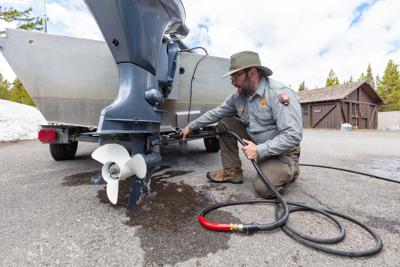
A routine boat inspection at Grant Village in Yellowstone National Park found quagga mussels on a visitor’s boat last week.
The park inspector prevented the boat contaminated with the aquatic invasive species from launching into park waters.
“Detection of the mussels prevented a major potential release of this highly invasive species into Yellowstone waters,” the park said in a news release. “If released into park waters, (aquatic invasive species) can cause catastrophic changes to the ecosystem.”
The park said quagga mussels are one of many invasive species that pose a grave risk to the ecology, recreation and economy of the park and surrounding areas. The park is currently spending millions of dollars each year to suppress invasive lake trout illegally introduced into Yellowstone Lake. Another invasive fish species, cisco, was recently found in Yellowstone Lake. Other invasive species in the park include the parasite myxobolus cerebralis which causes whirling disease in cutthroat trout, New Zealand mud snails and red-rimmed melania, a small snail imported by pet shop aquariums.
To prevent the introduction of aquatic invasive species such as quagga mussels into Yellowstone and other regional waters, park inspectors examine all boats, kayaks, canoes, and float tubes before visitors can launch them in the water. Boats with ballast tanks are not permitted to launch within the park.
Watercraft that arrives dirty or with standing water are subject to decontamination before being allowed to launch, the park said. Craft that can’t be cleaned will be turned away.
“If you plan to use your own boat or angler float tube in Yellowstone National Park, you will need a permit and an (aquatic invasive species) inspection,” the park said. “You can speed up the inspection process by arriving with a boat that is clean, drained and dry.”
Yellowstone reminds anglers that fishing equipment can carry microscopic invasive organisms. The park bans the use of absorbent felt or fibrous material on boot soles while fishing.
“I commend the Yellowstone (aquatic invasive species) inspection team for their efforts at preventing the introduction of this dangerous aquatic invasive,” park superintendent Cam Sholly said. “It’s critical the public continues to partner with us to do their part to prevent the spread of (invasive species) in Yellowstone waterways.”
Boats and angler float tubes entering the park can be inspected at Bridge Bay Ranger Station, Grant Village Backcountry Office and Lewis Lake Ranger Station. Angler float tubes can also be inspected at West Yellowstone Visitor Information Center, Bechler Ranger Station, the North Entrance and Northeast Entrance.
For more information, go online to nps.gov/yell/planyourvisit/boating.htm.

(0) comments
Welcome to the discussion.
Log In