

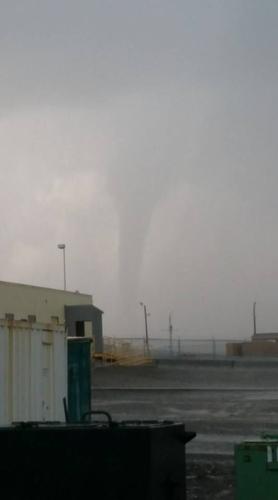
POCATELLO — Although there were reports of as many as four tornadoes in Eastern Idaho during Thursday’s thunderstorms, officials with the National Weather Service forecast office in Pocatello have only been able to find conclusive evidence of one. Still, they suspect there may have been others.
They say they did find evidence of a tornado that crossed portions of the Idaho National Laboratory around the East and Middle Buttes to the north and east across U.S. 20 between 4- and 4:30 p.m.
They gave it a preliminary rating of EF-1 (86-110 mile-per-hour winds) and estimated that its path was between 100- and 500 yards in width and roughly 240- to 270 yards in length.
Meteorologist John Keyes said they believe the winds from the tornado were on the high end of the scale; however, an EF-1 is still a fairly weak tornado.
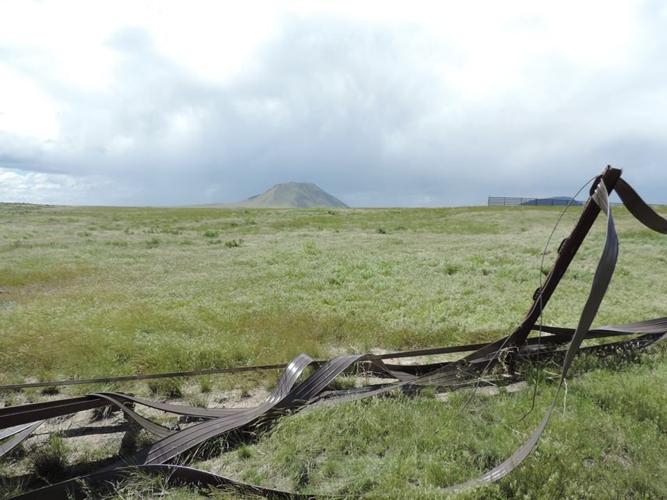
The tornado did cause significant damage to two snow fences in the area.
“Multiple steel beams were bent and twisted to varying degrees, with portions of those beams that were below the surface twisted/moved approximately 1 inch,” according to a public information statement from the National Weather Service. “The horizontal part of these fences, made of vinyl and steel cable, were ripped apart and strewn for several yards. Large metal pieces used to hold these together were snapped and/or thrown several yards away from the fence.”
Officials say the tornado also broke a sign, ripped some sagebrush out of the ground and tossed several small lava rocks.
Officials say satellite and radar data indicate that there were potentially other tornadoes to the south and southwest of Atomic City and across the southern reaches of Craters of the Moon National Monument, but they haven’t been able to find any conclusive evidence due to limited access and the terrain in the area.
Keyes noted that it can be difficult to determine if a tornado touched down if there isn’t anything in the area for it to damage or if it occurred in an area with limited access. And there are many remote areas in Eastern Idaho.
“There’s not a lot to indicate if it did touch down or (cause) damage in those areas,” he said. “Unfortunately, that’s a common thing in Idaho.”
Keyes says it helps when people who spot potential tornadoes and other weather phenomena can give the time, their location, and where the incident is occurring in relation to them when they report it to weather officials.
Keyes said they are still investigating Thursday’s incidents and are waiting to see if any more damage reports come in.
He noted that there’s an average of three to six tornadoes each year throughout the state of Idaho and most are in the EF-0 to EF-1 range.

(0) comments
Welcome to the discussion.
Log In