

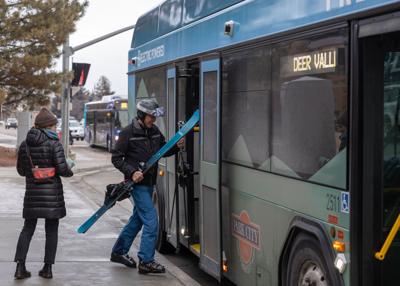


A passenger is seen boarding an EV bus in Park City in February of 2026.
The evening before the 2002 Salt Lake City Winter Olympic Games, a “foul” inversion fell over the Salt Lake Valley.
Utah was about to be broadcast to the world as a pollution-shrouded place until the next morning, when a storm blew through the valley, clearing the inversion for the entire span of the games.
“Will Utah be so lucky in 2034?” ask three Utah State University professors as the authors of “The Utah 2034 Winter Olympics: Leaving a Lasting Clean Air Legacy?”
Marketing professor Edwin Stafford, sustainable communities professor Roslynn McCann and civil and environmental engineering professor Randy Martin have coauthored this peer-reviewed academic research article to be publicized this August in a SAGE journal.
The three USU faculty members have collaborated with their unique backgrounds to analyze how Utah can implement sustainable practices in preparation for the Utah 2034 Winter Olympic and Paralympic Games.
“There's going to be a lot of those athletes and tourists going to be staying here in Cache Valley, and so, expanding charging infrastructure is going to be critical,” Stafford said. “Electrifying, that's probably number one. Almost 50% of our pollution comes from the tailpipes of cars and trucks.”
The previous Olympic Games held in the state were called the Salt Lake City Games, whereas the 2034 games are called the Utah Games, as the whole state will be participating, including USU. Hence why the professors feel the need to prepare the Salt Lake Valley just as much as Cache Valley.
“Regionally, we share the same air,” Martin said. “When they're inverted, we're inverted.”
According to the coauthors, USU has already assembled a team of around 30 faculty members to prepare for the winter games. Martin noted the faculty are from many different areas of USU, and he believes they have a good “cadre” of experts on various issues.
The coauthors are warning Utah leaders about what it needs to do in order to prepare for not only the impact of the large-scale tourism the state is anticipating, but also how to clean up to avoid global embarrassment.
From the moral balance of the honor of hosting a global event to the negative impacts it could have on the environment and economy, the three critiqued the state's disregard for the consequences.
“Hosting the Olympics is not a sustainable endeavor,” Stafford said. “We're going to have 500,000 people on top of our own population, so we're going to have a lot of guests. They're all going to be driving. They're all going to be using natural gas to heat their hotel rooms. Use natural gas to eat, and all that's needed-that's local fossil fuel burning-that's going to go into the Salt Lake Valley locally. So our proposals here tend to eliminate that.”
The proposals Stafford is referring to include more electric vehicles, EV charging stations and electric buildings. The article also mentions restoring the Great Salt Lake, an already politically charged and widely discussed topic in the state.
According to the article, Utah lags behind the national average in electric vehicle purchases and usage, as well as with other sustainable practices such as solar and wind energy. Utah has passed laws against solar as well. Stafford explained this is due to not only state-level politics but federal as well.
“It's the kind of political winds that we're facing right now,” Stafford said. "The Trump administration is actually paying billions of dollars to stop wind projects, offshore wind projects, so incentives for renewable energy have been eliminated.”
Stafford explained the pushback to solar and wind energy plants is that it takes land away from agriculture, a problem he feels is solvable through something called agrivoltaics, a way to integrate solar and agriculture.
The three spoke about the need for policy and incentives in order to make real change.
“Having policies that are firm about reducing fossil fuel emissions, about increasing renewable energy adoption, electrifying our buildings, bold policies and finances behind those incentives. Those are going to be much more effective than asking people to please not drive,” McCann said.
With a little less than eight years to go, it begs the question: Is that really enough time to clean up Utah’s air? According to the coauthors, yes, but it's now time to start. With the political leverage the Olympics provides, the coauthors are fighting for not only a sustainable winter games, but a sustainable Utah.
“There's still time,” McCann said. “If we improve our air quality and we end up not having an inversion. It still will improve the health of Utahns. These proposals we're putting forth; it’s a zero-risk approach.”
The proposals can be read in their entirety through the SAGE journal article once it is published this month; an official date of publication for the final draft is unconfirmed.


(0) comments
Welcome to the discussion.
Log In