

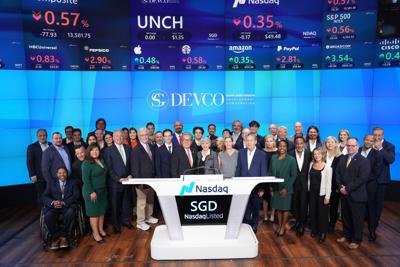
A local development company with strong roots in Idaho is shaping production across the United States with a broad focus in manufacturing, development, medical and environmental industries.
Safe and Green Holdings and its subsidiary company, Safe and Green Development Co., has been publicly trading on the NASDAQ for around six years. The company is involved in a massive amount of real estate and architectural development and helps design projects for industry leaders like Puma and Dominos.
While SG Holdings has enterprise with many large-scale businesses, the company’s seeds are planted in Idaho soil, its roots taking hold in places like Pocatello and Boise. The company’s CEO, David Villarreal, currently lives in Pocatello and has worked in the city for over eight years. Villarreal also serves as chairman of the Pocatello Development Authority.
“We provide design, manufacturing and delivery of modular units, both in the residential and commercial space,” Villarreal said. “Our initial launch into this 11 years ago, all our products were created out of shipping containers, and those shipping containers led to SG Holdings, and now SG Dev Co., to possess one of the only certified, environmentally safe licenses for containers that we use to fabricate anything. All that means is that it’s got a history where there's no contaminants, fluid or anything else that’s been in those containers while it was used in any shipping forum.”
Villarreal continued, “We're proud to say we're probably one of three in the world that have that global certification for containers. But our modular development means that we create modules, and we put them together almost like Lego blocks. Those modular containers fit together to either develop a house, to develop a manufacturing operation or to develop an office complex. We're talking to multiple developers here in Southeast Idaho, about actually constructing their projects out of our modular systems.”
The modular manufacturing operation is only one of the many endeavors that Safe and Green, and its subsidiaries, are involved in. One of their local projects involved a bid for Idaho state parks department through their architectural company Cline Smull Hamill Quintieri Associates, which was shortened to CSHQA.
“Luckily enough for us in the process of going public we had a bid submitted to the Idaho state parks department,” Villarreal said. “They were looking for bids to provide housing for state park employees in many of the state park facilities. Through our affiliation with CSHQA, our architectural firm, which is based in Boise, we were the recipients of that contract we outbid through or outperformed in the six other competitors.”
Villarreal continued, “Now we will be providing the initial phases of beta housing per state employee on state-owned parks. We're happy about that. Additionally, we've got somewhere close to about $800 million of a pipeline for production of residential units, commercial units and other supplements that we have in the industrial space for manufacturing that we also build around the country.”
Part of SG Holdings’ intention in the industry is to create environmentally friendly processes. Safe and Green Development Co. Chief Financial Officer Nicolai Brune detailed how they achieve a greener design concept by reducing waste and optimizing their operations.
“I would say it's not just the materials that are green, it's the process that is a lot greener,” Brune said. “It has a much smaller carbon footprint than traditional construction. What happens with modular is that it's essentially a form of prefabricated construction. In a factory environment the materials are stored, they’re covered, so they're not exposed to wind, rain, etc. They’re used in a more efficient manner, because you're in a controlled environment.”
In the future, Brune sees their factories being powered by solar energy, which will help create a more sustainable process for construction. Since prefabricated structures only need a one-way trip, emissions are reduced by an astonishing 90 percent. Modular creations are also 50 percent quicker than traditional construction, giving the company significant ancillary savings.
“You're able to build these structures a lot more efficiently and those structures will in turn, heat and cool a lot more efficiently, leading to an additional lower carbon footprint throughout the lifecycle of the development,” Brune said. “It's a really exciting way to build. We're happy to be a part of the modular real estate development movement.”

(0) comments
Welcome to the discussion.
Log In