







BOISE — Last week, Idaho Gov. Brad Little posted on Facebook a plea for Idahoans to get vaccinated so that students can safely return to in-person classes as the highly infectious delta coronavirus variant continues to spread throughout the state. A barrage of misinformed comments appeared in response — one example of a trend that’s helping drive vaccine hesitancy, experts say.
“Misinformation is a huge element of why we’re having so much (of a) problem getting this coronavirus under control,” said Dr. David Pate, former CEO of St. Luke’s Health System and the governor’s COVID-19 adviser. “Prior to this, if you were not an expert, not qualified, but you had opinions, you might be able to influence your neighbor or friends … Now, with social media, you don’t have to be qualified, you don’t have to have any educational background, you don’t have to have any experience, and you can put out whatever you want, and it can go to hundreds or thousands or millions of people.”
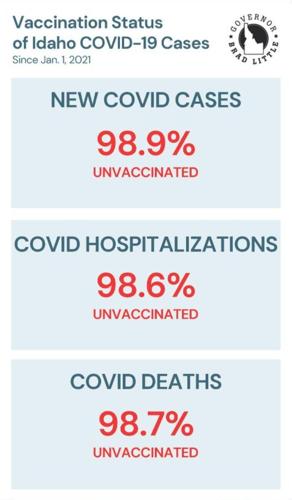
Little’s post included a graphic with data showing that the vast majority of Idaho’s recent COVID-19 cases, hospitalizations and deaths are among unvaccinated people.
“Our main defense in ensuring the new school year is entirely in-person — free from outbreaks and quarantines — is the COVID-19 vaccine,” he wrote. “To those friends and neighbors of ours waiting to receive the vaccine, the time to get the vaccine is now.”
Comments in response to Little’s post doubted the authenticity of the official data. The fact that the data used cases, hospitalizations and deaths since Jan. 1, when vaccines weren’t widely available, drew skepticism. But a news release linked in the post showed similar trends since May 15:
• There are 10 times as many COVID-19 cases among unvaccinated people compared to vaccinated people.
• There have been 13 times as many COVID-19 hospitalizations among unvaccinated people compared to vaccinated people.
• There have been eight times as many COVID-19 deaths among unvaccinated people compared to vaccinated people.
One comment argued, children “are going to be just fine” if they get COVID-19, and using vaccinations as a potential excuse for not opening schools is “cowardice.” Another said the vaccines have not been authorized by the Federal Food and Drug Administration — the FDA authorized for emergency use the Pfizer and Moderna vaccines in December and the Johnson & Johnson vaccine in February.
While it’s true that children are less likely to have severe symptoms from COVID-19, they still can infect their parents and others, said Pate, a doctor who has treated patients with infectious diseases and stays informed on the latest coronavirus research. It’s the parents “who end up in our hospitals,” Pate said.
“That’s what we’re seeing across the country is we’re seeing 20, 30 and 40 year olds in our (intensive care units), and they’re much sicker than they were last year,” he said.

Dr. David Pate, retired CEO of St. Luke’s Health System and current coronavirus adviser to Gov. Brad Little.
Another comment on the governor’s post wasn’t incorrect but lacked important context. The comment asked whether those who have natural antibodies from a previous COVID-19 infection really need the vaccine. “I don’t feel like I need both,” the Facebook user wrote.
It does appear that those previously infected have some degree of immunity from COVID-19, Pate said. But the doctor pointed to a recent study of Kentucky residents that found a significantly higher likelihood of reinfection among people who are unvaccinated against COVID-19 than those who are vaccinated.

This graphic was included in Gov. Brad Little’s Facebook post that pleaded with Idahoans to get vaccinated against COVID-19.
“If I had Covid, I would certainly still want to get vaccinated, but I do appreciate this person’s point,” Pate said of the comment. “I think they have to understand they will have a greater chance of being reinfected than if they were vaccinated.”
Other common arguments against the vaccine relate to possible side effects. But serious vaccine side effects are rare, and the risks associated with contracting COVID-19 are greater.
The Pfizer and Moderna vaccines have been linked to inflammation of the heart muscle, known as myocarditis. According to a recent report from the Centers for Disease Control and Prevention, by the end of June, there had been 497 reports of myocarditis among 141 million second doses of either the Pfizer or the Moderna vaccines. That’s a rate of 3.5 cases per million doses.
Additionally, the Johnson & Johnson vaccine may increase the risk of a blood-clotting disorder as well as a neurological condition known as Guillain-Barré syndrome. As of June 30, about 12.6 million doses of the Johnson & Johnson vaccine, given to American adults, led to 100 reports of Guillain-Barré syndrome, a rate of 7.8 cases per million doses. As of July 8, there were 38 reports of the blood-clotting disorder following the Johnson & Johnson vaccine. That’s a rate of three cases per million doses.
The report used data from the Vaccine Adverse Event Reporting System (VAERS). “VAERS is not designed to determine if a vaccine caused a health problem,” but is “useful for detecting unusual or unexpected patterns of adverse event reporting that might indicate a possible safety problem with a vaccine,” the website says.
The CDC’s report concluded that the risks of COVID-19 side effects outweigh the risks of these rare disorders resulting from the vaccine. For example, per million doses of the Johnson & Johnson vaccine administered to males aged 50–64 years, 1,800 hospitalizations, 480 intensive care unit admissions and 140 deaths attributable to COVID-19 could be prevented, compared with 14–17 cases of Guillain-Barré syndrom and one to two cases of the blood-clotting disorder, the report said.
THE IMPORTANCE OF MEDIA LITERACY
Seth Ashley, Ph.D., a professor in Boise State University’s communication department who researches and writes about media literacy, said misinformation spreads quickly online, and falsehoods are more likely to be shared than true information.
But misinformation is not unique to social media. Actually, it’s as old as the printing press, Ashley said.
“The internet is just a tool, like so many things,” he said. “It’s just a technology, and it’s up to us to determine how it gets used.”
When it’s used to spread misinformation that’s a result of “lazy thinking,” Ashley said. While that may be insulting to some people, “that’s what research has shown,” he said — analytical thinking, critical thinking skills lead to strong media literacy.
“We’re all guilty of (spreading misinformation),” he said. “The question is: Are we engaged in a good faith effort to stop it, or are we actively helping it proliferate?”

Seth Ashley
One way to reduce misinformation is “getting people to recognize that reality is complicated and there aren’t simple black-and-white answers to a lot of the questions people have,” Ashley said.
“The world isn’t run by a secret network of all-powerful people,” he said. “The world is just messy and it takes work to sort through it all.”
People should slow down and take a second before they “act or react” in response to a media message, Ashley said. Ask, “Who’s creating this message and why? What are they trying to get across, and is it a good thing or a bad thing?”
“It’s pretty easy to figure out who is engaged in a good faith effort to tell the truth as best they can and those who are not,” Ashley said. “If something does make you fearful or angry that’s exactly what false information is designed to do. If it makes you feel a strong reaction, slow down. That’s your first sign that there’s something going on and you need to check it out.”

(0) comments
Welcome to the discussion.
Log In