

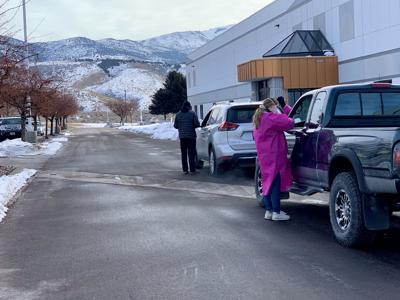

POCATELLO — The line of cars that once wrapped around the ISU Eames Complex COVID-19 test site parking lot, snaked down Alvin Ricken Drive and spilled out onto Terry Street was reduced to two vehicles on Thursday morning — allowing employees and volunteers at the site to breathe a sigh of relief.
For nearly three weeks straight, people waiting to get tested for COVID-19 there had to endure wait times between one to three hours on any given day, and test site workers were hustling to administer tests and keep the line moving.
The stretch of time between the second week of January and the first week of February saw the highest demand for COVID-19 tests locally to date amid spread of the highly contagious omicron variant. The busiest single day was Martin Luther King Jr. Day, during which 483 people were tested for COVID-19 at the Eames Complex, and staff there had to turn people away at the end of the day to ensure they had enough time to send the samples they got to the lab.
Ryan Richardson, of Southeastern Idaho Public Health’s emergency preparedness program, said while the agency was prepared in terms of staffing, testing and personal protection supplies, it was nonetheless challenging to accommodate such a large volume of people and seemingly never-ending lines at the drive-through site.
”It’s a breath of fresh air to see the testing numbers are finally going down again now,” Richardson said. “When we saw those long lines, it really kind of felt like, ‘Here we go again,’ with this pattern of COVID-19. There are days where the line never seems to end, and it can be hard to maintain hope and keep optimistic.”
In the last few weeks, Southeastern Idaho Public Health’s eight-county region reported pandemic-high, single-day COVID-19 case counts, alarming local health, school and government officials, and confirming omicron’s high transmissibility.
While the number of new cases has been back on the decline for several days now, hundreds of people are still getting infected with the virus every day. As of Friday, 198 people had newly tested positive, and there were 2,425 active cases with 51 people currently hospitalized for COVID-19 illness in the Southeast Idaho region.
Richardson said during the height of this latest surge in cases, the Eames Complex test site was reporting a 50% to 70% positivity rate among all tests administered — a rate he called alarming and exceptionally high.
“Typically, at about 10% positivity is when we start to panic and start to really think this is something bigger and the pandemic is still in full force,” Richardson said. “With a 50 to 70% positivity rate, that is through the roof and really demonstrates that the illness is still here.”
Now that the spread of COVID-19 has slowed down again, though, Richardson said staff and volunteers at the test site have been able to get some much-needed respite.
“When you’re running so fast at such an operational tempo for so long, it’s easy to kind of just get stuck in the tunnel,” he said. “But we’ve had so many volunteers willing to help out and they have been crucial to helping us catch some downtime when we really need it.”
The test site is now averaging about 100 tests each day, and wait times are back down to about 15 minutes or less in most cases, with the most time-consuming part being the paperwork people need to fill out before getting tested.
The agreement with Idaho State University for operation of the Eames Complex test site will expire at the end of February. Richardson said Southeastern Idaho Public Health is considering renewing that agreement for another six months given the pandemic’s persistence and cyclicality over the past two years.
“I think just out of an abundance of caution for planning purposes, it would be safest to assume that this isn’t over,” Richardson said of the pandemic. “It’s gonna come back. It might not be quite as big or it might be bigger than the previous or current surge. We’ll just kind of anticipate the worst and hope for the best.”
Southeastern Idaho Public Health continues to spread the message that the COVID-19 pandemic is ongoing and urges people to wear masks, get vaccinated and stay home if they are sick to avoid spreading the virus.
“It’s a breath of fresh air to see the testing numbers are finally going down again, but we don’t want to get ahead of ourselves and say, ‘Oh, it’s over. It’s over.’ because It’s not,” Richardson said. “The battle continues, and while hopefully it stays a little less busy, which we’re going to take as a success, we know that that by no means suggests that the battle against COVID-19 is over.”


(0) comments
Welcome to the discussion.
Log In