






The smell of manure still bothers Terumi Takenaga and she can’t stand the taste of mutton to this day — both lingering effects of the time she spent in Japanese-American internment camps about 80 years ago.
Takenaga was 13 years old when a government that didn’t trust people of her ethnicity forced her family to leave behind their strawberry farm in Fairview, Oregon. They were relocated to a Portland, Oregon, livestock arena, known as Assembly Center.
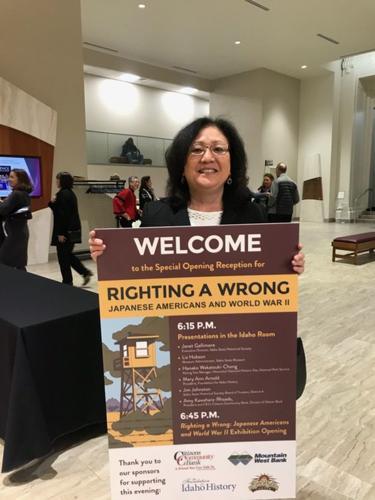
Takenaga’s daughter, Amy Kawahara-Rhoads, who is the president and CEO of Citizens Community Bank, shared her parents’ personal stories from the World War II period on Jan. 24 in Boise. Kawahara-Rhoads, who lives in Pocatello, was the keynote speaker at the Boise grand opening of a traveling Smithsonian exhibit about the Minidoka internment camp near Jerome. The exhibit, called “Righting a Wrong: Japanese Americans and World War II,” is on display through April 5 at the Idaho State Museum in Boise.
“They put a false floor on the bottom (at the livestock arena), but she could still smell the manure,” Kawahara-Rhoads said.
After a few months, her family was moved again to the hastily built Minidoka internment camp in the Jerome area, where mutton was a dietary staple. They were among roughly 75,000 Japanese-Americans, in addition to 45,000 Japanese nationals, who were incarcerated in such camps under Executive Order 9066, issued in response to the attack on Pearl Harbor.
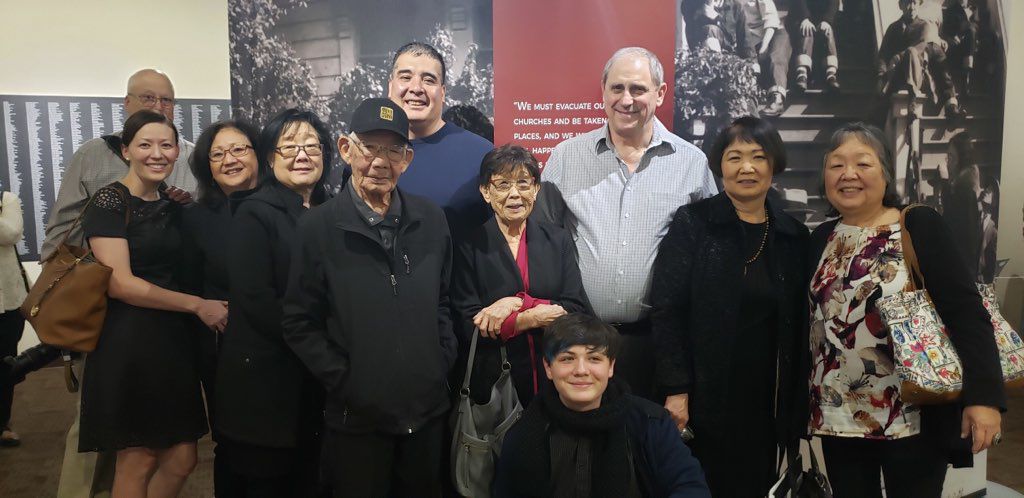
Both Takenaga, 92, and Kawahara-Rhoads’ 96-year-old father, Harry Kawahara, who was awarded the Congressional Gold Medal in 2011 for his heroism during the war, also attended the grand opening celebration. Her parents both now live in Caldwell.
Kawahara-Roads explained the bank claimed the family strawberry farm where her mother was raised during the three years they spent in captivity, leaving them without the option of returning to their former life.
But bitterness was not in the DNA of either her mother or her father, neither of whom spoke much about their shabby treatment. In fact, Kawahara-Rhoads thought her mother was talking about a church camp when she made infrequent references to Minidoka, until she accompanied her to a dedication making the camp a national historic site in 1979.
She said family members have had to pry information from both of their parents to learn about that dark chapter in American history.
“They’re very humble and they don’t like being known that way,” Kawahara-Rhoads said of her parents, who were both born in the United States. “They didn’t talk about it much. They told us it was part of life and you go on.”
Despite the nation’s vitriol at the time against anyone of Japanese descent, both of Takenaga’s brothers enlisted in the U.S. Army. So did Harry Kawahara, whose sister was forced to live in an internment camp. Harry Kawahara joined the U.S. Army’s famed 442nd Infantry Regiment, which included second-generation Americans of Japanese ancestry.
The regiment sustained heavy losses during the war and became the most decorated unit in U.S. military history. They also gained fame for the October 1944 liberation of the Lost Battalion, comprising soldiers from the Texas National Guard, who were surrounded by German forces in the Vosges Mountains of France.
Kawahara-Rhoads is certain her father survived only because he was shot and wounded by a sniper and was removed from combat. She said her father has struggled with survivor’s guilt ever since then.
Back at Minidoka, Takenaga said inhabitants strove to make life as normal as possible. She attended high school there and her family participated in regular community activities. Takenaga also worked in farm fields on the Minidoka grounds.
“The one thing she mentioned is when she would walk to the bathroom, it was dirt all the way around out there, and in the winter it turned to mud. She only had one pair of shoes,” Kawahara-Rhoads said.
After the war, Takenaga finished high school in Twin Falls, before enrolling in sewing school in Salt Lake City. However, her grandma, Yasu, never fully adjusted after being forced away from her home. She was a widow with no place to go and wound up working in the fields at a Caldwell labor camp after leaving Minidoka.
Takenaga joined Yasu at the Caldwell camp after completing sewing school. There, at a dance, she met Harry Kawahara.
Harry Kawahara, a man of few words, succinctly described his initial impression of Takenaga to Kawahara-Rhoads: “I saw her on the stage and I knew that was the one I wanted to be with.”
Takenaga simply remembered that he was a good dancer.
Her parents were grateful to a few business owners in the Caldwell area who welcomed Japanese-Americans into their establishments during the post-war period. Kawahara-Rhoads said her parents believed a Caldwell barbershop and a restaurant owned by the McCluskey family “deserved some kind of recognition for opening their doors.”
After the war, Harry Kawahara made his living working in the fields, but for someone else. He retired as the farm manager for J.C. Watson in Parma.
Gov. Brad Little issued a proclamation on Tuesday declaring Feb. 19 to be a “Day of Remembrance” in Idaho, honoring the anniversary of the internment.
“Japanese nationals, most of whom were permanent U.S. residents, were deprived of liberty and property without criminal charges or trial,” a press release about the proclamation reads.
The National Park Service also held a grand opening for the Minidoka internment camp site’s new visitor center on Feb. 22. The former warehouse No. 5, which served as an automotive repair shop when the camp was operational, has been renovated into the new visitor center with a ranger information desk, a bookstore and retail space, a theater and an exhibition space currently featuring an exhibit titled “The Issei: A Legacy of Courage” created by Friends of Minidoka.
“They’re just very honorable. Somebody has to say something for them because they’ll never say it,” Kawahara-Rhoads said.
Kawahara-Rhoads believes it’s fitting that the state is taking note of the dignity with which her parents — and thousands of other Japanese-Americans like them — handled unjust imprisonment.
“From my perspective, the (moral) is that you can persevere. You can make the most of wherever you’re at and go on and not harbor ill will,” Kawahara-Rhoads said.

(0) comments
Welcome to the discussion.
Log In