

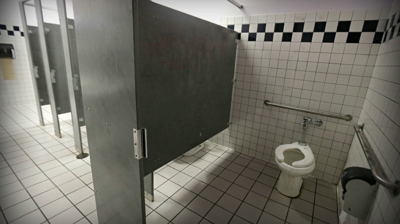
BOISE — A Senate committee voted Wednesday to advance a bill requiring government buildings and private businesses to have restrictions separating restrooms, changing rooms and other public accommodations on the basis of biological sex.
The bill was sponsored by Rep. Ted Hill, R-Eagle, and authored by The Idaho Family Policy Center.
Blaine Conzatti, president of the Idaho Family Policy Center, characterized the bill as the “last step in making sure that the privacy and safety of every person is protected in all public restroom and changing facilities” in Idaho. It follows the passage of two laws enacting similar restrictions on transgender individuals for other facilities in the state and, like the previous legislation, presented an opportunity for a civil lawsuit in the event of a violation.
Senate Bill 1100 passed in 2023 and required students at Idaho K-12 public schools to use the bathrooms or changing rooms corresponding with their biological sex.
Students who claimed to have used a restroom with a student of the opposite sex that received the school’s permission to do so could sue the school for up to $5,000.
In 2025, House Bill 264 enacted similar restrictions, and opportunities for civil suit, for universities, correctional facilities and domestic violence shelters, as was previously reported by the Idaho Press.
The House State Affairs Committee voted 9-5 to send the new bill to the House floor with a “do pass” recommendation.
Compared to its predecessors, House Bill 607 is significantly more expansive, applying to government buildings as well as privately owned businesses in the state of Idaho with public accommodations such as shower rooms, locker rooms and restrooms.
Conzatti said the aim is to clarify the principles of “premises liability” — which traditionally holds property owners liable for injuries visitors sustain as a result negligent or unsafe conditions — would extend to these facilities.
The impact this would have on businesses across the state ended up being the focus of Wednesday’s public hearing and committee member questions on the bill. The vast majority of those who testified were opposed to the new bill.
Rachel Anne Pierce, a Boise State University student, cited her past experience with the consequences of House Bill 264. Though she didn’t need to change her behavior to use bathrooms that align with her sex, Pierce said the bill nonetheless repeatedly disrupted her daily routines at university.
“I have short hair,” Pierce said. “Other than that, I sound like a woman, I look like a woman, I dress like a woman and I was born a woman.”
In spite of this, Pierce spoke to being stopped several times trying to use the bathroom at school, “sometimes in polite ways and sometimes in rather aggressive ways.” Rather than making women safer — as is the bill’s stated intention — Pierce said the end result was her privacy being violated as she was interrogated about her gender while trying to use the bathroom.
“I’ve been harassed and made uncomfortable for just trying to pee in between my classes or when I’m studying in the library,” Pierce said, “and now you’re telling me that this could be my reality in public businesses too. Everywhere, every day.”
Karissa Folks, a Boise resident, spoke in favor of the bill, saying it provides protections for a vulnerable population. She spoke to what is required to take care of her two toddlers, including working to navigate adult bathroom stalls. In some instances she may need to use the restroom herself while her children wait outside and in other cases, she may need to leave the stall door open to assist her child with using the bathroom.
“That is not a place that I personally, as a mother, want to worry about who might walk in behind me while my other toddler stands by and hopefully obeys and stays still,” Folks said.
Pam Eaton, speaking on behalf of the Idaho Retailers Association and the Idaho Lodging and Restaurant Association, spoke in opposition to the bill on the basis of the added civil liability that businesses across the state would face with its passage. Eaton said the associations’ interpretation of the bill means male and female restroom signage may not be enough to protect themselves from legal consequences.
Under the language of the bill, private businesses with public accommodations would be liable for “all damages attributable to its negligence.”
The result could be businesses policing restrooms, or closing them to the public entirely, to avoid any instance of a civil suit arising, Eaton said.
The bill does have several exemptions in place, including for single-occupancy restrooms, for parents or guardians assisting minor children, for employees tasked with cleaning restrooms and other public accommodations, for law enforcement engaged in official activities and for individuals rendering medical assistance to another. Bathrooms with sex-based signage, however, is not among this list.
Outside of these limited circumstances, businesses with restrooms or changing facilities have a “duty to take reasonable steps to secure that the privacy and safety of an individual is protected from members of the other sex.” When this duty isn’t met, they are opened up to civil liability.
“I’m afraid that if we don’t fit one of those exemptions,” Eaton said, “that then they can come up and say, ‘well, the reasonable steps weren’t taken because you didn’t meet those exemptions.’”
Committee members raise legal questions
If legal action were taken against a business for violating the bill, Conzatti said it was “possible” a jury could find posting male and female signage was a sufficient, reasonable step to insulate businesses from liability under the bill. A “safer way” would be for businesses to have this signage in addition to an internal policy of single-sex restrooms and then “take reasonable steps” when notified of a person using a restroom that doesn’t align with their sex, he said.
Rep. Stephanie Mickelsen, R-Idaho Falls, questioned why it wasn’t written into the bill that businesses have male and female bathroom signage along with an internal bathroom policy instead of including a private right of action provision, which opens up businesses to lawsuit for failing to meet the bill’s standards.
Conzatti said the approach taken was a matter of not wishing to “impose” on property rights by allowing public building and business owners to come up with the policies that “best reflect their values” and best allow them to achieve compliance.
Rep. Shawn Dygert, R-Melba, said he would prefer a bill making bad actors “responsible for their own behavior,” rather than shifting the burden to businesses or other outside entities.
Addressing potential legal action, Rep. Anne Henderson Haws, D-Boise, questioned how an individual suing under the law proves they encountered an individual of the opposite sex in a restroom, particularly whether they would need to take a picture of them in a public restroom to do so.
Conzatti said this was “possibly” the case.
As in other evidentiary cases, Conzatti noted the plaintiff bears the burden of proving what they are alleging took place.
Responding broadly to concerns of future lawsuits, Conzatti said he didn’t imagine there being a “groundswell of lawsuits,” as this hasn’t been the case for prior legislation on the issue. Conzatti’s organization, however, is notably involved in a legal battle on the issue.
The Idaho Family Policy Center filed a tort claim on behalf of a student’s family in the fall arguing the Boise School District and Boise High School violated Senate Bill 1100 by allowing a “biological male student to use the girls’ restrooms,” as was reported by Idaho Education News.
With this case still pending, Haws said it remains unknown the degree of liability businesses would be burdened with if lawsuits pursued under the bill were to arise.
“It takes a while for things to move through the court system,” Haws said. “… If this were passed, we wouldn’t truly know if it would result in a lot of liability for businesses for several years.”

(0) comments
Welcome to the discussion.
Log In