

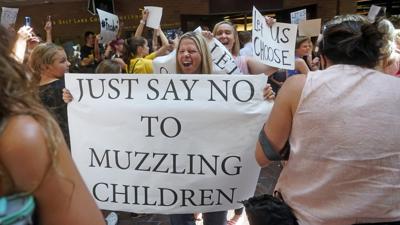
BOISE — No Idaho government entity, at any level, could ever require masks, face shields or any kind of face covering to slow the spread of an infectious disease, under legislation that cleared the Idaho House Monday on a 46-24 vote after a lengthy debate.
HB 631 now moves to senators for consideration. The bill is the latest version of Rep. Karey Hanks’ proposal to forbid mask mandates at the local level; Idaho never had a statewide mask mandate, even during the worst of the COVID-19 pandemic.
Hanks, R-St. Anthony, acknowledged that her bill has no enforcement mechanism; she said if there were violations, that might result in a lawsuit.
“Parents are just begging us to end the masks,” said Hanks.
The prohibition would apply to schools, public colleges, health districts, and any other state or local government entity or official. She distributed a handout to the House and said, “There are some serious issues with this (sic) mask mandates and requirements for our children especially to be wearing masks.”
Hanks’ handout claimed a Brown University study found that “the mean IQ scores of children born during the pandemic have fallen by as much as 22 points.”
Rep. Sally Toone, D-Gooding, a longtime teacher, asked Hanks, “What IQ test is given to children under the age of 2?” She noted that the pandemic started during the spring of 2020, so that’s the age of children born during it.
“I’m not an expert in these things,” Hanks responded. “I just read some different studies and it seems like people are always asking me for studies and research.”
According to the journal Nature, a preliminary study at Brown of infant brain development found babies born during the pandemic scored lower in cognitive and motor development, possibly because of less play and interaction; it didn’t point to mask use. The Nature article also cites two other studies suggesting that mask use doesn’t affect early childhood development.
Rep. Ron Nate, R-Rexburg, told the House, “I trust parents better to be able to make those decisions, better than some so-called expert from across the country.”
Rep. Greg Chaney, R-Caldwell, said, “I’m no fan of mask mandates myself, but I’ve seen school boards turn over on this topic. … Perhaps that’s the way it should be addressed. We seem to be swatting at flies with a sledgehammer here. This doesn’t say schools and it doesn’t say COVID. It says every single branch of government under every single circumstance.”
Chaney, an attorney, said the bill appeared to have the same legal flaw he highlighted in last year’s version and said it overreaches while trying to get at “our greatest aggravation at the moment.”
Rep. John McCrostie, D-Garden City, a teacher, said, “My students actually thrived this year. They’re actually doing better in a pandemic and wearing masks than they did two years ago before the pandemic. I’m really proud of the work my students have done in spite of having that requirement placed on them.”
He called for letting local school boards decide what’s best in their area.
Rep. Greg Ferch, R-Boise, said he conducted his own experiment, cleaning a pellet stove while wearing a paper mask. Lots of soot got into the mask, he said. “My nostrils were covered in soot. … You’re sucking in whatever’s around you, because the masks gap and leak.”
Rep. Scott Syme, R-Caldwell, asked, tongue in cheek, “I mean, why in the world would anyone, any political subdivision want to slow the spread of any contagious or infectious disease? Who would want to do that?” He added that the bill “says we’re clairvoyant — we know what’s going to happen in the future. We know there’ll never be another disease that we might need to have somebody say we need to wear a mask for.”
Rep. Gayann DeMordaunt, R-Eagle, said, “This is not a simple aggravation of the moment when it comes to our kids. This has had lasting impacts, these masks have had lasting impacts on our children. … We know enough now to make our own decisions. … I will no longer stand for mandates on masks and I would hope that you would join me in that as well.”
Rep. Chad Christensen, R-Iona, said, “It’s absurd that we’re having this debate right now. I’m embarrassed for our state and our country. It is my decision … period. It’s not your decision.”
Asked about the lack of an enforcement mechanism, Hanks said, “We don’t want infractions, misdemeanors, all that kind of stuff. We just want to free our people, unmask Idaho, we want to unmask our children. So we chose not to do a penalty at this point.”
Rep. Lauren Necochea, D-Boise, noted that her husband is a doctor who treats COVID patients.
“He always wears an N-95 mask,” she said. “He’s had a COVID patient sneeze in his face. To this day, he has not contracted COVID. So masks work.”
In her closing debate, Hanks said, “I just want you to look around and look how many of us are wearing masks.” Few in the House were. “We have that choice,” she said. “There are people in our different state offices and our school districts that do not get that choice.”
To become law, the bill still would need to clear a Senate committee, pass the full Senate, and be signed into law by the governor. Last year’s version of Hanks’ bill, HB 339a, passed the House but died in committee in the Senate.

(0) comments
Welcome to the discussion.
Log In