

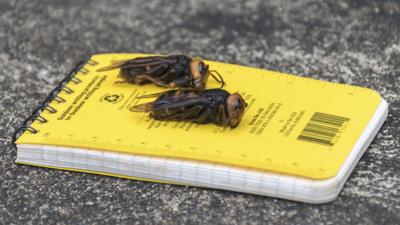
The Idaho State Department of Agriculture has no confirmed reports of Asian giant hornets being found in the state, the department said Thursday, though it is monitoring the situation around the hornets closely.
The world's largest hornet, a 2-inch killer dubbed the "Murder Hornet" with an appetite for honey bees, has been found in Washington state, where entomologists were making plans to wipe it out, the Associated Press reports, noting that the sting could be fatal to some people.
In a press release, the department said only two specimens of the giant hornet have ever been collected in the United States, both in northwest Washington.
"Each year (the Department of Agriculture) investigates calls concerning the observation of possible non-native bees and hornets," the department said in the press release. "Some native species are surprisingly large with a color pattern similar to that of the Asian giant hornet."
The Department of Agriculture routinely surveys for many invasive pests around the state annually and evaluates potential sightings by the public on other species of local and national concern. When non-native species are found, the department works with property owners and communities on control measures if any are appropriate and available.
The department is developing a public fact sheet with more information about Asian giant hornets, including known distribution and identifying characteristics. It recommends people use extreme caution near Asian giant hornets. A person who is allergic to bee or wasp stings should never approach an Asian giant hornet.
If you believe you have found an Asian giant hornet, email info@isda.idaho.gov with information and photographs, if you can do so safely. You may be contacted by the Department of Agriculture to discuss confirmation by scientific experts.

(0) comments
Welcome to the discussion.
Log In