

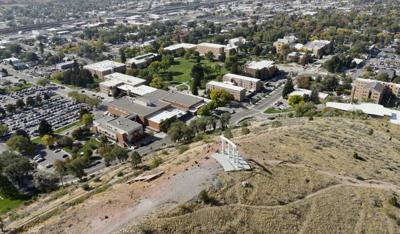
POCATELLO — Idaho State University President Kevin Satterlee is beginning to make good on his promise to bring the school’s carbon emissions to net zero.
Satterlee on Monday met via Zoom with the ISU Faculty Senate to relay details of a comprehensive plan and presidential charter that entails forming a committee to first study the university’s carbon footprint and then provide recommendations to reduce greenhouse gas emissions.
“We’re going to put together a group to take the necessary time to get the information we need to make informed decisions,” Satterlee said. “This effort of sustainability won’t be done overnight, and in fact, it’s going to take years to get this done. Year one is going to be about studying and learning. We have to gather the right data, collect the best practices, learn from others who’ve done this before us and take the advice from experts in the field — both experts we have on our own campus and outside experts.”
To begin this process, Satterlee in the next coming weeks will be launching a presidential charter on sustainability. ISU defines a presidential charter as “an assignment or task that a unit is charged to work on, with a statement of scope, responsibilities and objectives.”
“ISU’s project charters range in short-term measures to multi-year initiatives focused on enhancing the university,” ISU says on its presidential charter webpage. “Each charter identifies the main stakeholder assigned to oversee completing the project and a brief description. The assigned unit is responsible to develop action items, determine budgetary needs, set deadlines, and if necessary, assemble task forces.”
During his address with ISU faculty on Monday, Satterlee said the presidential charter will involve commissioning a sustainability council.
“The sustainability council is going to be a collaborative, multidisciplinary participatory body designed to work across the campus to develop this sustainability plan — a plan that’s going to be transparent, cost effective and provide the framework for reaching carbon neutrality,” Satterlee said. “This council is going to have representation from every area of campus. There’ll be members from all of our colleges, from our facilities to every corner of the campus. This group will be responsible for things like advising the university on the integration of sustainability into research, on educational programs, on water operations and community outreach, determining what partnerships we need, recommending both long term and short term sustainability goals and policies and identifying our strategies as to how we’re going to achieve them.”
Satterlee said he aims to have broad representation on the committee, which he anticipates to be 33 members strong and will include faculty, staff, students and key expertise groups. He said some members will be appointed and others will need to apply to serve on the committee.
Satterlee also outlined three high-level goals that he will charge the committee with completing.
“Objective No. 1 that I’m going to charge this group with is to collect and review the data, which will include examples on successful sustainability efforts from institutions similar to Idaho State,” Satterlee said. “Objective No. 2 is to review and assess our current practices on all of our campuses so that we can define and inventory our carbon footprint within these areas and then bring this information we need to allow the institution to make informed decisions to go forward. Objective No. 3 is for us to participate in the Association for the Advancement of Sustainability in Higher Education. They have a program called the Sustainability Tracking Assessment and Rating System, STARS is what they call it.”
The committee will then be tasked with composing a report or guide to outline recommendations that the entire university could implement in four key areas of focus, Satterlee said. Those areas include measures the university needs to implement to reduce its carbon footprint, a phased approach in implementing the measures, a realistic timeline as to when the university can achieve carbon neutrality and the implementation plans for specific measures Satterlee mentioned regarding sustainability during his State of the University address in August.
“I set a few goals for us (during the fall address) like transitioning our fleet vehicles on campus to electric or hybrid vehicles, installing charging stations on all of our campuses and installing solar panels on all of our campuses,” Satterlee said.
The next step of the process will involve launching the charter and assembling the committee. Because much of the project requires a large amount of research, Satterlee has not put any time constraints on achieving net-zero carbon emissions.
The local community can expect to learn more about the presidential charter in the coming weeks.

(1) comment
“sustainability objective chartered unsustainable”
Welcome to the discussion.
Log In