







POCATELLO — Gus Schultz may have lost the battle Thursday night, but he’s betting he’ll win the war in court.

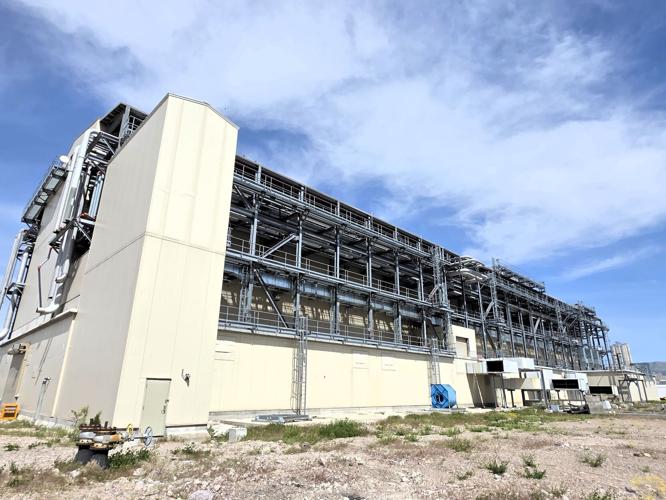
The former Hoku polysilicon plant site at 1800 River Park Way in Pocatello will not become an AI data center — at least not yet — after the Pocatello City Council voted 4-1 Thursday to uphold a hearing examiner’s denial of a conditional use permit for the project.
The Pocatello City Council voted 4-1 to uphold Hearing Examiner Kathleen Lewis’ May denial of the conditional use permit that would have allowed Gilbert, Arizona-based Lex Developments LLC to build an AI data center on the former Hoku polysilicon plant site — a decision Schultz called, perhaps counterintuitively, the best possible outcome for him.
“That was the best thing that could have happened for me,” Schultz told the Idaho State Journal in an exclusive interview after the vote.
Asked whether he planned to pursue judicial review, Schultz responded immediately.
“Absolutely, 100 percent,” he said.
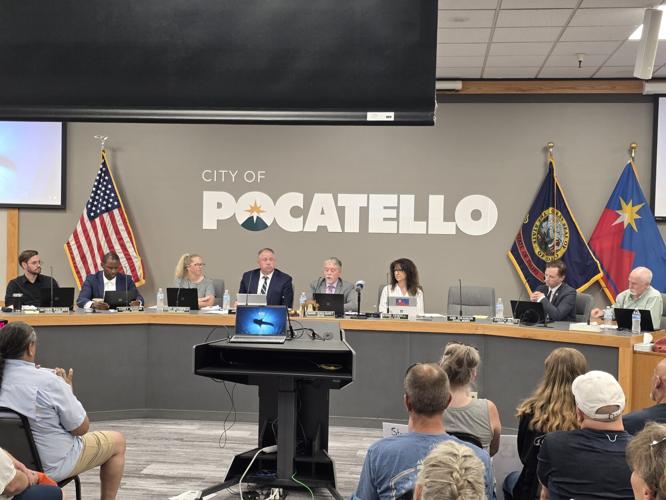
Councilmember Brent Nichols made the motion to affirm Lewis’ decision, seconded by Hayden Paulsen. Stacy Satterfield and Corey Mangum also voted in favor of upholding the denial. Councilmember Dakota Bates cast the lone dissenting vote — effectively siding with Schultz in his view that the permit should have been approved. Councilmember Ann Swanson was absent.

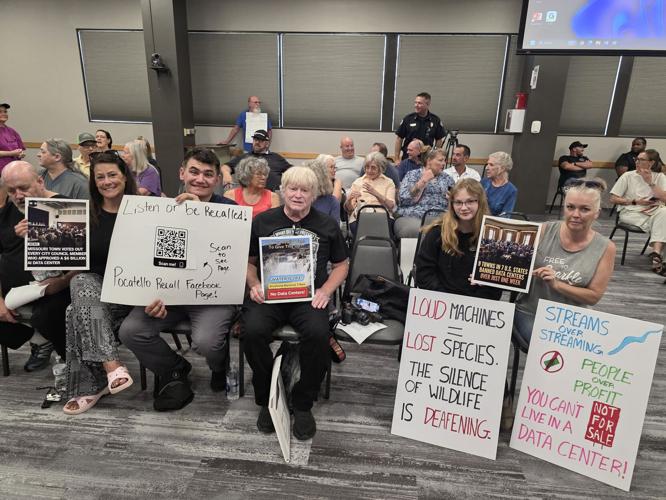
Community members pack a Pocatello City Hall meeting room Thursday for a hearing on the proposed AI data center at the former Hoku site.
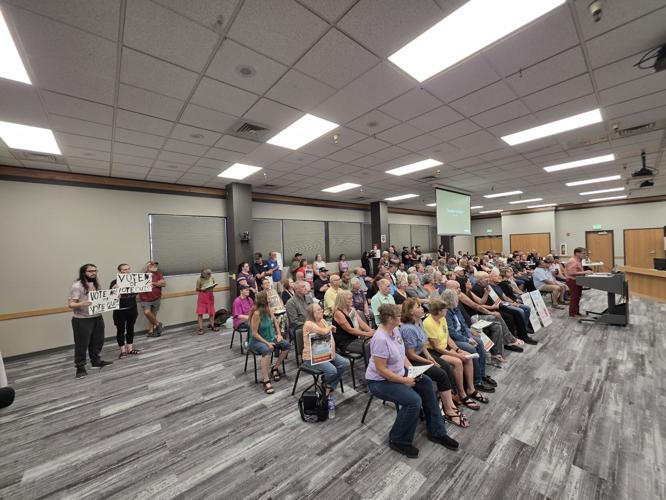
The meeting drew about 100 people to City Hall Council Chambers, of whom roughly a dozen held signs opposing the data center throughout the 90-minute hearing.
Under city code, Schultz has 14 days to file a request for reconsideration with the city and 28 days to initiate a lawsuit in Bannock County’s 6th Judicial District Court, according to City Attorney Jared Johnson.
Schultz expressed confidence he would prevail in court, adding a pointed warning for those hoping the city can use the intervening time to rewrite its land use code to block or constrain a future data center application.
If the 6th District Court sides with him, Schultz said, it won’t matter what changes the city makes to its code. He’ll essentially be grandfathered in under the rules in place when he applied.
It was a point that appeared to weigh heavily on Bates as he explained his vote against affirmation before the roll was called.
“I’m very concerned that we’re going to be taken to judicial review, and that there’s high potential that a judge would find in the applicant’s favor,” Bates said. “In that case the city loses the opportunity to place conditions on this development. In the time frame of like two months, this data center could be approved without any of our control over it — and public concerns be damned.”
That concern was shared, at least in part, by Mangum, who voted to affirm but acknowledged the tension. Both Mangum and Paulsen noted during deliberations that the city needs time to modernize its land use code — a document that Pocatello Director of Planning and Development Services Brent McClane says traces its foundational framework back to the 1990s and never contemplated AI data centers.
“I would imagine that AI data centers weren’t necessarily defined in this code,” Mangum said.
Mayor Mark Dahlquist, who would have cast the deciding vote in the event of a tie but otherwise does not vote, made clear he believes the city’s code surrounding data centers needs a top-to-bottom revision.
McClane estimated that process could take up to 18 months.
Johnson confirmed the Council has the authority to waive the standard 12-month reapplication bar if Schultz were to come back before that window closed, and that any new application would be subject to whatever code is in place at the time of submission — not the code that governed this one.

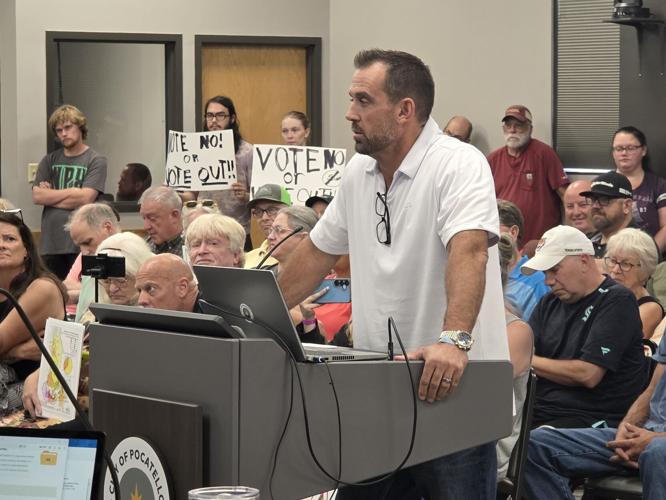
Gus Schultz addresses the Pocatello City Council during Thursday’s hearing on the proposed AI data center at the former Hoku site, as opponents hold “Vote No or Vote Out” signs behind him.
The path to Thursday’s vote was anything but smooth. Before the Council deliberated, Dahlquist pressed Schultz directly, asking whether he had any companies lined up to actually use a data center if one were built.
“I have multiple,” Schultz replied.
“Why aren’t any of them here?” Dahlquist asked. The question drew applause from the audience.
Dahlquist pushed further, asking if Schultz had a signed letter of intent from any of those companies.
“Yeah,” Schultz said.
The exchange demonstrated the central frustration that has dogged this application from the start — a project of extraordinary ambition, presented with limited specificity, before a community that showed up in extraordinary numbers to demand answers that never fully materialized.
Bates, who said he had watched the recording of the original May 14 hearing examiner meeting in preparation for Thursday’s appeal, did not mince words in describing what he saw.
While state law and city code confined the Council to only consider or discuss facts and testimony already in the record from the May 14 hearing as opposed to subjective impressions, Bates admonished Schultz with what he said was an obvious impression or takeaway.
“Simply as a taxpayer and a citizen of Pocatello, it was disappointing to me to see a request that is both highly controversial and unprecedented in terms of the level of investment in our city, to be treated in what I frankly viewed as a somewhat clumsy and casual manner,” he said.
Lewis denied the CUP in May after finding Lex Developments’ application fell short on three of the seven criteria required for approval — that the project could be adequately served by public facilities and services, that it would not adversely affect the environment to a greater degree than a use permitted outright under the ordinance and that it would not be detrimental to the public interest, health, safety or welfare of the city.
In each case, Lewis found the application provided insufficient information, calling for studies on power, water and wastewater capacity, air quality and long-term environmental impacts before any new application could be considered.
Idaho Falls attorney Jon Stenquist of Parsons, Behle & Latimer, who attended Thursday’s meeting alongside Schultz, argued in the appeal that triggered the meeting that Lewis’ denial was wrong on all three counts.
He maintains that the city never should have required a conditional use permit in the first place, that the denial was arbitrary and capricious given that city planning staff had recommended approval, and that outright denial was fundamentally unjust when conditional approval was an option explicitly available under both Idaho Code and Pocatello’s own ordinance.
Bates, the Council’s most vocal advocate for reversing Lewis’ decision, spent considerable time during deliberations walking through each of the three criteria Lewis found unsatisfied. He argued that Schultz’s water usage estimates, Idaho Power’s preliminary feasibility letter and the project’s comparisons to other permitted heavy industrial uses were sufficient at the conditional use permit stage, which he characterized as a land use compatibility determination, not a final engineering review.
“This is the first step in the development process,” Bates said. “I don’t think we can say that the applicant did not meet the criteria if we’re asking for specific things like final engineering numbers. Those are things that would be determined through a building permit process.”
Nichols, framing his motion to affirm, said simply that he believed Lewis met the requirements of the conditional use process.

Opponents of the proposed Hoku site data center hold signs during Thursday’s Pocatello City Council meeting.
Meanwhile, a recall effort aimed at holding the Council accountable for Thursday’s vote has already been launched. Pocatello resident Daniel Harrington, who is leading the effort through a Facebook page dedicated to the cause, said he will focus the recall initiative solely on Bates — not those who voted to uphold Lewis’ denial, but the one councilmember who voted against it.
Bates’ own pre-vote remarks explain the stakes he saw in that vote — that Schultz would likely prevail in court, that the city would lose the ability to place conditions on the development and that the whole process would ultimately cost taxpayers money without the public having any meaningful say in the outcome.
The Council’s vote is not the end of this story, and it may not even be the most consequential chapter.
If Schultz files in 6th District Court and a judge finds in his favor, the case returns to the city — potentially with directions the Council must follow and without the leverage to impose the conditions a majority of its members expressed support for.
It is a scenario that has played out in communities across the country as AI data center proposals collide with land use frameworks that were written long before anyone imagined what a 200-megawatt server campus would look like or demand from a mid-sized city’s infrastructure.
For a site that has cycled through a bankrupt polysilicon plant, a parade of unfulfilled redevelopment promises and a community debate that has consumed Pocatello for the better part of two months, Thursday’s vote was consequential — but almost certainly not final.
As Dahlquist put it before adjourning: “This has been a real rough process. There’s lots of passion throughout the community both ways.”
He wasn’t wrong. And by the sound of things, that passion has several more chapters left to write.



(3) comments
Some people just won't take NO for an answer.
I think this reaction is a warning of the developers true colors. I suspect they will be bad neighbors in our community and hard headed employers.
Throwing good money after bad outcome. Should have received okay for CUP before purchasing. All he could see was dollar ($) signs.
Welcome to the discussion.
Log In