




It will now be up to the Pocatello City Council to decide whether the former Hoku site will be transformed into an AI data center.
On Monday, the Arizona company proposing the project, Lex Developments LLC, of Gilbert, Arizona, officially filed a request for reconsideration of Pocatello Hearing Examiner Kathleen Lewis’ denial last month of a conditional use permit that would have greenlit the project’s development, meeting the June 2 deadline and putting the matter before the Pocatello City Council.
The 41-page appeal includes 10 pages of argument from Lex Developments’ Idaho Falls-based attorney Jon Stenquist of Parsons, Behle & Latimer, and two exhibits. The first is Lewis’ May 19 five-page amended findings of fact and her May 18 original findings. The second is the original agenda item description of the May 14 public hearing that was packed to the brim with hundreds of local residents mostly opposing the project.

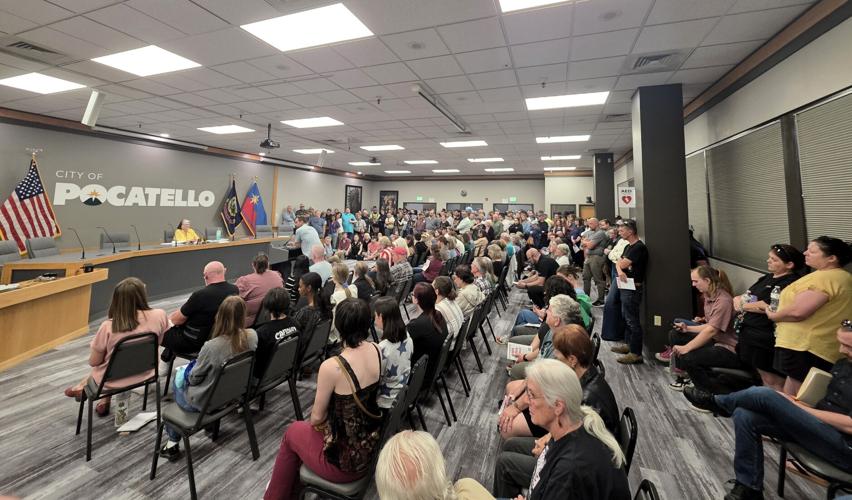
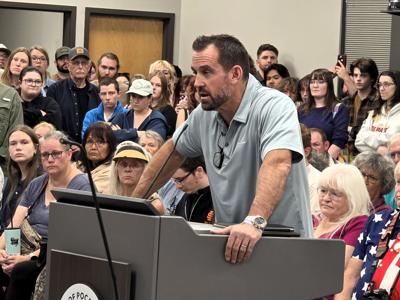
Hearing Examiner Kathleen Lewis, seated at the dais at left, presides over a standing-room crowd Thursday inside Pocatello’s Council Chambers during the public hearing on a conditional use permit for a proposed AI data center at the former Hoku polysilicon plant site.
Through attorney Stenquist, Lex Developments and its representative, Gus Schultz, present three major arguments for why the Pocatello City Council should reverse Lewis’ decision.
When reached for comment Thursday morning, Schultz declined to comment, referring all questions and further communication to Stenquist, who also declined to provide further comment outside of what is included in the request for reconsideration.
Three arguments for reversal
The first and most fundamental of Stenquist’s arguments is that the city never should have required a conditional use permit application in the first place.
Stenquist argues that under the provision governing unlisted uses of Pocatello’s city code, the planning director was required to conduct a formal, written analysis of whether an AI data center is compatible with and similar to other uses that have already been permitted in the heavy industrial zone where the center would be built.
Stenquist argues that analysis was never done — that the director and Mayor Mark Dahlquist instead simply declared a conditional use permit, or CUP, was necessary and placed the project before the public.
Stenquist argues that had the proper process been followed, the only reasonable conclusion would have been that a data center fits comfortably within the heavy industrial zone on the city’s northwest side that had already contemplated energy production facilities, large-scale machinery sites and continuous industrial operations, all of which describe a modern data center.
Stenquist argues that because the city skipped the analysis entirely, the resulting denial is legally defective from the start.
‘Arbitrary and capricious’
Stenquist also presents an alternative second argument in that even if the CUP process was appropriate, Lewis’ “outright denial was arbitrary and capricious and not supported by a sufficiently reasoned statement.”
“The City’s own planning staff reviewed the Lex CUP application and recommended approval with suggested modest conditions,” the appeal states. “In denying the application, the Hearing Examiner departed from staff’s conclusions based solely on Applicant’s failure to submit comprehensive studies that are ordinarily required during the site development and building permit process, not at the CUP stage.”
The second argument of Stenquist’s appeal leans heavily on the notion that denying a CUP on the basis of studies not yet required and not yet submitted “improperly inverts the regulatory process and constitutes an abuse of discretion.”
‘Fundamentally unjust’
Lastly, Stenquist presents a third argument in that even if some additional information was legitimately needed, outright denial was “fundamentally unjust.”
Both Idaho Code and Pocatello’s own ordinance explicitly contemplate conditional approval — the ability to grant a CUP subject to conditions requiring future studies, analyses or coordination, which is exactly what the city’s own staff recommended — approval with four conditions.
Instead, “The Hearing Examiner nevertheless adopted the most extreme possible outcome: full denial coupled with a one-year prohibition on refiling,” Stenquist wrote. “That result is not equitable or just considering the Hearing Examiner’s quasi-judicial role and Idaho’s foundational principles of free use of land.”
Stenquist argues that the result is “especially unreasonable and completely unjustifiable given this particular property, its zoning designation, history, and existing entitlements.”

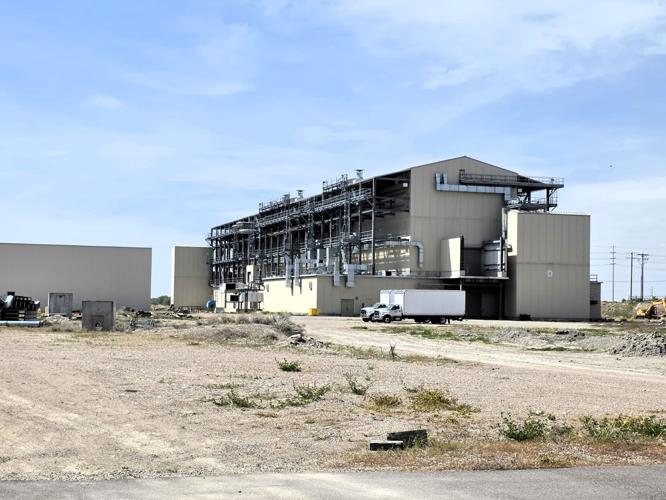
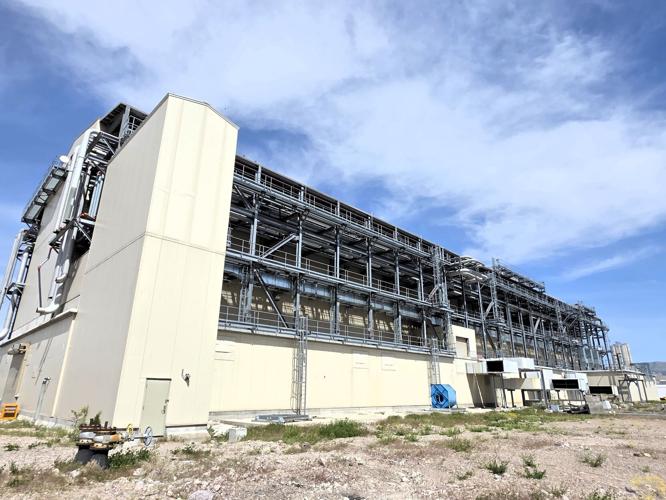
The hulking reactor building of the former Hoku polysilicon plant looms over the River Park Complex. The $700 million plant broke ground in 2007 but never opened for commercial production, filing for bankruptcy in 2013.
Stenquist’s appeal also raises an additional argument tied to the property’s history in that the site already carries approved entitlements for the former Hoku polysilicon plant — a chemical manufacturing facility that required extraordinary electrical capacity, water and wastewater infrastructure and significant environmental review.
Those entitlements run with the land. Stenquist argues it is legally incoherent for the city to have approved a 110-megawatt chemical processing plant on this same property and then deny a data center that, by virtually every relevant measure, is less intensive, less noisy, less chemically hazardous and less demanding on public infrastructure.
Original vs. amended findings
The version of Lewis’ findings attached to the appeal as an exhibit is her amended findings of fact, dated May 19 — one day after she issued her original findings. The two documents are substantively identical on all seven criteria, with one key difference.
In the original findings, Lewis marked criterion D6 — the environmental impact standard — as compliant with a “yes.” In the amended version, that same criterion was changed to “no,” consistent with the rest of her denial rationale. The change tightened the internal consistency of the denial, though Stenquist’s appeal argues it does little to address the underlying deficiency in that Lewis failed to articulate a reasoned factual basis for any of the three criteria she found unsatisfied.
The reconsideration request concludes with asking the City Council to reverse Lewis’ decision “and permit (Lex Developments) to proceed with lawful development,” and that if the Council feels a CUP is required, to impose “reasonable conditions as the Council deems appropriate to address infrastructure coordination and study requirements.”
Background

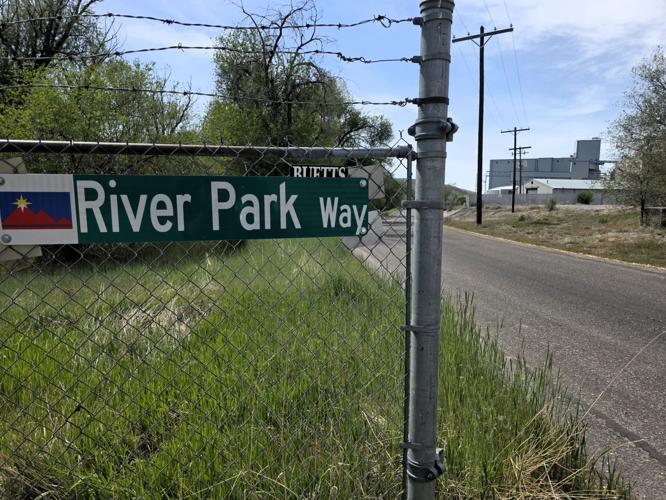
The River Park Way street sign marks the entrance to the former Hoku polysilicon plant site on Pocatello's northwest side in this May photo. Portneuf Capital rebranded the road — formerly known as Hoku Way — as part of an effort to shed the property's troubled past.
The data center proposal at 1800 River Park Way, on the site formerly occupied by the Hoku polysilicon plant, has been years in the making and centered in the public eye for about two months.
Portneuf Capital — which includes Soda Springs natives L.D. Barthlome and Chad Hansen, along with Pocatello High School graduate Darren Miller — purchased the defunct Hoku plant from the Pocatello Development Authority in December 2019 for $1.25 million.
The site had sat largely idle since Hoku Materials went bankrupt in July 2013 with roughly $1 billion in debts, after a $700 million polysilicon plant backed by Chinese investors was abandoned mid-construction in 2012, never having produced a single product.


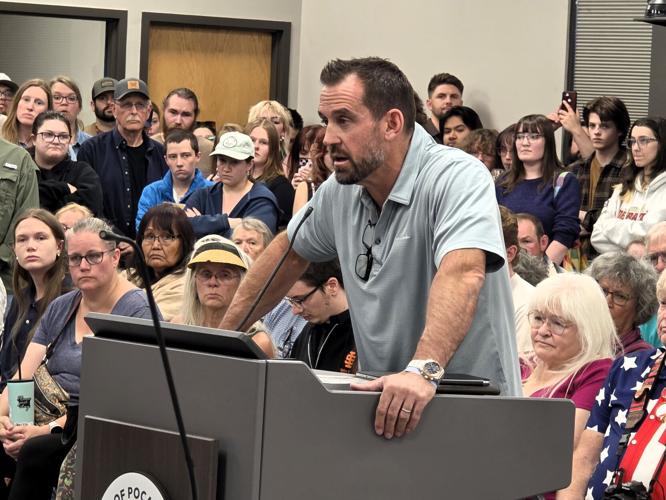
Every seat in Pocatello’s Council Chambers was claimed well before the May 14 hearing began, with hundreds more standing along the walls and spilling into the foyer of City Hall. More than 100 people ultimately testified during the more than four-hour hearing.
Schultz, representing Lex Developments, closed on the property on May 13 — the day before the public hearing — paying approximately double what Portneuf Capital paid for it six years earlier.
The May 14 hearing drew hundreds of residents who filled City Hall’s Council Chambers and spilled into the foyer, with more than 100 speakers offering testimony over nearly four and a half hours. Lewis issued her original denial on May 18, one day before issuing the amended version.
What happens next
What happens next is largely in the city’s hands, on a timeline it controls. The reconsideration request was received June 1, one day ahead of the June 2 deadline, and the city has up to 60 days to respond.
A $200 fee plus noticing costs apply, and while those fees had not yet been processed as of this week, they are expected to be entered into the city’s system shortly, city officials told the Journal on Thursday.
When the city schedules the matter for the Council, no new public comment will be permitted — the Council’s role is to review the existing record and determine whether to affirm Lewis’ denial, reverse it or approve the CUP with conditions.
Nothing introduced after the May 14 hearing may be added to the record. An exact hearing date has not been set, but the matter is expected to come before the Council within the 60-day window.
Whether or not an AI data center will be conditionally approved now rests in the hands of the six-person City Council, which includes two new members who assumed the roles in January, and potentially new Dahlquist if the Council ultimately remains deadlocked after calling the measure to a vote whenever the matter is finally scheduled and added to the Council’s calendar.

The former Hoku polysilicon plant, now known as the River Park Complex, in northwest Pocatello.
That doesn’t, however, guarantee that the former Hoku site will in fact become an AI data center. Lex Developments’ proposal must then pass all necessary checks as part of the building permit process mentioned briefly in Stenquist’s appeal letter.
But even before that, local residents still have one final measure of remedy to challenge the process in their back pockets, hiring an attorney of their own and challenging the City Council’s decision in Bannock County’s 6th Judicial District Court.
As has been the status quo since the Idaho State Journal first reported on this endeavor almost exactly two months ago, this story is far from over.



(2) comments
Attorney Stenquist's impassioned appeal mentions nowhere that a big majority of those testifying at the hearing were opposed to the proposed data center construction. Indeed a big majority of communities where construction of data centers has been proposed have been against allowing said construction. This most recently includes Box Elder County, Utah.
Welcome to the plutocracy. If a majority lowly citizens are opposed, who cares? We'll just sue them into submission.
Welcome to the discussion.
Log In