

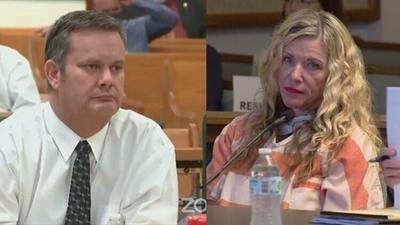

Murder defendants Lori Vallow and Chad Daybell appeared before Seventh District Judge Steven Boyce on Thursday for a pretrial hearing, where mental health issues, a motion to dismiss Daybell’s indictment, and a renewed motion to sever Daybell and Vallow’s trials were reviewed.
Daybell’s lawyer, John Prior, has repeatedly requested that Daybell’s trial be held separate from his wife’s. Doing so would provide him with a fair trial, Prior claimed. Vallow has never waived her right to a speedy trial.
Much of the hearing involved Prior complaining that he has little time to adequately prepare a defense for Daybell.
Both defendants are scheduled for trial on April 3 in Ada County.
Prior says his experts won’t have time to review recently discovered DNA evidence just weeks before trial. He noted the state’s lab failed to come up with a DNA profile on newly discovered miniscule strands of human hair. To ensure they get a good reading on the hair, both the prosecution and defense agreed to send it to a separate lab to come up with a DNA profile. The results were expected the same day as Thursday’s hearing.
Fremont County Chief Prosecutor Tawnya Rawlings told Boyce the prosecution has not been withholding information.
“Having collected these additional hairs at a later date was problematic,” she said. “The state made significant efforts to find a private lab to test smaller hairs that don’t have the roots.”
Prior noted that law enforcement recently turned over 1,188 pages containing 500 tips received when J.J. and Tylee went missing. Rawlings reported that not every single piece of paper had tips on the then-missing children.
“Each tip contained on a single piece of paper — maybe had a few lines at the top, and the rest were blank,” Rawlings said.
Prosecutors learned about the tips in January and turned those over to the defense.
“There is a voluminous amount of information and much of this material has been available for inspection and review for approximately two years,” Rawlings said.
The court set a deadline for evidence to be turned in by Feb. 27, she said. For Daybell to ask that his indictment be dropped because some discovery has not been provided before the deadline is unjustified, she said.
“Dismissal of a case is extreme,” Rawlings said.
Law enforcement seized various items from Daybell’s home in Salem on Jan. 7, 2021. During the search, 32 electronic devices and 26 journals were retrieved.
“In essence, with five or six weeks before trial starts, I’m supposed to spend my time determining whether there is any information that is potentially exculpatory,” Prior said.
Prior also reported there are an additional 12 terabytes of evidence to review. He claimed that amount of data would fill up the “back of a cargo van.”
“(The prosecution) downloaded, and they took piecemeal, small pieces of that evidence,” he said. “They said the defense can go down any time and copy or review this evidence, but I don’t have (the) leisure to go through a truckload of evidence that they’ve been sitting on.”
To retrieve the data, Prior said he will provide the prosecution with a 12-terabyte hard drive to download the information themselves. Prior also reported that there are “half a million GPS points” from cellphones — and one in particular — that he’s waiting for.
Prosecutor Lindsey Blake noted that on the eve of the trial, Prior complained evidence hadn’t been received in a timely manner.
“With regard to the DNA testing,” she said, “the defendant had the ability to go request testing, request to move forward and file motions. The defendant did not come in and request to look at the 12 terabytes that he’s known about for two years.”
Vallow’s attorneys also spoke and reminded Boyce they wouldn’t bring up her mental health issues during the trial.
“We acknowledge that mental illness is not a defensible crime,” said Jim Archibald. “However, mental illness can be presented if it is an element of the crime. What that means (is if) Lori Vallow ever said ‘I did it, but I was crazy,’ that’s clearly where it applies.”
Vallow has told Archibald she will be found innocent during the trial.
“She believes she will not be convicted,” he said.
Archibald noted that in death penalty cases, lawyers prepare for sentencing while also getting ready for trial.
“In the event she is convicted, then we intend to present our mental health evidence,” Archibald said. “The mental health evidence would not negate the crime if the jury found her guilty. However, it would be mitigation for the jury to consider for punishment.”
Blake expressed concern that doing so would make it look like the state was allowing for a mental health defense.
“They (the defense) do reference mental health evidence presented if it negates an element of a crime,” she said. “The concern with that is the state should not be prohibited from talking about things that someone could try to spin and indicate her mental health.”
While Vallow’s mental health issue was of concern, Blake did say the state will present Vallow’s religious beliefs. Vallow and Daybell believed that some spirts were dark, they were now zombies, and needed to die.
“The state absolutely intends to talk about the issue of the defendant’s beliefs,” she said.
Concerning Daybell, Blake said that Daybell’s defense didn’t have good grounds for a continuance or a delay in the trail. Prior at one point requested that Daybell’s trial be postponed until next year.
“Again, it’s disingenuous to come in and blame the state (and saying it) didn’t follow through with our obligation,” she said. “We have met our discovery obligation.”
Boyce said he would take all the motions under consideration.

(0) comments
Welcome to the discussion.
Log In