

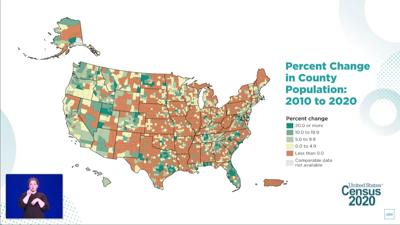
Several counties in eastern Idaho have seen significant population increases over the last decade.
The U.S. Census Bureau released its 2020 Census Redistricting data during a press conference on Thursday. The data shows demographic information for counties and states including population changes from the last census, race, housing status and adult population.
Bonneville County’s population increased from 104,234 to 123,964, which is a 18.9% increase. The only county that had a higher percentage increase in the region was Madison County which had a 41% increase.
Madison County had the fastest population increase in the state, going from 37,536 in 2010 to 52,913 in 2020.
Jefferson and Teton counties also had population increases of greater than 10%.
The state of Idaho has grown by nearly 300,000 people since 2010. In 2010, the bureau recorded 1,567,582 people living in Idaho, which has increased by 17.3% to 1,839,106.
Most people in the state identified as white or a combination of white with another race at 90%. About 13% of the state is ethnically Hispanic or Latino. The bureau tracked 10.4% of the population identifying as some other race, 3.6% identified as American Indian and Alaskan Native, 2.6% identified as Asian, 1.5% identified as Black and .5% as Native Hawaiian and other Pacific Islander.
The total population in the country has increased by 22.7 million, growing to 331.4 million. This is the lowest increase (7.4%) in population since the 1930s (7.3%).
There were seven counties in the state that have tracked population decreases over the decade. Butte County (2,574 total population in 2020) and Clark County (790 total population in 2020) had 11% and 19.6% decreases respectively.
This data will be used by state legislatures to redistrict or redraw the boundaries of their congressional and state legislative districts.
“Local leaders can use this data to make decisions such as where to build roads and hospitals and how to help our nation recover from the pandemic,” said Ron Jarmin, U.S. Census Bureau acting director. “These results will also help inform how hundreds of billions of dollars in federal funds will be distributed each year nationwide.”
Idaho Secretary of State Lawerence Denney announced in a Thursday news release that the state has officially formed a Commission for Reapportionment to redraw the boundaries of Idaho’s 35 legislative districts and two congressional districts.
The commissioners appointed by the six appointing authorities are:
n Republican Bart Davis of Garden City
n Republican Tom Dayley of Boise.
n Democrat Nels Mitchell of Boise.
n Democrat Amber Pence of Tetonia.
n Republican Eric Redman of Spirit Lake.
n Democrat Dan Schmidt of Moscow.
The commission will begin meeting within the next few weeks, and once it convenes its first meeting, will have 90 days to complete its work, the release said.
The U.S. Census Bureau’s data comes late as it is typically done by April 1 under federal law. Denney said he is confident that the commission is eager to begin.
“While the delay will make the timelines of redistricting challenging, I have confidence that this Commission will be both thorough and expeditious in developing a fair and intelligent plan that adheres to constitutional and statutory requirements,” Denney said.

(0) comments
Welcome to the discussion.
Log In