

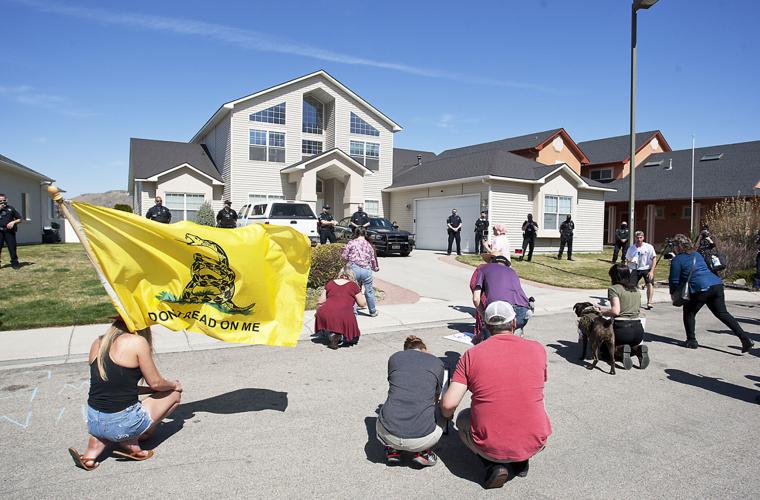





BOISE — In 1977, Arizona passed a law to ban “residential picketing,” defined as demonstrating in front of someone’s home with the “intent to harass, annoy or alarm.”
Before passing, the statute won support from Rep. Jim Skelly, a Republican from Scottsdale who was “anti-gay rights” and whose house had been picketed by gay rights activists while his wife and children were home, the Arizona Republic reported at the time. Skelly was also an “ardent opponent of abortion,” according to the Arizona Capitol Times, and, ironically, almost 20 years after law went into effect, it was challenged as unconstitutional by anti-abortion activists, who were demonstrating near the home of Planned Parenthood’s local director.
The law was upheld by a federal court, as were other residential picketing laws enacted in other states, although not all of them. It was on that Arizona law that Idaho state Reps. Greg Chaney, R-Caldwell, and Brooke Green, D-Boise, modeled their “targeted picketing” bill earlier this year.
Their bipartisan proposal, House Bill 195, which ultimately failed to pass, came after a year of protests at the homes of Treasure Valley public officials and employees. Groups from the political left and right took to neighborhoods to picket officials over policies they disagreed with, such as police funding or public health restrictions.
“This tactic is an intimidation technique, no matter how it’s used,” Chaney said during a March debate.
Green said, “It’s coming from both sides, guys. It’s the left, it’s the right — and they’re taking it to your doorstep.”
Targeted picketing is one of the increasingly few issues in Idaho that has found common ground with Democrats and Republicans. Every Democrat in the House voted in favor of Chaney and Green’s bill, and they were joined by a handful of Republicans. Law enforcement groups and local government officials supported the bill, as well. But it still failed to pass, a missed opportunity, according to Chaney.
The American Civil Liberties Union (ACLU) and Idaho Freedom Foundation — two policy groups often at odds with one another — both lobbied against it. Thirty-eight House Republicans voted it down. One of them, Rep. Chad Christensen of Iona, in March said, “I understand these inconveniences are very trying, uncomfortable.”
He added, “That’s the cost of liberty.”
WHO PAYS FOR LIBERTY?
On Dec. 5, former Ada County Commissioner Diana Lachiondo was at the Boise office of Central District Health, the government agency responsible for enacting coronavirus-related public health protocols for four counties, including Ada, which had the largest share of the state’s COVID-19 cases. The district’s board of health, of which Lachiondo was a voting member, was considering a revised public health order as COVID-19 cases were rising.
Hundreds of protesters — from conservative political groups along with anti-vaccine activists and a faction of parents opposed to mask mandates in public schools — gathered outside the Central District Health office to oppose any additional restrictions the agency might impose. Early in the meeting, Lachiondo, a Democrat, who consistently supported mandates to curb the spread of the virus, received an urgent call: The protesters weren’t just at her office, they were also at her house, where her 9- and 12-year-old sons were home alone. (Lachiondo later clarified that her mother was home with the boys but had left to take the dog on a walk.)
Lachiondo said she expected being a public official would be difficult and sometimes personal, but dissidents at her front door was wholly unexpected. In total, Lachiondo’s house has been picketed three times. After the December demonstration, Lachiondo said, her youngest son had trouble sleeping.
“The saddest part is their loss of innocence and feeling of safety,” she said. “I’m a fourth-generation Idahoan, and I never imagined in this community we’d have people protesting at homes.”
The December protesters belonged to People’s Rights, a group founded by anti-government activist Ammon Bundy to oppose coronavirus safety mandates. It wasn’t the first time the group organized a residential picket and it wouldn’t be the last (they returned to Lachiondo’s house the following night).
On April 21, 2020, Bundy led a People’s Rights demonstration outside the home of a Meridian police officer. Earlier that day, amid a statewide push to defy government-mandated shutdowns, dozens of Treasure Valley moms took their kids to a closed playground in Meridian. When police arrived, one of the mothers, Sara Brady, refused to leave and encouraged officers to arrest her; one obliged, and his house was picketed that night.
WHERE THE LAWS COME FROM
Targeted picketing over coronavirus mandates last year wasn’t limited to Idaho. The home of Gallatin City-County (Montana) Health Officer Matt Kelley was picketed for nearly two consecutive weeks, the Bozeman Daily Chronicle reported — Kelley later resigned. And home protests aren’t a strategy unique to the political right.
Last summer, after the murder of George Floyd by a Minneapolis police officer, protests erupted around the country calling for police departments to be defunded. In Boise, the local Black Lives Matter group organized protests at city hall, as the Boise City Council debated a $1 million increase to the police department’s budget. When the council approved the increase, protests spilled over from city hall to the homes of Mayor Lauren McLean and the four council members who voted to approve the budget, Elaine Clegg, Holli Woodings, TJ Thomson and Patrick Bageant.
“I don’t know what their true objective was because I never spoke with them, never had the opportunity to speak with them,” Bageant recently told the Idaho Press. “My guess, frankly, was the purpose was to make a scene. Nobody who’s ever protested my house, to my knowledge, has ever asked me for a meeting … has ever attempted to talk with me directly. I don’t believe the objective of any of these protests was a dialogue. I don’t think they were trying to reach me.”
This year, another group of picketers came to Bageant’s home to protest a city parking ordinance. In an email sent to constituents last fall, Bageant wrote, “protests and political speech please me greatly,” but “protesting a residence utterly misunderstands political power.” Invading private spaces “feels threatening and intimidating,” and those feelings “impede, rather than help,” open-mindedness, he wrote.
“My house isn’t the problem, my street isn’t the problem, my neighbors aren’t the problem,” he told the Idaho Press. “It’s presumably some policy that the city implemented that people want to see changed. My home isn’t the seat of city power, my home isn’t where the laws come from, my home isn’t where the policy is made. That’s city hall.”
But what if the public officials making laws, like many others over the past year, are working from home? What if city hall and other government buildings are closed to the public, and it seems as though no one can hear you?
SOMEWHERE TO BE HEARD
Public hearings on the targeted picketing bill, HB 195, attracted significant testimony — two days’ worth. Some who testified said demonstrating at homes has been necessary during the pandemic because government meetings have been largely conducted online, the Associated Press reported.
“Why would I feel the need to go to their personal residences? It’s because I’m not being heard,” said Del Chapel, during a February hearing at the Statehouse. “That’s why. I’m not being heard. And when I feel like I’m not being heard, I’m going to go someplace where I can be heard.”
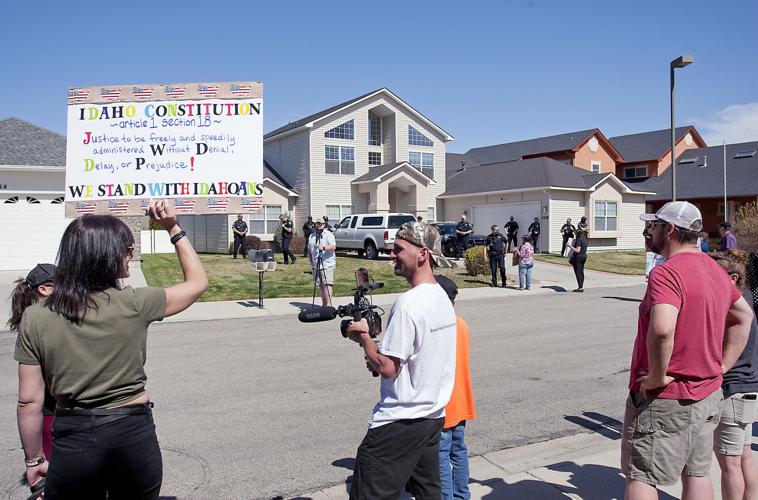
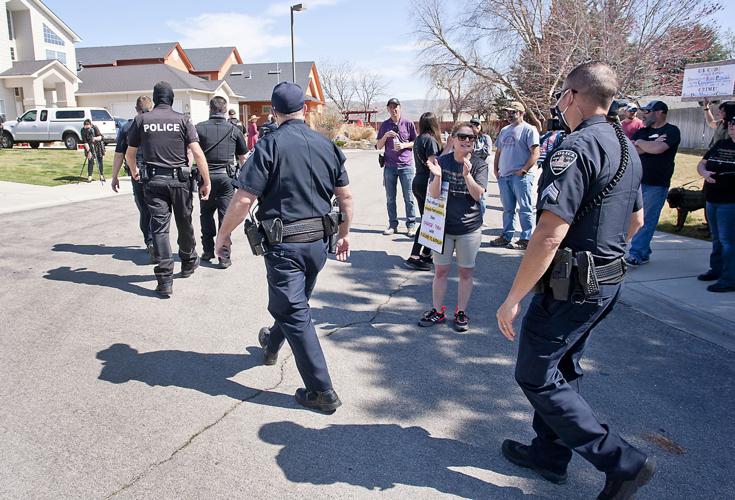
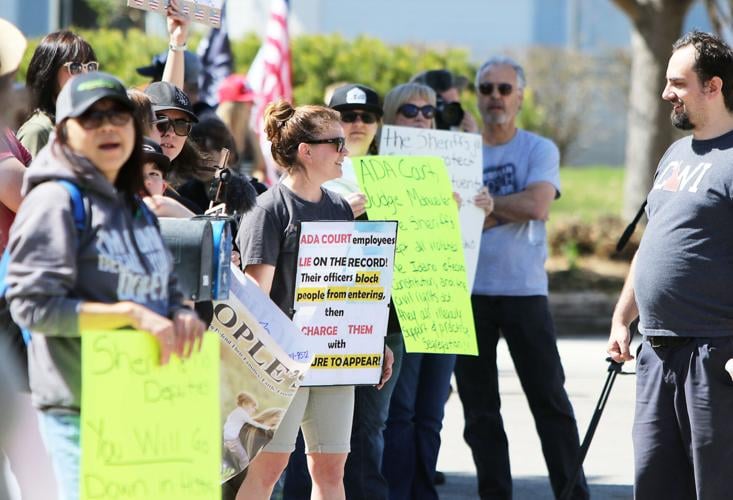
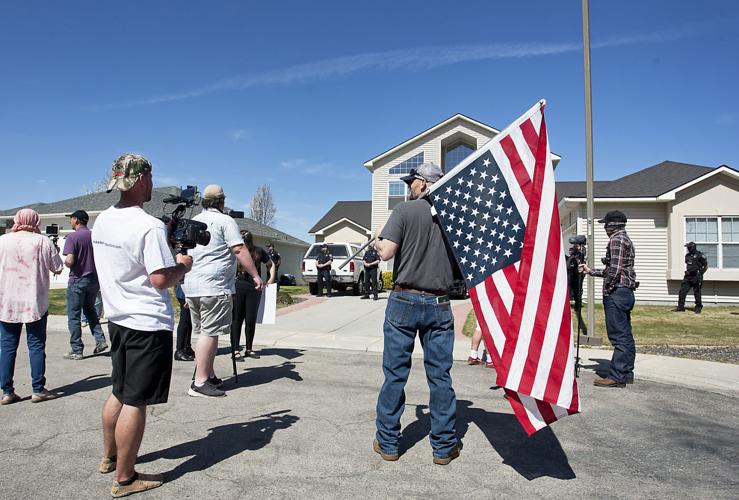
Last month, about two weeks after Bundy was arrested outside the Ada County Courthouse for failure to appear at a trial because he refused to wear a required face mask, Bundy’s supporters protested outside the home of Magistrate Judge David Manweiler, who issued the bench warrant for Bundy’s arrest. Later that day, the same group also protested at the courthouse, where Joey Gibson, founder of the Vancouver, Washington-based conservative group Patriot Prayer, commended the group for targeting the judge’s house.
Last fall, Gibson led a protest in the Tri-City area of Washington, at the home of an officer with the state’s Liquor and Cannabis Board, which had issued warnings to bars that were shirking public health orders, the Tri-City Herald reported. At the Ada County Courthouse, Gibson told the crowd, “It’s going to take boots on the ground” to oppose government mandates.
“Boots on the ground every single time, every single court date, whatever it is, like today — some of you showed up to the judge’s house,” he said. “Boots on the ground is so powerful and that’s what they’re afraid of and they want to stop that. They want to throw people in jail for showing up and redressing their grievances. This is why they shut down all the public buildings. Because they don’t want the people to confront these politicians who sold us out.”
SIGNIFICANT GOVERNMENT INTEREST
Much of the opposition to Idaho’s targeted picketing bill was based on constitutional concerns. Many, including the ACLU of Idaho, feared it violated First Amendment protections of free speech.
Historically, the interpretation of targeted picketing by courts has been dubious.
Chaney, one of HB 195’s sponsors, told the Idaho Press the bill was modeled on the Arizona law because it has stood up to court challenges. Further, Arizona, like Idaho, falls under the 9th Circuit Court of Appeals, meaning such a law has been on the books in the 9th Circuit for several decades.
The U.S. Supreme Court has long held that the government cannot restrict speech based on its content, but it can place reasonable restrictions on the time, place and manner of speech. Any restriction must be content neutral, leave open ample alternative channels of communication and serve a significant government interest. In Frisby v. Schultz (1988), the Supreme Court upheld a Wisconsin city’s residential picketing ban, arguing it met those three standards. The government interest: protecting residential privacy.

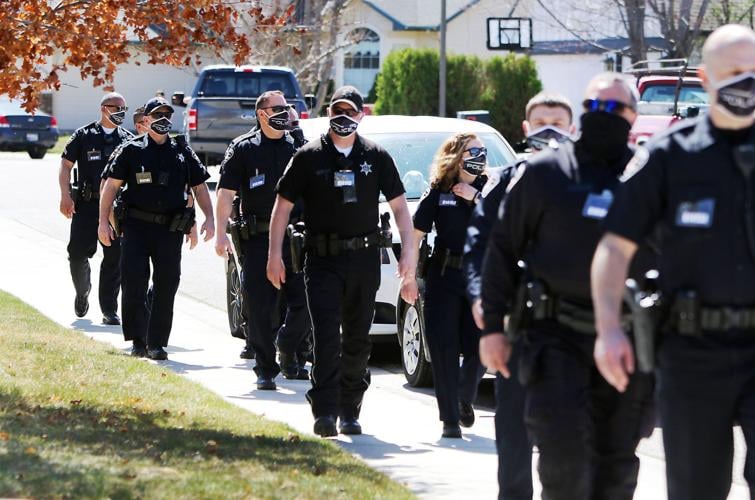
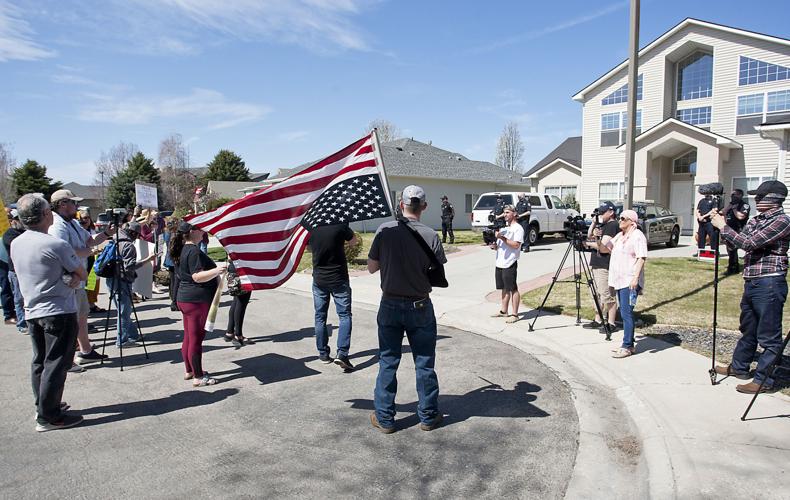
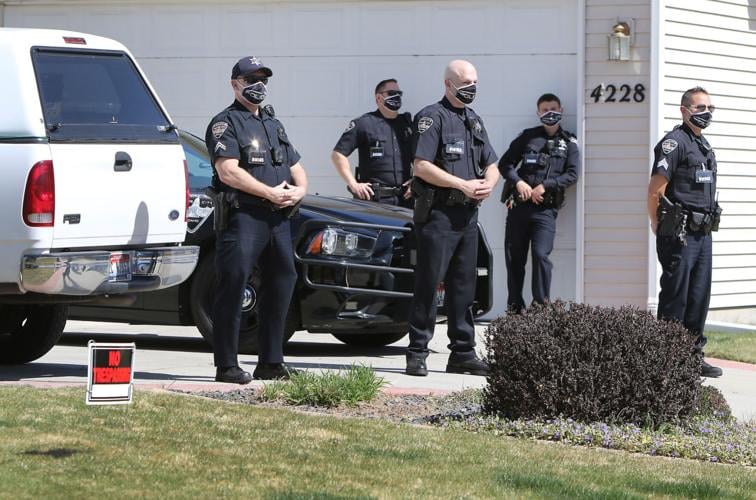
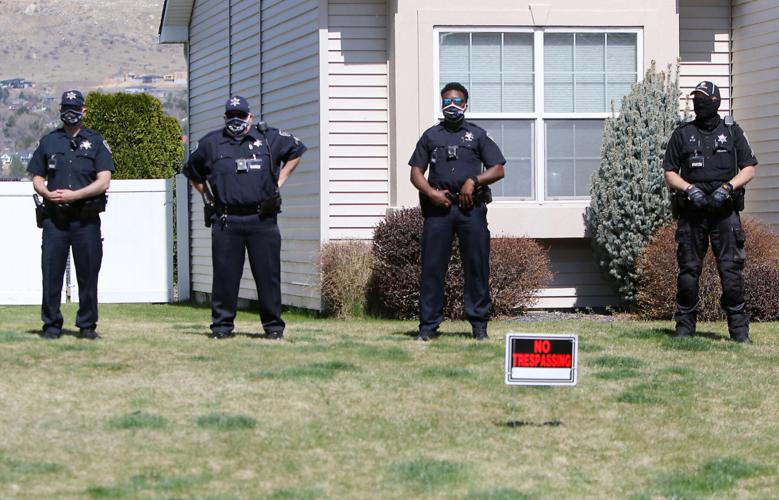
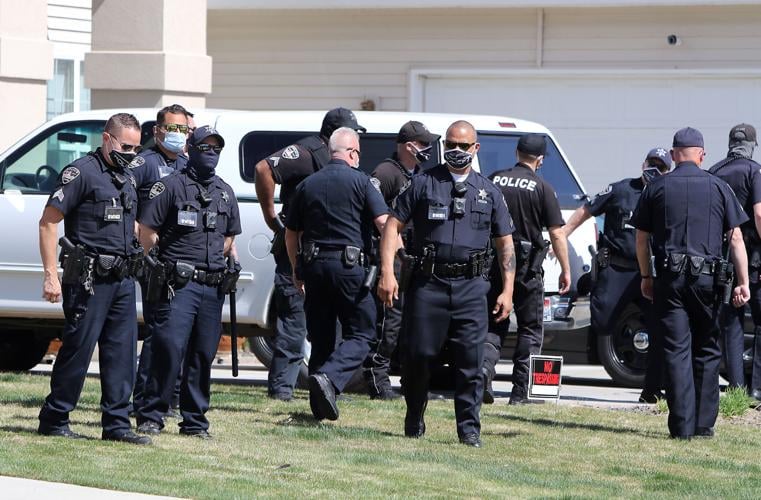
Boise police officers stand in front of the home of Judge David Manweiler as protesters gather on the street, Saturday, April 3, 2021.
Regardless, the ACLU argues HB 195’s restrictions on speech are too broad.
“Federal courts have upheld restrictions of this kind only upon very narrow readings — for instance, when the Supreme Court has upheld them at all, it has done so only based on the promise of counsel that the law would not actually be enforced as written,” the ACLU argued in remarks prepared for a House hearing. “And since then, the Supreme Court struck down residential picketing restrictions because they were neither sufficiently justified nor narrow enough.”
Chaney believes the constitutional concerns were disproved “rather handily,” but “that doesn’t mean disproving and persuading are always the same thing.”
“I know that for a lot folks that this was an uncomfortable vote,” he said. There was an “inability” among some to address the act of targeted picketing without fearing it would be a “repudiation” of the protesters’ cause, Chaney said.
“I think it’s something that should be addressed irrespective of what the message is,” he said. “It’s not as though I agree with this particular point of view, therefore it’s justified, or I disagree with this particular point of view, therefore it’s not justified.”
INTENSIFYING PROBLEM
Another targeted picketing bill could return next year. Chaney said he would “like to not have to” bring it back, but “it doesn’t look like the problem is abating itself.”
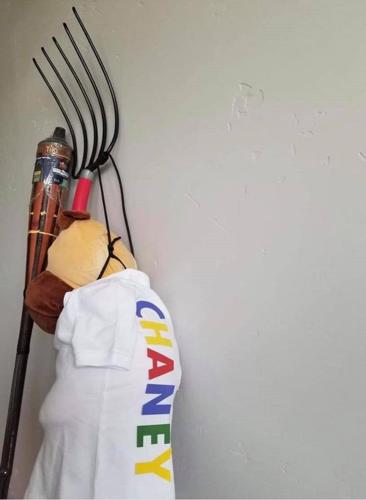
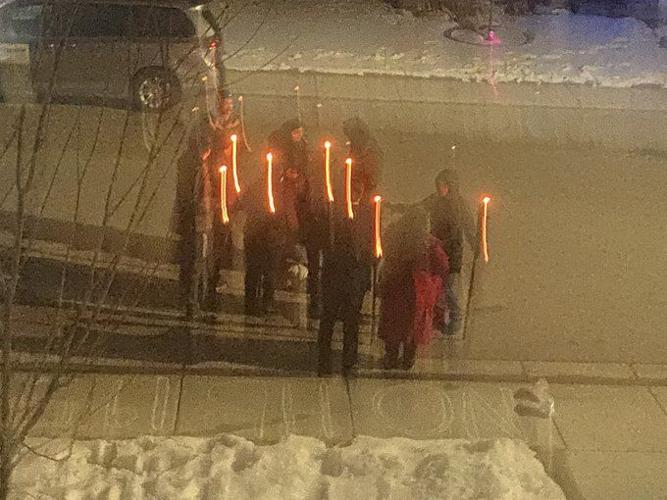
One night in March, after a hearing on HB 195 at the Capitol, Chaney’s house was targeted by torch- and pitchfork-wielding protesters. They also carried a stuffed animal with Chaney’s name on it, apparently hanged in effigy.
“They say they do this because they aren’t heard — but we’d just spent hours hearing them in committee and they still showed up where my wife and kids were,” Chaney said in a Tweet the following day. “They say they do this because have nowhere else to protest. I was at the Statehouse all day allowing them to insult and slander me in my own committee and they still showed up where my wife and kids were. They say this isn’t an intimidation tactic but they showed up with torches and pitchforks and a stuffed animal hung in effigy.”

Rep. Greg Chaney, R-Caldwell, posted this picture of an effigy protesters left outside his home Wednesday night.

Protesters gathered outside Rep. Greg Chaney, R-Caldwell, Wednesday night. Chaney and Rep. Brooke Green, D-Boise, are proposing a bill to ban protests at residences.
In the meantime, local governments could pass their own targeted picketing ordinances — Salt Lake City, for example, has a targeted residential picketing ordinance. Currently, Idaho cities can enforce the state’s disturbing the peace statute, which essentially outlaws being loud and/or offensive. Boise charged the protesters at Lachiondo’s house — who blew horns and banged together pots and pans — with disturbing the peace. But Chaney said that statute has its limits. It was not drafted to address residential picketing, specifically, so picketers who aren’t being boisterous could avoid or challenge disturbing the peace charges.
If targeted picketing continues, Lachiondo said her broader concern is the effect on future candidates who may be considering a run for office. “Do you need to live in a gated community?” she asked.
“More than ever we need thoughtful, reasonable, average human beings who want to contribute their thoughts and perspectives to the public discourse,” she said. “And if the only people who feel like they’re able to do that safely live in a gated community, that’s a problem.”
Idaho Press reporter Erin Sheridan contributed to this report.

(0) comments
Welcome to the discussion.
Log In