

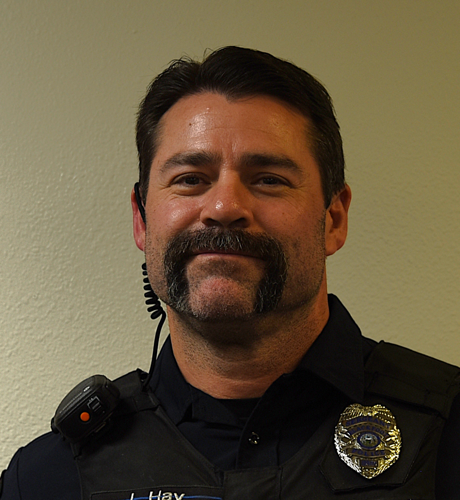




Sergeant Jonathan Hay will be ending his 30 years of service with the Blackfoot Police Department this year, a career that began when he enlisted in the Marines in 1992.
Hay comes from a family tradition of Marine service. His father was a mechanic with the Blacksheep Squadron and worked on the Ba Ba Blacksheep. Unfortunately, he learned about his father’s service by watching the old TV show. His father died when Hay was 5 years old. And that was when his family moved from California to Southeast Idaho to be near family.
After what Hay characterized as a “colorful” childhood, he moved out of the home at the age of 15. Still attending school, he began working four jobs to keep a roof over his head. After three years, he graduated from high school and started “spiraling downward” when he quit his jobs and drifted between friends’ homes.
On a whim, “almost a dare,” Hay enlisted in the Marines, not realizing how much of a life-changing experience it would be. After boot camp, Marine combat training and the School of Infantry, he was stationed at Camp Pendleton in 1992.
Over the next four years, he was deployed three times — first to the Persian Gulf on a humanitarian mission, then to Mogadishu, Somalia, also on a humanitarian mission and lastly again to the Persian Gulf, but this time on a defense mission.
All three deployments were serving in enemy territory, and even though two deployments were missions to bring food and medical supplies to the people caught in the conflict, Hay’s squad was under fire by snipers, mortar fire and convoy attacks. The enemy in those areas didn’t want the people to find relief because they would lose control of the populace.
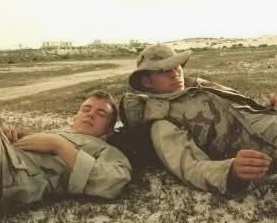
It was while he was in Mogadishu, after he had been in the Marines just a year, that Hay saw his best friend die right in front of him. One of the photos of his service that he cherishes is the one taken the very next day in December of 1993. It was a tough time for their squad that had faced so many dangers together.
Hay draws a comparison of those times with how he serves Blackfoot now — not about snipers or mortars — but that he is here to be a “shield and protection” for the people.
In 1996, Hay made the transition from the Marines to law enforcement positions in Southeast Idaho. After serving two years as a detention deputy in Bannock County, he moved to patrol and soon qualified as a SWAT team member.
As Hay was called to crisis situations across this part of the state, he noticed how the various police departments operated. For him, the Blackfoot Police Department stood out for its excellence and camaraderie.
In 2009, Hay joined Blackfoot’s law enforcement family and has never had the desire to go anywhere else. By then, he had married Kim Clark of Pocatello, and they had a young family. Hay, who came from a family of brothers, soon stepped into unfamiliar territory as the proud dad of three daughters. He maintains that his bloodline is thick with military pride because one daughter was born on the Fourth of July and one on Veterans Day.
Hay is also blessed in another way. His wife comes from a strong background of law enforcers, having grown up with a stepfather who served in the Pocatello Police Department. She understands the stresses law enforcement families live with, and her support has been invaluable.
In a very real sense, Hay has two families — Kim and his daughters (and one granddaughter so far) and the Blackfoot Police Department.
Under the leadership and example of Chief Gordon Croft and Capt. Wes Wheatley, the department has embraced peer support practices that have replaced the traditional stiff upper lip attitude with listening, sharing and hugs of support. Law enforcement officers face the tougher side of society, confrontive and abusive attitudes, violence, disasters and heart-rending emergencies. Being able to find support from those who understand this struggle firsthand has created a strong family of first responders in Blackfoot.
Being a self-made man, Hay has always been most comfortable in the active parts of law enforcement. According to Hay, being a sergeant is still being a part of that hands-on portion of law enforcement, and he has never had much interest in leadership ranks.
However, Wheatley has nudged Hay to share his experience and knowledge with the younger patrol officers and, in this way, prepare them to continue the department’s excellence as a protective shield of the city. It means that he steps back a bit from the action, which was difficult at first. But he understands that “new officers are created in the image of their senior officers.”
Another role he has accepted has been in leading the D.A.R.E. program with fifth graders. In that role, he emphasizes that everyone makes bad decisions at times, but that doesn’t make them a bad person. His message is that everyone can begin to make better choices.
Two years ago, Sgt. Hay began leading the school resource officer program, overseeing four busy SROs who serve in all of Blackfoot School District’s schools. This is in addition to being the day shift patrol sergeant. During the summer months, his responsibilities shift fully to the patrol officers until school starts again.
At a conference a few years ago, Hay heard of an effective high school elective class on law enforcement. After talking with the leader of that program and gaining the support of the Police Department and School District, Hay started a similar course at Blackfoot High, co-teaching the course with social studies teacher Chase James. James gives a valuable civilian perspective to each discussion and also takes over if Hay needs to assist patrol officers in the field.
The course explains the procedures of the department, the philosophy of service and openly discusses controversial examples of policing in the news. Hay requires each student to choose a policing incident that bothers them, and to get all the information they can on the incident from several sources before deciding how they feel about it. After doing so, Hay supports their right to feel as they do. Each researched incident is then discussed in class for peer, civilian and law enforcement perspectives.
Currently, there are about 600 students wanting to take the class, but they only have the manpower to teach 170 a year.
With retirement on the near horizon, Hay isn’t worried about what he will do or how he will feel. He knows that he has an identity beyond the uniform that won’t be changing. And, over his 52 years of life, he has learned to find value in everything he does. He figures the biggest difference will be that the clock may not be pushing him as much.
—

(0) comments
Welcome to the discussion.
Log In