

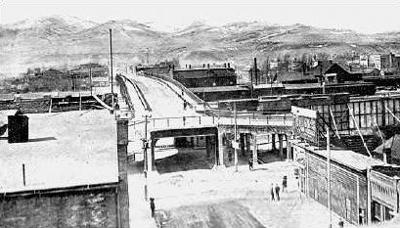

The viaduct’s east side always had an unfinished look.
By Bill Ryan
Call it viaduct or overpass, most folks in Pocatello were happy to end dodging trains to get from West Center to East Center streets. The town was split, with a community on each side of the Union Pacific tracks. Pedestrians and horse-drawn wagons followed a little path at track level to get from one side to the other.
Finally the city or railroad — or both — decided to build a viaduct to carry traffic across the tracks. The going would be easy on the western slope. But business interests to the east noticed that plans called for the slope to shadow the entire 100 block of East Center Street and return to street level at Second Street.
Bowing to pressure from the eastsiders, American Bridge Company designers simply chopped the structure off at First. This forced all traffic to climb or descend a steep ramp between the street to the viaduct’s roadway. Pedestrians were forced to use a long stairway. It might well have been that some preferred to live dangerously and still cross the tracks at grade level rather than use the street or stairs for foot traffic. That’s the way it was from 1911 until the subway replaced the structure in 1934.
While the overpass was being built, the Halliday Street subway was being dug. Its main purpose was to benefit residents living or working south of Center or attending what would become Idaho State University. Its entrances and exits were cobblestone, possibly the only place in town with this surface. Not only was it spooky to walk through, the ceiling needed bracing because of the heavy trains constantly passing overhead.
The east side merchants may have been simply protecting their businesses, but failure to complete the viaduct was a disaster for everyone.
Pocatello native Bill Ryan is a retired UPI editor who was earlier with Idaho State University. He lives in the Dallas suburb of Richardson, Texas, and can be reached at wryan1807@aol.com.

(0) comments
Welcome to the discussion.
Log In