

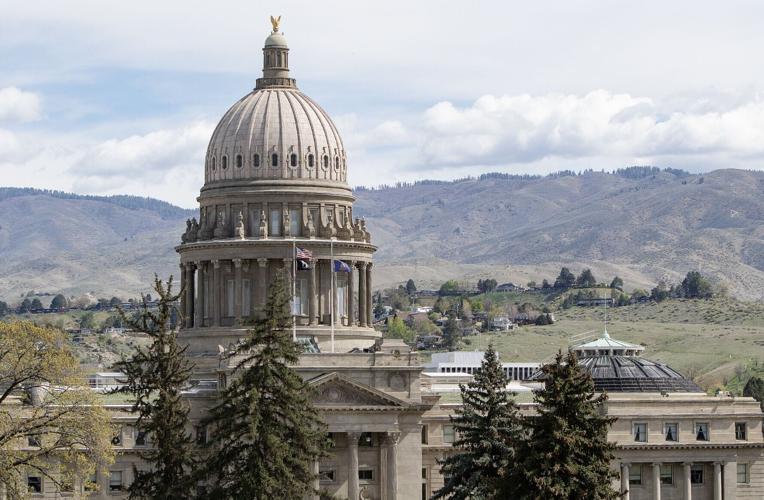

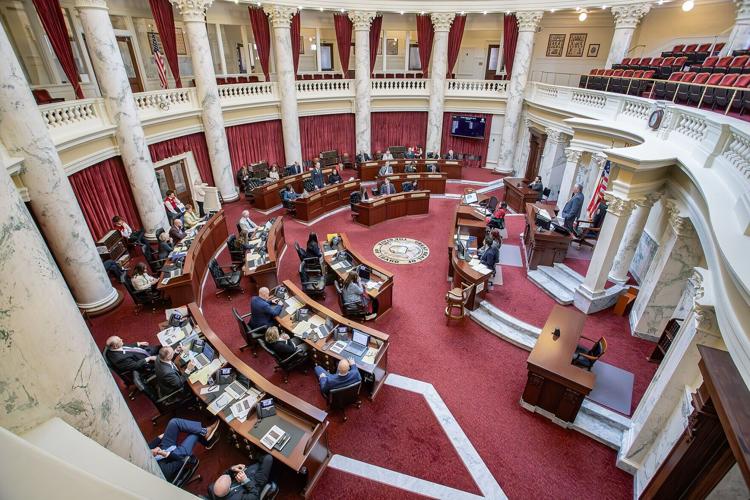





Legislation, passed during the 2026 legislative session, is due to take effect on July 1 as we enter the new fiscal year.
More than 700 bills were introduced over the course of what was a particularly busy 2026 legislative session that broached issues of social media, zoning codes, property rights and other issues.
Below is just some of the legislation that passed through the Idaho Legislature and took effect at the start of the fiscal year on July 1.
Short-term rentals
House Bill 583 was the third, and ultimately successful, effort from Rep. Jordan Rodman, R-Coeur d’Alene, to change how local government can regulate short-term rental properties in their communities.
The legislation primarily impacts short-term rental property owners and marketplaces, such as Airbnb and Vrbo, by limiting when they can face specific regulations or taxes.

Homes offering short-term rental availability stand along Franklin Street near downtown Boise in February. House Bill 583 will change how local government can regulate short-term rental properties in their communities, primarily impacting short-term rental property owners and marketplaces, such as Airbnb and Vrbo, by limiting when they can face
.
Counties and cities will now only be able to enact ordinances on short-term rentals to address a variety of safety requirements, including those for smoke alarms, occupancy limits and carbon monoxide detectors.
Cities and counties are also no longer be able to require specific licenses, fees or permits for the operation of short-term rentals and can only subject these properties to existing ordinances — such as those for noise, parking or curfew — when they are applicable to non-short-term-rental uses as well.
Zoning code changes
In an effort to respond to the state’s high demand for housing, Senate Bill 1352 prohibits local zoning codes from barring compact, single-family housing developments.
The change applies to cities with populations exceeding 10,000 and requires starter home subdivisions, defined as subdivisions of four or more acres with lots less than or equal to 1,500 square feet, to be allowed within residential zones.
Senate Bill 1354 was enacted with a similar aim. Cities of 10,000 or more will have to remove bans on accessory dwelling units in residential zones. Affected cities need to allow at least one ADU per lot, allow them to be as large as 75 percent of the primary dwelling and not require additional parking in most circumstances.
Partisan county highway districts
After previous efforts died in committee, Senate Bill 1356 laid out new rules for how the elections undertaken by the Ada County Highway District (ACHD) — the only countywide highway district in the state — will be carried out in the future.
Starting in the 2028 election cycle, ACHD will keep its five sub-districts, but commissioners will run in partisan and districtwide elections after previously only being elected by the residents of their district and acting as a non-partisan body since its inception.
Teachers union funding restrictions
House Bill 516 implements significant restrictions on how teachers unions for Idaho public school districts will be able to use taxpayer funds. Moving forward, public schools cannot provide taxpayer funds for teachers unions, including the use of paid time off to partake in “teachers union activities.”
These are defined broadly and include supporting or opposing candidates seeking public office, influencing the passage or defeat of legislation, regulation, ordinances or ballot measures and preparing, conducting or attending teachers union events.
The legislation applies to all contracts between teachers unions and school districts negotiated, amended or extended after July 1.
Firing squad execution change
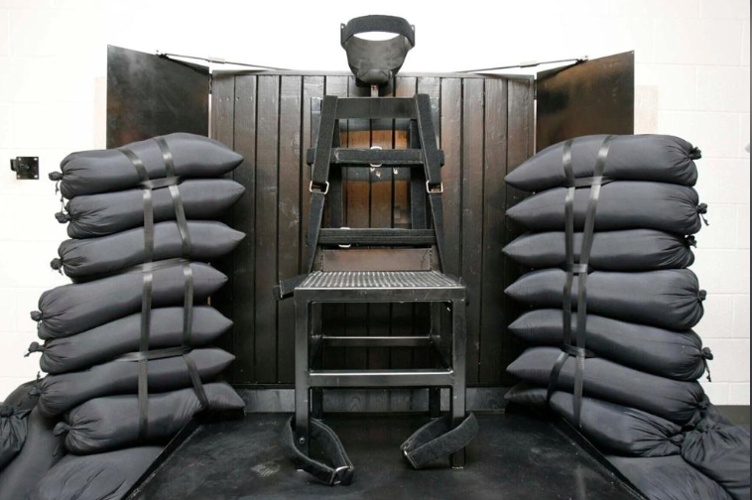
House Bill 37 makes firing squad the primary method of execution in the state, and makes Idaho the first state in the nation to do so. The change to the state execution law arrived after instances of lethal injection being unavailable and botched execution resulted in executions being called off or the expiration of death warrants. The Idaho Department of Correction currently has eight inmates held under a death sentence.

A chair sits in the execution chamber at the Utah State Prison on June 18, 2010, after Ronnie Lee Gardner was executed by firing squad in Draper, Utah. The firing squad will become Idaho's primary method of execution beginning July 1, 2026.
Though initially passing in 2025, the law was written to not go into effect until this year to allow IDOC to make the necessary renovations to its execution chamber to accommodate for the change, an endeavor costing over $1.2 million, as was previously reported by the Idaho Press.
Child social media restrictions
In an effort to curb youth social media addiction, the legislature passed House Bill 542 requiring social media platforms to remove a variety of addictive traits on child-owned accounts — such as infinite scrolling, auto-play video and push notifications — and obtain parental consent for accounts belonging to children 16 years old and under.
To determine whether an account needs to subject to these restrictions, impacted social media platforms are required to estimate the age of account holders. If finding with 80 percent confidence or higher a user is above 16 years of age, they are not be treated as a child account.
The legislation only applies to platforms that generate $1 billion in advertising revenue in a single year.
This carve-out drew pushback from Meta, the parent company of Facebook and Instagram, which contended the result would be an inconsistent application of the law, as previously reported by the Idaho Press.
Merit-based healthcare bill
Under House Bill 928, healthcare facilities in the state that receive Medicaid funding are required to eliminate any diversity, equity and inclusion (DEI) practices, including hiring based on race or sex as well as mandatory bias training or pledges supporting DEI tenets.
Sen. Ben Toews, R-Coeur d’Alene, who co-sponsored the legislation, said that the aim was to prevent hiring quota efforts that prioritize characteristics other than merit.
Medical professionals who testified on the legislation voiced concerns that the legislation would limit the ability to receive specific training on how to effectively tailor care for patients of different backgrounds, as previously reported by the Idaho Press.
Parental consent changes
House Bill 860 updated Idaho’s exiting parental consent law that passed in 2024 and requires parental consent for any medical care provided to minors with limited exceptions in instances where the child’s life was in danger or parents were unreachable and the child faced risks to health or life.
Changes in the law include making clear first aid can be administered if a child appears or represents themselves as being be sick or injured. It also clarifies children can utilize the state’s suicide hotline without receiving parent or guardian consent.
Transgender bathroom change
House Bill 752 makes it illegal for transgender individuals in Idaho to use bathrooms, changing rooms and other sex-separated public facilities that align with their gender identity. The legislation applies to government-owned buildings a well as private businesses and prohibits anyone from “knowingly and willfully” entering a public accommodation if its designation differs from their biological sex.
First offenses are considered misdemeanors and carry up to a year of jail time while second and subsequent offenses carry felony charges and up to five years of jail time.
The legislation is currently facing a legal challenge from transgender Idahoans, the American Civil Liberties Union (ACLU) and its Idaho chapter and other legal groups who contest the law’s bathroom component. A federal judge issued a partial block of the legislation in June to prevent the ban from taking effect in single-user public restrooms, as previously reported by the Idaho Press.
Pediatric transitions notification bill
Deemed the “Pediatric Secretive Transitions Parental Rights Act,” House Bill 822 requires educators as well as healthcare and child care providers to notify parents or guardians about a child’s “social transition.” Doctors, teachers and relevant care providers are required to notify a parent or guardian when they are requested by a child to “facilitate” or “participate” in their transition.
The bill defines participation to broadly include adhering to the child’s request to be referred to by pronouns or titles that don’t correspond to the child’s biological sex, to use a name other than their legal name or derivative nickname, to use public facilities designated for the opposite sex or to participate in an athletic team or other sex-separated school activity for the opposite sex.
Teachers, doctors and impacted care workers have to notify parents or guardians within 72 hours if such a request is made by a child. Entities found to be in violation of the legislation face penalties of up to $100,000.
Idaho ‘Son of Sam’ law
Senate Bill 1232 implemented a new “Son of Sam” statute, serving to update the 1978 law concerning the ability of criminals to collect profits from the coverage of their crimes. The legislation closes potential loopholes around ongoing royalties and redirects anything of value received by a criminal from the notoriety of a crime are to go to the Idaho state treasurer, who will distribute the proceeds if a victim’s claim to the funds are approved in court.
Exceptions to the legislation include wages and income unrelated to the crime, payment for legal services and news or documentary works “create mainly to inform or educate and where the offender is paid only normal interview fees.”
Sen. Tammy Nichols, R-Middleton, who introduced the bill, had said it was meant to respond recent high-profile crimes in the state that drew national attention. Though none were explicitly referenced, the 2022 killings at the University of Idaho and the 2025 ambush of Coeur d’Alene firefighters both drew national media headlines.

(0) comments
Welcome to the discussion.
Log In