







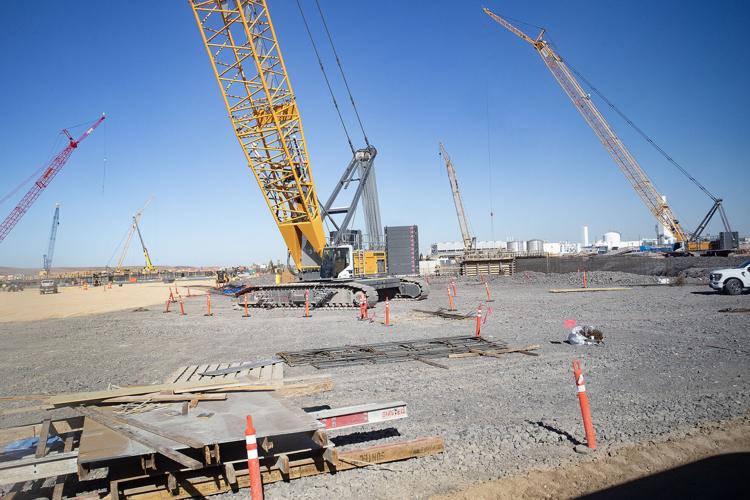







A white charter bus rumbling past more than 10 cranes starkly contrasted the brown landscape of the gargantuan construction site at the outskirts of southeast Boise.
On the bus sat Sen. Mike Crapo, U.S. Deputy Secretary of the Treasury Wally Adeyemo, Micron executives and members of the media as the microchip manufacturing company on June 10 touted its progress on the expansion of the Boise campus as a result of federal grants and tax credits.
The 2022 CHIPS and Science Act provided $6.1 billion to Micron to build manufacturing facilities in Idaho and New York. The company broke ground on the $15 billion Boise project last year.
Adeyemo said investing in manufacturing microchips in the U.S. is important because of supply chain issues as well as to ensure that “America remains a global leader in terms of technology.”
“For me, I understood the importance of chips and microchips during the pandemic,” Adeyemo said in an interview with the Idaho Press. “When we started to see that everything from cars to iPads were stuck in the assembly line because we didn’t have enough chips from this country to complete them. ... What I’m seeing here is that that investment’s working.”

Heavy equipment dots the landscape as construction continues on a new 600,000-square-foot microchip manufacturing facility at Micron Technology in Boise.
Memory microchips are used in products such as modern cars, cellphones, generative artificial intelligence and military weapons.
Idaho was once a major hub of microchip manufacturing, specifically dynamic random-access memory or DRAM chips, but Micron moved most of its manufacturing operations overseas over the years.
The memory fabrication plant, known as a fab, will be the first new fab built in the U.S. in 20 years.
“With the CHIPS grants and investment tax credits, we’re able to offset the cost deltas between the U.S. and Asia and make our fabs competitive here with Asia,” said Scott Gatzemeier, the corporate vice president of U.S. expansion.
Construction has created about 600 jobs in Boise so far, he said. Later in the process, that total is expected to jump to 4,000.
Once the facility is completed and online in 2026, it will generate an estimated 2,000 jobs at Micron, most of which will be engineering and technician positions.

Micron Operations Manager Jeff Binford, at right, looks on as Micron CEO Sanjay Mehrotra, Deputy Treasury Secretary Wally Adeyemo and Sen. Mike Crapo peer into a clean room in one of the buildings at Micron Technology in Boise on June 10.
Given that Idaho has experienced low unemployment for the past few years and labor shortages in many fields, the company is also partnering with universities and community colleges in the state to support degree, certification and workforce training programs.
The new fab will be 600,000 square feet, and there are 15 total new structures that will be built. The new facilities will connect to part of the existing campus, where research and development takes place.
Much of Micron’s manufacturing currently takes place in Japan and Taiwan, Gatzemeier said, and the company had been lobbying for the U.S. to add incentives to make it as cost-effective to manufacture domestically as it is to do so in Asia, where there are a number of government incentives and lower construction and labor costs.
Crapo voted against the 2022 act, citing added spending in it. He was not available for an interview with the Idaho Press.
“It is important to our national security that the U.S. semiconductor industry have the stability to maintain supply chains and expand production,” Crapo said in a statement to BoiseDev at the time. “That is why, as the ranking member of the Senate Finance Committee, I worked on legislation that would provide that much-needed support, including for Idaho’s semiconductor industry. Unfortunately, this critical semiconductor legislation was hijacked by Sen. (Chuck) Schumer who, at the last minute, added hundreds of pages authorizing $200 billion of increased spending unrelated to semiconductors. This fuels the inflationary fires that we are all battling and drives up our national debt, which in itself is a tremendous threat to our national security. At a time when every day brings a new record high for rates, costs and inflation, we must stop this unfettered spending that is crippling our economy and penalizing everyday Americans.”

(0) comments
Welcome to the discussion.
Log In