

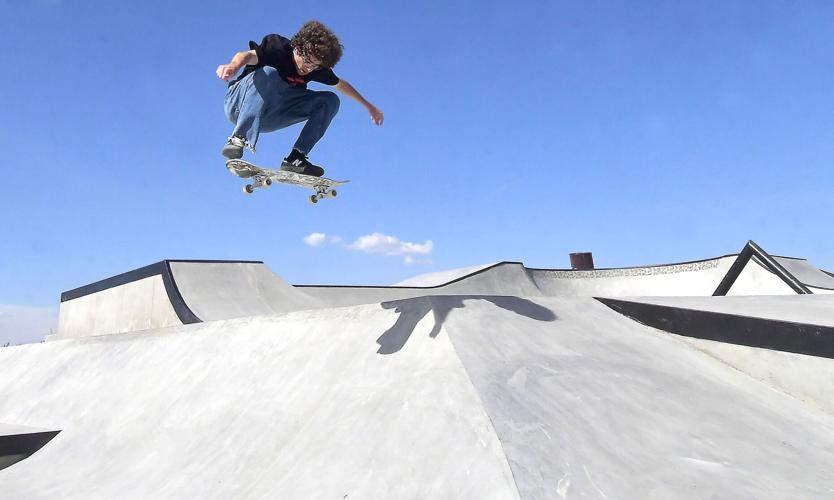
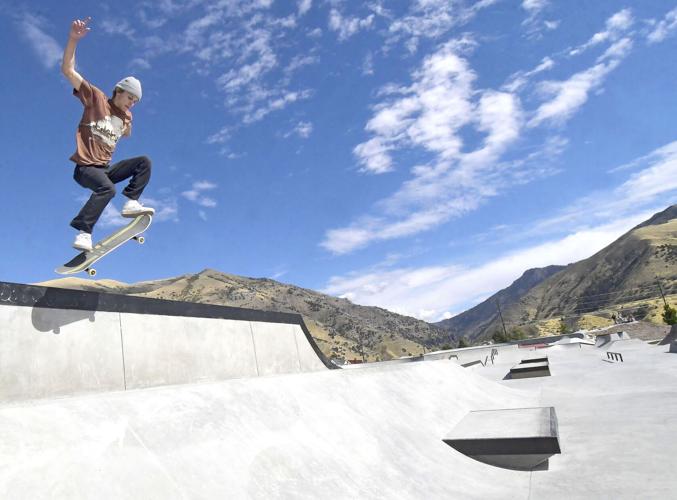
Construction on one of the Beehive State’s largest skateparks was completed last month after nearly five months of work in Hyrum, Utah.
Fashioned by Hunger Skateparks — a skatepark design and build company based in Bloomington, Indiana — the Blacksmith Fork Skatepark spans 30,000 square feet near the mouth of its namesake in northern Utah.
Though the skatepark is open to the public, Hyrum City Administrator Ron Salvesen said other parts of the park are still under construction. Bathrooms, lighting and general landscaping are still in the works, Salvesen said, and a grand opening is expected to take place next spring.
Christy Wiesenhahn, the co-owner and director of Hunger Skateparks, said the park is the largest ever built by the company. Designed with input from Zach Shepherd, owner of Directive Boardshop in Logan, and Dave Smelli, a professor of graphic design at Utah State University, Wiesenhahn said the final product keeps park users of all abilities in mind.
“The project started at half of its size,” Wiesenhahn said, explaining Hyrum city showed openness to expansion for the sake of accessibility and overall park aesthetics.
“We showed up at (the build) site and then the city was fantastic,” Wiesenhahn said. “There was just a lot of cooperation which allowed us to get more creative … and expand the design once we got there.”
According to Wiesenhahn, the park is accessible for beginners as well as advanced riders with features appealing to all styles of skateboarding.
“We covered like a ton of bases for everybody, I think. And even, like, beginners can throw the board down and just learn how to gain speed and get all around the park,” Wiesenhahn said. “I think that you’re gonna see that it’s gonna grow skateboarding in that region.”
The park’s large footprint is punctuated by creative touches implemented during the build. For instance, a cow-spotted tile band wraps around the park’s amoeba bowl and large rocks were integrated into skate-able features.
“The city found these amazing rocks in Idaho,” Wiesenhahn said. “And this was like three weeks before the skate park was supposed to be finished.”
Wiesenhahn explained the density and shape of the rocks found by the city provided an ideal riding surface for skateboarding and could also be used for seating or other features.
“At that point it was like, ‘Man, let’s get our art project on,’” Wiesenhahn said.
Wiesenhahn said some of the rocks were used to craft a picturesque spot overlooking Blacksmith Fork Canyon.
“I feel like everybody should go take their prom picture there,” Wiesenhahn said with a laugh. “It’s so beautiful.”
Salvesen said the city, too, was happy with the final product.
“We’re pleased with what we got for our money. We feel like it was a pretty good value,” Salvesen said. “There’s a lot of interest in it.”
Since its completion on Sept. 7 and a subsequent soft opening, the park has seen skateboarders from surrounding areas who’ve made the trip to skate Hyrum. While the attention is generally positive, Salvesen said the park was ultimately built for the sake of Hyrum’s citizens.
“The purpose was … first for our residents and the second for the valley,” Salvesen said.
While happy with the attention the park has garnered, Wiesenhahn said the Salvesen’s response highlights what should be a main goal of any skatepark — community.
“That is the right attitude,” Wiesenhahn said. “You do it for your community first, because you want your community to be interested in where they’re at. You know, like, for people to grow in that space to not just feel like they have to leave to find interesting things to do.”
The result, Wiesenhahn said, is the creation of a unique experience “that people from all over want to experience as well.”
“It’s cool,” Wiesenhahn said. “They did it right, you know? They did it for the right reasons.”
Speaking to the evolution of skateparks over the years, Wiesenhahn said part of the reason Hunger Skateparks was formed was to bring higher quality parks to communities.
“We were so — we still are — just supremely disappointed in those prefab skateparks that were going up everywhere. And the bad concrete skateparks.” Wiesenhahn said, explaining those parks were sometimes built with one type of skateboarder in mind. “It didn’t really grow skateboarding. … It didn’t have, like, the generational view to it.”
Growing skateboarding and helping build community is a company goal, Wiesenhahn said, and inclusive skateparks help get the job done.
“We’re in it for all of that,” Wiesenhahn said. “There’s something about skateparks that allow for it. And part of it’s because skateboarding is just so artistic and creative.”

(0) comments
Welcome to the discussion.
Log In