

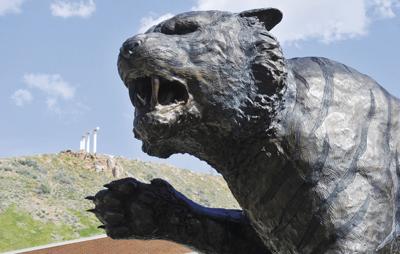

A bronze tiger statue stands at Idaho State University in Pocatello, where officials are optimistic about the future despite enrollment losses.
By Shelbie Harris, sharris@journalnet.com
POCATELLO — Idaho State University’s budget for the next fiscal year indicates the true impact of the school’s decreasing Middle Eastern student population.
Students from Saudi Arabia and Kuwait left ISU in droves prior to the start of the spring semester of 2017. The departures came on the heels of reduced scholarships from the governments in the students’ home countries as well as various controversies involving the students, including that they experienced racism in the Pocatello community.
While ISU’s spring 2017 enrollment was down 4.6 percent from the year prior, largely because of the Middle Eastern student exodus, and fall enrollment projections show an almost identical decline, university officials remain optimistic that recent expense adjustments will bear future growth opportunities for student enrollment and retention.
Despite the controversies surrounding the Middle Eastern students, ISU’s plan for the future is to rely on recruiting more international students along with Idaho high school graduates.
ISU President Arthur Vailas in January told the Idaho Joint Finance-Appropriations Committee that an exodus of hundreds of Middle Eastern students from ISU had left the school with a $12 million shortfall. But internal expense adjustments including the reorganization of part-time and adjunct positions, a decision to eliminate 37 unfilled full-time positions, and laying off one Alumni Relations administrator have reduced that shortfall by approximately $7 million, ISU officials said.
“One of the goals of this process was to make sure that we were creating a foundation that we could grow on top of,” said ISU Executive Vice President and Provost Laura Woodworth-Ney. “We didn’t want to contract growth opportunity and are essentially bringing down the overhead here.”
The State Board of Education recently approved ISU’s proposed tuition and fee increases of 5 percent for graduate students and 3 percent for undergraduates, the second lowest tuition increases at ISU in 29 years, university officials said.
In spite of the overall drop in spring enrollment at ISU, there were some bright spots. Compared to the year prior, ISU’s full-time graduate student enrollment during the spring of 2017 increased by 3.2 percent, enrollment in the Early College Program increased by 20.3 percent, and the number of U.S. students from outside of Idaho grew by 4.6 percent, ISU officials said.
But those increases didn’t come close to making up for the departure of so many Middle Eastern students. While Vailas anticipated a 35 percent drop in students from the Middle East, the declines were actually much worse. ISU reported a 60 percent decline in Kuwaiti students and a 52 percent decline in Saudi Arabian students during the spring of 2017 compared to the year prior.
ISU’s total enrollment for spring 2017 was 11,317 students, a decline of 540 students from 2016. ISU’s international student population dropped from 1,317 students in spring 2016 to 783 students in spring 2017, which included the departure of 573 Middle Eastern students.
The controversies surrounding ISU’s Middle Eastern students, which reached their peak with a March 2016 front page article in The New York Times, have apparently soured the university from accepting future students from that region, though attracting foreign students from other parts of the world is still a big part of the school’s future plans.
“What we have lost is those large numbers of Saudi and Kuwaiti cohorts and we are not accepting new students from those countries, and when they graduate it just exacerbates the enrollment problem,” Woodworth-Ney said. “Our goal is to continue to recruit international students and to continue to have the international population be somewhere around 10 to 15 percent of our total student population.”
ISU’s international student population as a whole is more diverse and growing, Woodworth-Ney said, adding that international students from Nepal increased by nearly 60 percent, or 47 students, during the spring of 2017 in comparison to the year prior.
ISU Vice President for University Advancement Kent Tingey said the biggest enrollment growth goal for ISU is recruiting more Idaho students. Woodworth-Ney said the university’s recruiters are working hard to get more in-state high school students to choose ISU.
ISU enrolled students from all 44 counties in Idaho during the spring 2017 semester. That was up from 42 counties during the year prior.
Woodworth-Ney said, “We implemented new scholarships targeting high school students who are in dual-enrollment courses who will get an additional $1,000 on top of the scholarship matrix they already qualify for. We call that the Step Ahead Program and that is internally funded by ISU.”
In addition, a new retention program is providing scholarship funding for junior and senior ISU students because some are running out of financial aid even though they are in good academic standing, Woodworth-Ney added.
Despite a June snapshot predicting a 4.7 percent enrollment drop for the fall 2017 semester at ISU, Woodworth-Ney said she is optimistic ISU will start to see an enrollment increase in the future.
“Trends for the fall semester look positive,” said ISU spokesperson Stuart Summers. “ISU is expecting significant gains in new Idaho students, which is one key area our enrollment team has been focused on this last year. It’s too early to draw definite conclusions about our fall enrollment numbers, but we feel optimistic.”
In addition to a decline in Middle Eastern students, ISU’s enrollment could be impacted by the arrival of the College of Eastern Idaho in Idaho Falls.
The new college will be offering technical programs and an associate’s degree in liberal arts when it opens this fall and expects to have over 1,000 students by the end of its first year in operation.
“We already have about 700 students in the technical education program and are expecting to add 500 to 700 students at the end of the first year,” said College of Eastern Idaho Board Trustee Park Price.
Summers said that ISU is actively working with the new college to help it get off the ground.
“We’re focused on redirecting what may be perceived challenges into opportunities that will benefit both institutions,” Summers said. “We believe that a number of the community college graduates will seamlessly transfer to ISU to complete their degrees, and we’re making plans right now to accommodate those projections.”
In order to make up for the loss of hundreds of Middle Eastern students, ISU officials have already enacted $7 million in expense reductions at the university — $2.1 million from changes within academic areas and $4.9 million in non-academic units. In order to make up for the loss of hundreds of Middle Eastern students, ISU officials have already enacted $7 million in expense reductions at the university — $2.1 million from changes within academic areas and $4.9 million in non-academic units. Factoring in some significant revenue increases in recent months, ISU will still be $1.3 million in the red for fiscal year 2018.
“Both the academic and nonacademic units really need to be praised for the hard work that they did in order to make sacrifices so that we can invest in growth moving forward,” Woodworth-Ney said. “That’s our goal, to invest in programs that will be beneficial to students and to the state of Idaho.”
ISU Interim Chief Financial Officer Brian Hickenlooper said the reserve fund will not immediately be able to replenish itself.
“This year we will probably have a decrease and will not be able to add to our reserve fund because we will need to take some of that money to address the budget problems,” he said.
The non-academic budget cuts included changes to the university’s mail delivery system, reductions in maintenance contract supplies and the elimination of lesser-used library collections.
Hickenlooper said the decision to eliminate some adjunct and part-time faculty positions actually made up less than 10 percent of the total $2.1 million in cuts from academic areas.
The impact of the cuts on adjunct and part-time positions varies among ISU’s many colleges. Some colleges shuffled the workload to full-time professors. But others such as the College of Business and the College of Pharmacy decided to retain some adjunct and part-time staff to teach industry specific courses, Woodworth-Ney said.
In addition, Hickenlooper said the decision to eliminate the 37 unfilled full-time positions afforded ISU the ability to refrain from laying off full-time professors.
“There weren’t necessarily any layoffs,” Hickenlooper said. “A layoff is where you eliminate the position and you aren’t going to replace it and you basically fire the person. That’s how I define layoffs.”
He continued, “What we did here was we had vacant positions from people who have left the institution and we said we don’t need those positions any more so we are going to restructure how we manage them. There was a total of about 37 positions that fell into that category that we did that with.”
There was, however, one person who did lose her position in a shakeup in the ISU Office of Alumni Relations.
That employee was K.C. Felt, the Office of Alumni Relations director who had worked for ISU in various capacities for the past 24 years and received an annual salary of more than $87,000.
“The university went through its restructuring process in the non-academic area, who took about two-thirds of the haircut,” Tingey said. “In my areas, which include Marketing and Communications, Alumni Relations, Development and Events, we did several things to make some reductions, which included in my case one employee.”
Considering what ISU was up against in terms of balancing its budget, Woodworth-Ney said it’s a huge accomplishment the school was able to avoid large-scale program closures and massive layoffs.
“I think in that sense, everybody is happy about the process,” Woodworth-Ney said. “The level of anxiety on campus has been reduced significantly…. As a whole, I think everyone is comfortable with where we landed.”

(0) comments
Welcome to the discussion.
Log In