

We were walking around Hulls Pond in early January looking for any birds out braving the winter morning. Male red-winged blackbirds had already returned to the pond and were singing. The pond was solid ice, and the cattails looked like they were in a diorama in a museum — frozen in time.
Red-wings are one of the first signs of spring. Males return to their breeding habitats early — well ahead of the females — to claim space for the upcoming breeding season. The competition for territories and females is keen. More on that in a minute.
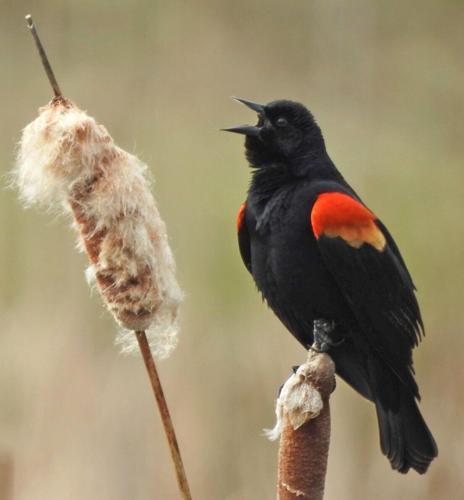
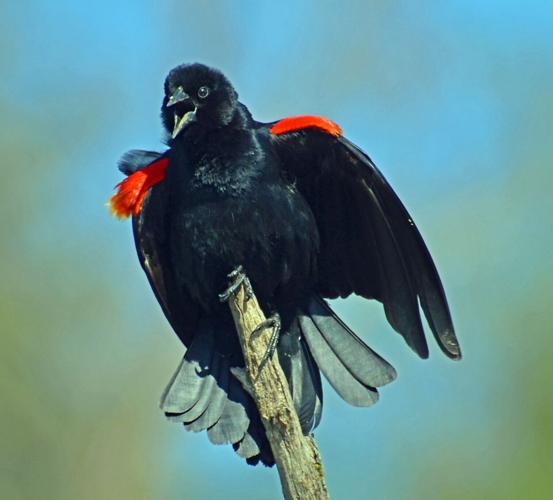
The French name for the red-winged blackbird is troupiale commandeur. This translates to “troop commander.” You can see the military connotations in the bird’s black plumage and bright red epaulettes. “Troupiale” also means oriole. Red-wings are in the Icteridae, along with New World orioles.
The scientific name — Agelaius phoeniceus — is half familiar and half not. Agelaius comes from the Greek word “agelaios” which means “flocking.” These birds are rarely seen alone. Phoeniceus comes from the ancient words phoenix and phoinikeos, signifying the color red. So, here we have “flocking red” with a hint of rising from the ashes.

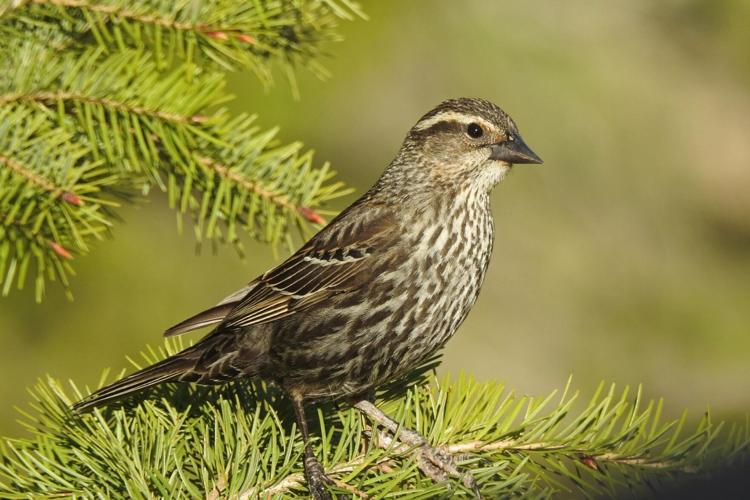
Female red-winged blackbirds look very different from the males, with varied markings on a brown body. They look something like a giant sparrow.
Females look very different, with heavy and varied markings on a brown body. They look more like a giant sparrow. But their larger size and long, sharp bill distinguish them from the sparrow bunch.
The red-winged blackbird is one of the most abundant birds in North America. It’s the most frequently reported species on the 4200+ Breeding Bird Surveys across the continent. This includes every place from southwestern deserts to western mountains to eastern forests to northern plains.

Give a red-winged blackbird a wet spot with a few cattails or willows, and they will call it home.
This is not too surprising if you know this bird. All they need is a wet spot with a few cattails or willows, and they will not only call it home, but will arrive early in the year to defend it. They are as much at home in large marshes as they are on the edge of a small pond in an urban park.
Red-wings are resident over most of the U.S., including Idaho. But that doesn’t mean they stay in the same place all year. They obviously move out of marshes around southwestern Idaho to spend the winter months foraging around feed lots, ranches, farming operations, and other places with more abundant food.
They become much more social during the non-breeding season when they aren’t competing for mates and breeding opportunities. Winter flocks in the southeastern U.S. may have over a million individuals, typically with European starlings and other blackbird species mixed in.
So, why the rush to get a territory in the spring? Because this is one of the most highly polygynous among all species of birds. As many as 15 females have been observed nesting on the territory of a single male. Males with the best territories and who are themselves the best — best song, best plumage, best behavior — win. They get to mate with all those females and pass their genes into the future. Lesser males must learn to be better, or they are mostly out of the picture.
But not totally. DNA analyses have shown territory owners are not always responsible for all the nestlings on their territories. Females often copulate with other males, and vice versa. Still, the competition is fierce. It’s little wonder a cattail marsh in spring is a riot of blackbird action.

Male red-winged blackbirds frequently fly after females, with their red epaulets erected, giving a variety of vocalizations.
Red-wings don’t fight much, but they do a lot of chasing. Males frequently fly after females, with their red epaulets erected, giving a variety of vocalizations. The chase may start with the male and one of the females on his territory. But other males often join the chase. It may end with a male clutching the female and even tumbling down into the vegetation.
Males defend their territories with song, displays and aggressive responses to trespassers. This is typical territorial behavior exhibited by countless bird species. Also, as found in other species, males show reduced aggression toward neighbors. They get to know each other and then save a lot of energy over the breeding season by not fighting as much over space. One theory about why birds sing so much early in the morning, often well before sunrise, is to tell their neighbors, “I’m still here. No trespassing.”
The average territory size of this blackbird is about a half-acre. But they can be as small as 1/20th of an acre and as large as over 7 acres. Territories in marshes tend to be much smaller than those in upland habitats. Marshes are richer in various sorts of food than upland habitats, so that explains some of this variation.
You may wonder, does a male with 15 females help feed young in 15 nests? And, do they go grocery shopping together? According to Birds of the World, the percentage of males feeding nestlings varies enormously among populations — from 6% to 88%. No doubt, many factors influence this percentage in different locations and situations.
Both males and females vigorously defend the nest area. Anybody who has walked around an urban pond or biked along the Greenbelt in May is familiar with blackbirds hovering overhead and even diving at you when you get too close.
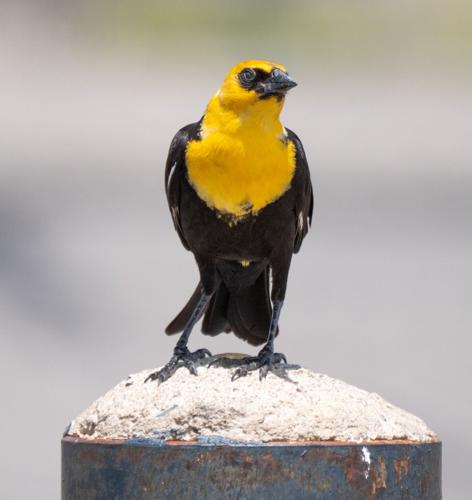
But curiously, they can’t always defend their space from other species. Males are displaced by both tricolored blackbirds and yellow-headed blackbirds. Yellow-headeds prefer larger marshes with more open water. There are many places in Idaho where both species occur. One good spot is the marsh on the east side of Deer Flat National Wildlife Refuge. A little farther, Camas Prairie Centennial Marsh Wildlife Management Area has many more yellow-headeds and is awesome for marsh birds in general.
From the poem “Red-Winged Blackbird,” by John Grey:
Their scarlet epaulets give them rank
and they mean to make the most of it.
Wings tilted back, head forward
like a sergeant barking orders,
they vilify intruders
from the safety of their high branch perch.
Despite their satin beauty,
those are threats.
And for all their clerical black,
no doubt, in that hectoring trill,
there’s an avian cuss or two.



(0) comments
Welcome to the discussion.
Log In