

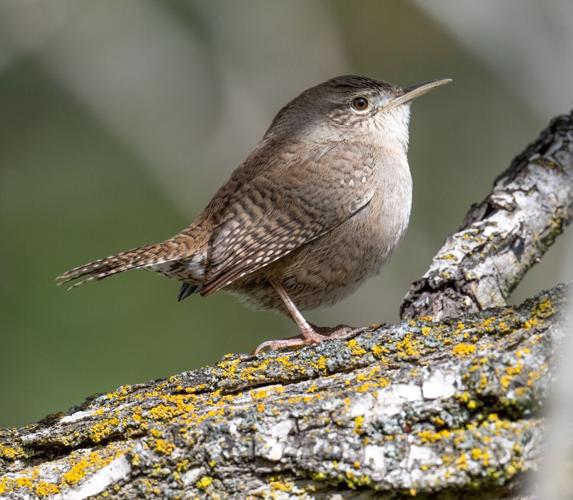

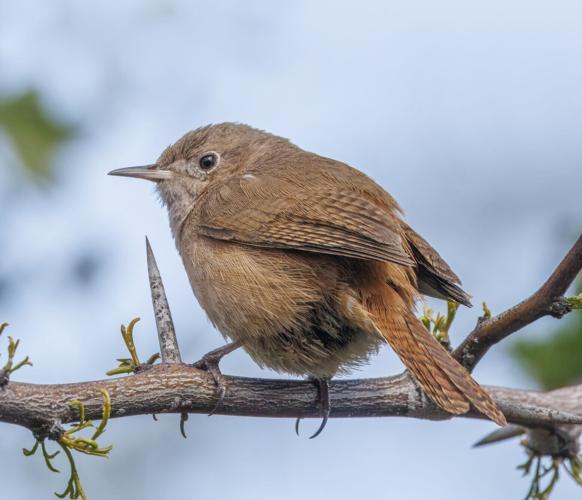

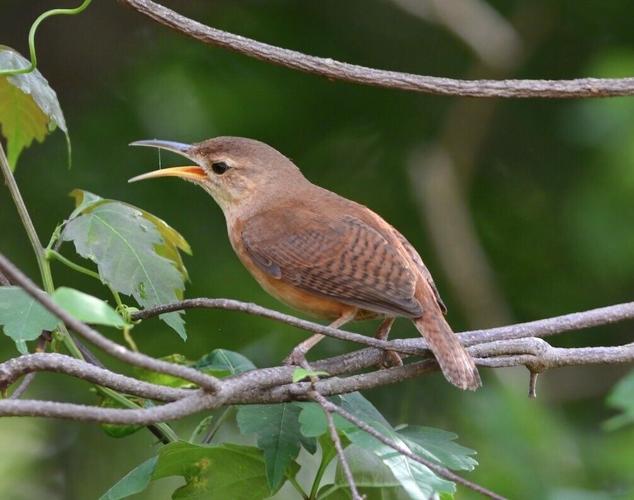

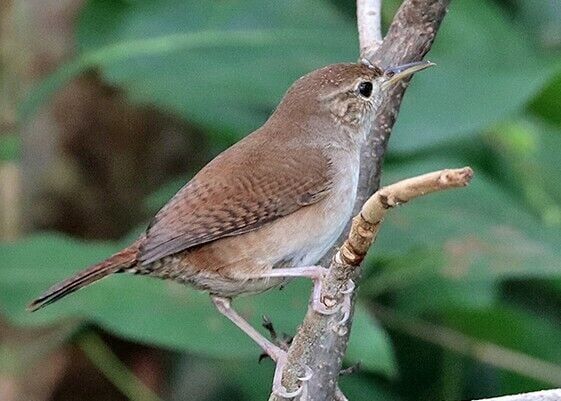

Some birds get shortchanged with the names we assign to them. The house wren and house sparrow are on top of the list. We love our houses, but we don’t want to be identified with just a house. Car ads routinely show families in their SUVs barreling across deserts, splashing through streams and ricocheting down mountain roads. That’s where we see ourselves. Hanging around the house is the ultimate in boring.
The original “house wren” — now split into seven species — may feel especially aggrieved. Its range includes all of South America, except for parts of the Amazon Basin, all of the U.S., and a good part of southern Canada. It’s hard to find another landbird with a similar massive range.
Some other species with huge ranges includes terns, albatrosses and various shorebirds. They do fly over awesome distances, but they don’t occur across all that land/water in between. The house wren, on the other hand, can be found in most of those spots within its range. Given the enormous variety of habitats from Tierra del Fuego to Fort St. John, British Colombia, its adaptability is simply spectacular.
Taxonomists have been futzing with the house wren for a long time. It was originally described as a single species (Troglodytes aedon) in 1809. Since then, various authorities have defined over 30 different species and subspecies.
In 2024, the American Ornithological Society split the house wren into two widespread species — northern house wren and southern house wren — and five species endemic to the Caribbean: Cozumel, Kalinago, St. Lucia, St. Vincent and Grenada wrens. I would say “finally split,” but little is “final” in the world of taxonomy. Let’s just say it’s what we have for now. Further research into DNA and behavior can always change things yet again.
Birders have a variety of terms we use within our particular niche in the world. One acronym that is definitely “inside baseball” is FOY. This simply means “first of year” and applies to the first individual bird of a species seen in the year by a particular person. FOY can apply to any species. My FOY for 2026 was a house finch on one of our feeders — big surprise.
But FOY is especially applicable for returning migrants. Although I’ve seen countless northern house wrens over my lifetime, my 2026 FOY was at Eagle Island State Park on April 16. In fact, there were three, including a pair. It was fun to hear them, seem them, get a photo or two, and, more importantly, welcome them back to Idaho for the nesting season. With ongoing habitat loss, climate change and other huge problems for birds, you really don’t know if the birds who left in the fall will return in the spring. Sigh of relief.
In looking through all these wrens at Birds of the World, I was not surprised to see they look pretty similar. If you took any one of the species and plunked it down in Hulls Gulch, I doubt anyone would think, “wow, that’s not a northern house wren.”
Except for the Grenada wren. This species has a larger and more decurved bill than the others and is darker. It brought to mind the Middle American leaftosser, if that helps.
Northern house wrens have a distinctive song. No other species in this part of the world has a similar, high-speed sequence of trills. Although some of their calls are like those of Bewick’s wren, I would call their song “unmistakable.” This is clearer than “distinctive,” which allows that the song might be confused with another species or two.
With all those “new” house wrens, I was eager to visit Xeno-canto to see how different the songs are. Xeno-canto has not yet updated its species list. But it does allow you to find songs by subspecies, some of which are still technically just subspecies.
I started with the southern house wren, occupant of much of South America. There are a bunch of recordings from Argentina, one of several places where I’ve found them. Those songs were mostly similar to our northern house wren, although there are notes I’ve never heard from our birds. The same was true for birds in Brazil, Peru and Colombia.
There is enough variation in the southern house wren for evolution to work on, particularly if the females start to prefer some of the longer, sweeter notes. Sexual selection is a powerful force, and I can imagine how those songs might morph over time into something different from what they are now.
How about the five species that occur on Caribbean islands? Islands are classic places for evolution to take off because the gene flow from surrounding areas is zero or close to it. Thus, species can take their own course and spin off into new species. For a classic introduction to these ideas, see “The Theory of Island Biogeography” by MacArthur and Wilson (1967).
The Cozumel wren is very different. Although it has bits that sound like a northern house wren, it has long notes and different timing. Songs of the other island endemics have familiar trills and notes mixed in with those you don’t hear from the northern house wren. If I were in the woods and heard any of these songs, I might figure out what was singing after hearing it for a while.
So, as it turns out, the house wren is not just a little brown bird associated with houses. It’s a complex web of species who have figured out how to live almost everywhere in the Western Hemisphere. There are another 11 species in its genus — Troglodytes — occupying yet more places and habitats. The northern house wren isn’t in the Far North yet, but with global warming, I’ll bet it’s on its way.
Because northern house wrens take readily to nest boxes, you might attract one to your yard. They like dense shrub cover, so be sure to place the box near a nice patch where they can hide and sing.
But you may not even need a nest box. A.C. Bent (1948) writes of the western house wren: “ … any nooks or crannies on or in buildings are used, or any tin can, box, pail, crate, empty stove pipe, or old hat or coat left hanging in a shed will do.” Now that’s agreeable. No wonder they have succeeded.



(0) comments
Welcome to the discussion.
Log In