



This is the last in my series on the owls of Idaho because we have run out of owls. I continue to rank species on the basis of how often I’ve seen them rather than on some other list somewhere.
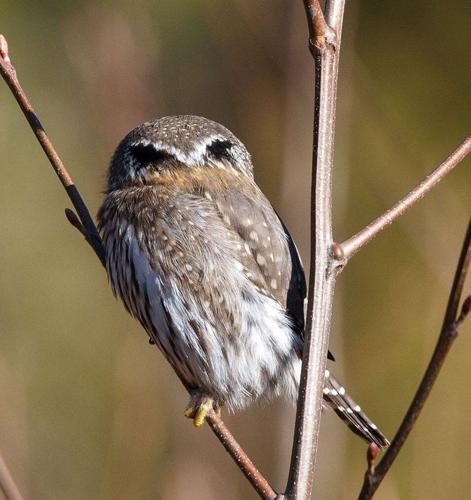
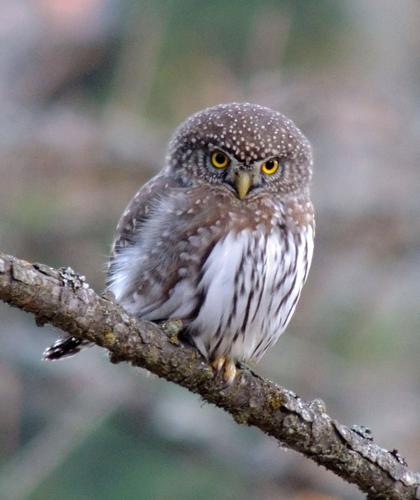
I’m going with the northern pygmy-owl next. I’ve seen exactly one of these birds in Idaho since we moved to Boise in 1992. That was a singing bird in the top of a snag near the Buttercup parking lot at Bogus Basin, if you know where that is. As this species is largely diurnal, I continue to watch for them in the tops of trees — like I watch for black-chinned hummingbirds and Townsend’s solitaires — despite essentially never seeing the owls.
But there are many other species of pygmy-owls, and I’m sort of mixing in the frequency of seeing some kind of pygmy-owl somewhere over the years. They aren’t that hard to find if you consider the whole group. According to Birds of the World, there are 17 species of pygmy-owls, all in the New World. I’ve seen several of them in Mexico, Central America, and South America, but I won’t bore you with my personal travelogue of pygmy-owls.
Except for one anecdote. Some years ago, we were birding in Oaxaca — one of the most amazing states in Mexico, due not only to its birds but also its food and culture. Well, you can say that about every state in Mexico! On this morning, we were looking for the red-breasted chat. One great way to coax skulky birds out of hiding, especially in Mexico and Central America, is to imitate the local pygmy-owl. This often causes various small birds to fly in to mob (harass) the owl. Fortunately, the tooting of these owls is one of relatively few bird songs that is easy for a human to imitate.
We were in the chat’s habitat, and one of us began giving a pygmy-owl call. We got an immediate response, but it wasn’t from the chat or other small birds that we were hoping to see. Rather, it was from a bunch of pygmy-owls. Five or six owls responded by flying in or calling nearby. It had the opposite effect than we had hoped for on the rest of the bird community! No other species were seen or heard for a long time. Too many owls! Live and learn.
Pygmy-owls eat a lot of birds, as well as small mammals. When prey is abundant, they will cache prey, like the northern saw-whet owl, but also impale them on thorns as do various species of shrikes.
They are famous for the big spots on the back of their heads that look like eyes. This may be a mechanism to keep larger predators, such as great horned owls, from attacking them because it looks as though the pygmy-owl is watching them.
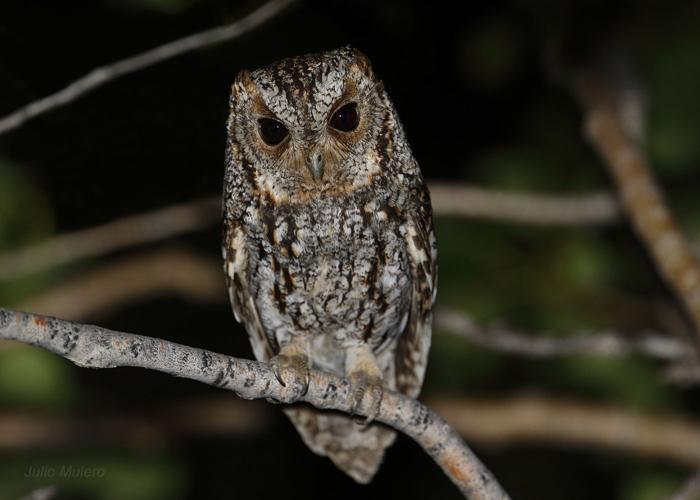
The flammulated owl is another small owl that is hard to find. Although I have heard a number of them while camping and backpacking in the western mountains, I have only seen one. I was hiking on the top of Sand Butte, near Craters of the Moon. I came around a small patch of tall shrubs, and there, about six feet away and at eye level, was a small owl with jet black eyes. I’m sure he/she was as surprised as I was, but the bird just sat there as I quickly moved on. It was mid-day, and I’m sure that little flam was not eager to go out into the open.
Birds of the World describes this owl as, “… the most common raptor of the montane pine forests of the western United States and Mexico.” Once again, the biological commonness of an owl does not translate into how often you will see it.
Flammulated owls are apparently completely migratory, unlike many species of owls, and spend the winter in the mountains of western Mexico. They are highly insectivorous, somewhat like burrowing owls, and focus on moths, crickets, and beetles. This is probably why they migrate out of the U.S. in winter. It’s curious that other small owls eat plenty of small mammals. But apparently not this one.
Flams have an unusually large trachea for their body size. This leads to vocalizations that are at a lower pitch than expected, making it sound more like a large owl. This presumably keeps great horned owls away, much as the eyes on the back of the head of pygmy-owls possibly do. Because flammulated owls are nocturnal, fake eyes on the back of the head would have little effect on hungry great horneds. Listen to this and other owls at All About Birds.
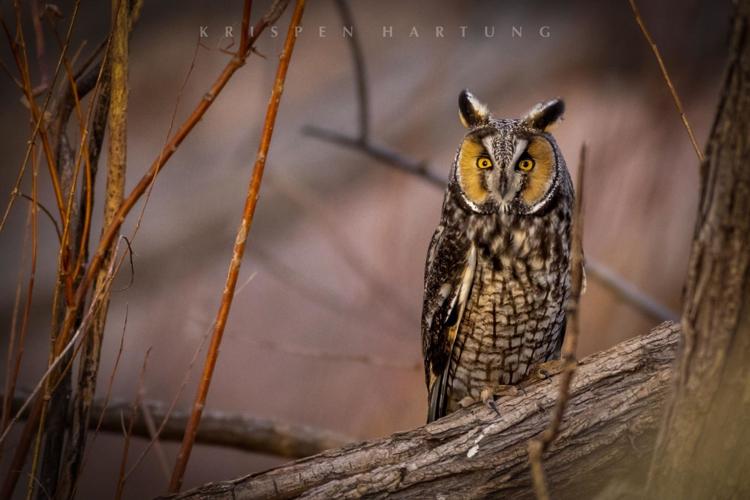
Next up is the gorgeous long-eared owl. I recently saw a photo on the Idaho Birding Facebook page of a long-eared owl that had flown onto someone’s porch near Idaho Falls. I have never been nearly so lucky. I recall a few long-eared owls in Great Basin riparian zones over the years. Like so many owls, these birds are also not eager to be seen. Their long, thin posture, along with the long “ears” allow them to blend in perfectly in a willow thicket along a stream.
Long-eared owls are found around the world in temperate habitats. The northern-most birds migrate south in winter, but a large proportion of the population is resident. Despite their love of dense vegetation for nesting and roosting, they hunt mostly in open habitats. Their relatively long wings and light wing-loading help them take a variety of small mammals by actively searching the vegetation below them. Although I’ve not seen them hunt, I envision a nocturnal northern harrier. Good luck to all marsh and meadow mice. No rest for you!
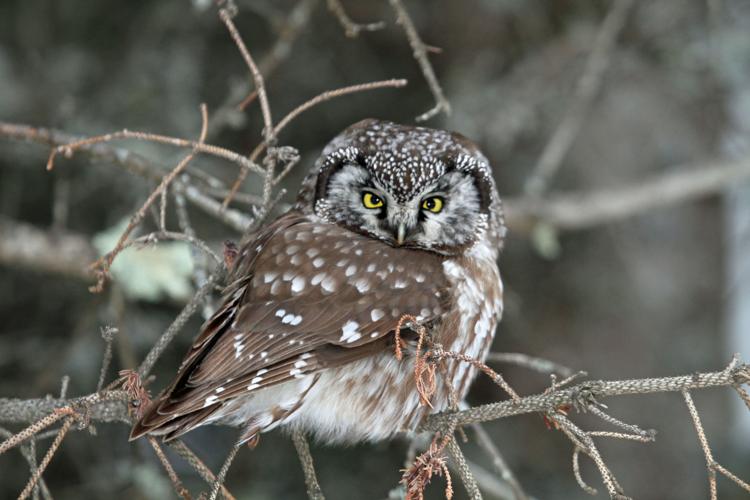
The last owl on my list is a species I’ve never seen, despite two serious attempts to see “known birds.” I didn’t even hear them. That’s the boreal owl. Partners in Flight estimates that there are a half million of these owls in the U.S. and Canada. But as far as I can tell, this species doesn’t even exist. In Eurasia, this bird is known as Tengmalm’s Owl. Peter Gustaf Tengmalm was a Swedish physician and naturalist — a frequent combination of skills and interests in the Old Days.
I’ve pointed out in several previous columns that among raptors, the female is typically heavier than the male. The boreal owl sets the record for American owls, with the females up to twice as heavy as the males. There are several theories as to why this might be, but I’ve never been convinced that the same arguments couldn’t be applied to warblers, sparrows, flycatchers, or any other group where males and females weigh about the same. I’m probably out of date on the sexual dimorphism theories. Drop me a line.
Boreal owls also cache excess prey and are known for defending those caches from other birds. A particular problem for them are Canada jays, my favorite camp robber. Owls may move their stash to a new site under pressure from jays or just quickly eat what they can and give up the rest. As with most raptors, when mobbed by passerines such as chickadees, they just sit with their eyes closed and put up with it. Little birds are so annoying.
A quick aside on small birds mobbing raptors. I once watched some European starlings harass a sharp-shinned hawk. The starlings and the hawk were perched on a telephone wire. Different starlings would sidle up near the sharpy and squawk at it. After a few minutes of this, the hawk suddenly reached sideways and grabbed a starling. It commenced to pluck and eat the bird. Thanks for playing.
Back to owls. Like a few other owl species, the boreal owl is found across the boreal forest of both the Old and New Worlds. But unlike other species, it is resident in those forests. Even the northern-most birds apparently do not move south in winter. They also use nest boxes. So, if you live in the forest you really can’t miss by putting up one or more boxes. If you don’t get a boreal, you might get a saw-whet! And maybe worst case — northern flying squirrels. Sure, they’re just tree rats, but they are awfully cute.
In the end, owls are endlessly fascinating. They’re mostly out at night in a world that we avoid, dislike, or even fear. We don’t know too much about them. They are beautiful and the young are super cute. Photographers love them. They fly with silent wings and call in ways that make us wonder what is really out there. Human cultures have attributed to them a huge variety of supernatural powers and meanings. I can’t think of another group of birds that has so many expectations heaped upon them. Of course, owls care nothing for human ideas. They are just trying to live their lives.



(0) comments
Welcome to the discussion.
Log In