

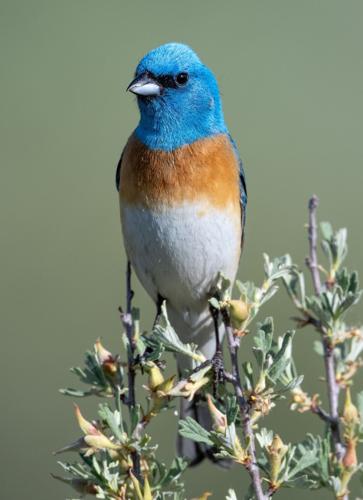
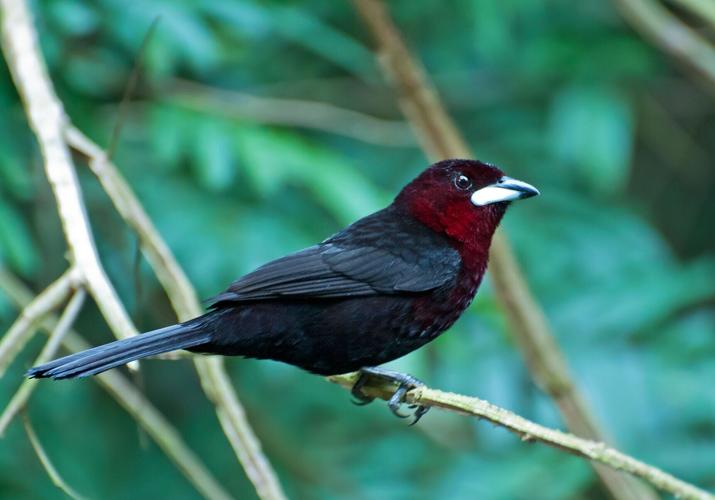
I recently got one of my best photos ever of a male lazuli bunting at close range. When I uploaded the images to my PC, I was struck by how the lower part of the beak was almost like a reflector. It brought to mind the uber-reflective beaks of silver-beaked tanagers and several of its relatives in the tropical genus Ramphocelus.
Those of us in Idaho are used to seeing dozens of lazuli buntings during spring migration and during the nesting season. They have a wide elevational range in spring and summer, being found from the Snake River to the top of Bogus Basin. But I never noticed the bill before.
But the thing is, we are not lazuli buntings. We don’t know their language. We can identify them and enjoy their attributes, but we really don’t know what’s going on among them. Is that bill important?
After seeing this bird up close, I contacted the lead author on the species at Birds of the World (birdsoftheworld.org/bow). That is Erick Greene, who spent his career at the University of Montana, and who recently retired to his roots in Nova Scotia. I’m sure Erick saw countless lazulis around Missoula, although his homeland has only a single eBird record for the species over all time.
Erick recalled that some work was done in the distant past on lazuli beaks to investigate possible ultraviolet reflectance. I failed to find any publications on the topic, but many research projects do not end in publications. I have boxes of data in our shed and files on my computer to prove that point. The thing is, the data are still useful. You just have to do the literature review, write the story, get peer reviews, select a journal … Ugh.
But that’s not fatal to my point. Many bird species have reflective or iridescent bits, or use their “everyday” colors in unexpected ways. Hummingbirds are obvious, and if you’ve ever caught a black-billed magpie in the right light, they are stunning in their green and blue sheen. Many other species are just covered in color. Mountain bluebirds, western tanagers, northern yellow warblers and white-faced ibis are a few starting points.
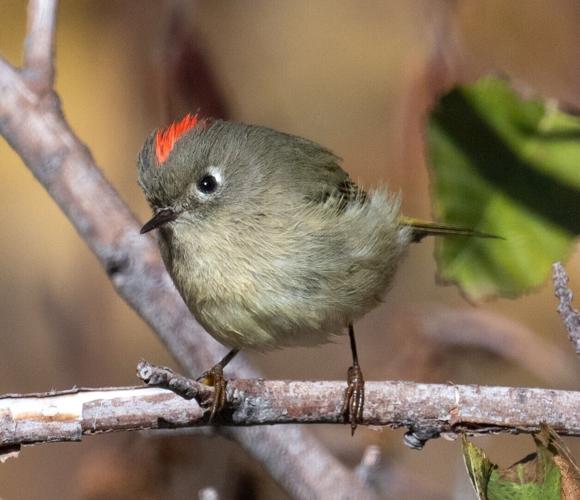
But what I find particularly interesting are those species that have just a touch of color. Consider the ruby-crowned kinglet. Most of the time you can’t see that ruby crown. But when the males need it — in encounters with potential mates or with other males — that red bit becomes obvious and important. Big color on a small bird.
Both western and eastern kingbirds have red/orange/yellow crown patches that are used during interactions much as kinglets do. I have rarely seen the crown of either one over all these decades. But as with my lazuli bunting close-up, we would see a lot more if we could get really close to birds. That’s one reason many of us use good binoculars and high-power cameras. When you get that great look, it changes things. Birding becomes ever more interesting.
The orange “crown” on the orange-crowned warbler is possibly the most inconspicuous crown among all these species. The bird is drab and almost completely unmarked. Adding a little orange patch you can’t see seems in line with its overall philosophy. But, as with the species mentioned so far, that crown can be flared when trying to attract a mate or when interacting with other males. I have never seen this. It’s on my “watch” list.
Other bits of color can be found in other parts of other species. Consider the bright red wing tips on cedar and Bohemian waxwings. The number and size of the red tips increase as the bird gets older. Younger birds typically have from zero to five tips, while more mature adults have nine or more. Waxwings use these tips to assess potential mates. Birds with a high number of red tips tend to pair up with other more experienced waxwings. This assortive mating has real consequences as older pairs tend to nest earlier and have larger clutches.
Similar to the control of crown patches in kinglets and kingbirds, red-winged blackbirds can regulate the amount of red that shows in their epaulets. The red can be completely covered or flared out and elevated to provide for a spectacular aerial display. Again, the variation depends on social interactions of various sorts.
Hummingbirds use their gorgets in a similar way. The red feathers on calliope hummers and the brilliant raspberry-gold on Anna’s, for example, can be flared out to greatly expand their visual impact. Because gorgets are the result of structural colors, not pigments, the angle of viewing is critical. We assume the birds are highly conscious of this fact when displaying for a prospective mate or when trying to fend off a rival male. The birds do not seem especially concerned that we birders most often see only black.
One of the hardest hummer colors to see is the violet in black-chinned hummingbird gorgets. It seems that no matter the angle, these common birds just look like they have black chins. But if you watch a male display in front of a female, flying back and forth with the gorget raised (the Shuttle Display), you can see the gorgeous deep violet of the throat. Getting a photo is another matter.
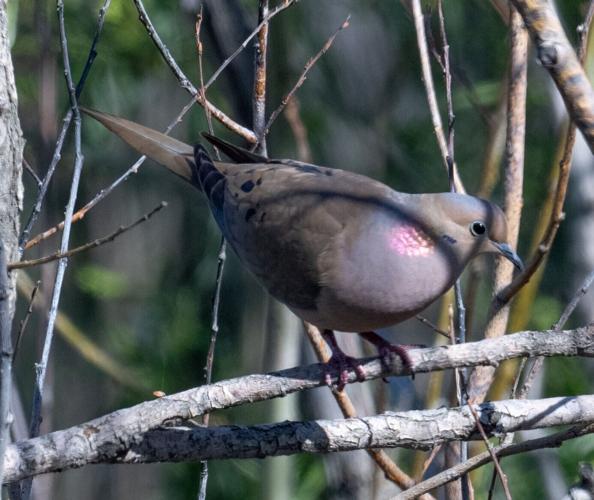
I was recently surprised to see an iridescent patch on two mourning doves, a species that I’ve probably seen at least a million times. Well, according to eBird I’ve reported exactly 9,092 mourning doves since 1968. But it seems like a million.
The birds were perched below me with the sun coming in over my shoulder. This was an unusual lighting situation for me and probably explained my surprise at the shiny rainbow-colored patches on the sides of their lower necks. Males typically display a pink or purplish iridescence, while females tend to show olive-green. As with the other species covered so far, these feathers can be shown off during mating. This personal mini-discovery demonstrates once again how much there is to learn about birds, even the most common ones.
Finally, realize that many species can see ultraviolet (UV) light. We humans have only three types of color-receptive cones in our retinas, while birds have four. The fourth type is dedicated to UV. This allows them to perceive countless signals in the world from birds, plants and other things that are invisible to us.
So much is going on in the world that we are clueless about. It’s good for humans to realize once in a while that we don’t know everything. Keep watching and keep wondering what we are missing.



(0) comments
Welcome to the discussion.
Log In