



I have only ever known Kay Wilson as one thing: my grandfather. As a child, I had no comprehension that this towering figure who was always good for a hug or a chocolate donut was a well-rounded person who had lived a life full of love, loss and miracles. Instead, he was simply my grandpa. As I aged, I began to see glimmers of this good man’s life. Instead of seeing my grandfather, I began to see a young man asking the pretty girl to marry him. I began to see the man working hard every day to come home to his wife and two children. I began to see the middle-aged man tipping the nice waiter a little extra because he understood how hard life can be. In short, I began to value his heart, not just because he was my grandfather, but because he is a man of service.
Born on New Year’s Eve in 1934, my grandfather entered a country just exiting the Great Depression and a world on the brink of war. He grew up in a time of neighbors helping neighbors get by. A time where extended families stuck together to make ends meet and raise children. A time where technology was something for a science fiction book, not something for posting and tweeting. My grandfather’s natural joyfulness combined with the sassy hand of his mother and the hard-working hand of his father created a man of faith and service regardless of time or place.
As a man of service, my grandfather joined the National Guard in 1952 as the Korean War raged. As most in this community know, young men of The Church of Jesus Christ of Latter-day Saints typically serve two-year missions from age 18 to age 20. But back in those days because of the wartime need for men of the same age group, the Church sent a select few to serve. In 1955, my grandfather was called into his bishop’s office and asked to serve a mission. Aside from the cost and the fact he would be gone for two years, my grandfather had to consider another element few potential missionaries do: his fiancé! With the approval of his leading lady, Joyce Birk, my grandfather switched from one form of service to another and happily accepted the call. After two long years of waiting (and serving), they were married on Nov. 14, 1957.
My grandfather remained on active/inactive duty until 1965. He served multiple times as an unpaid religious leader, overseeing hundreds of people and loving each of them individually. He served neighbors, friends, and family. He handed out money just as generously as he handed out jokes. He became a father to two incredible children. He worked tirelessly as a State Farm Insurance agent, and this in a time when agents traveled to see clients and help them after car wrecks. And through it all, he never stopped holding my grandmother’s hand or delivering a dozen red roses to her every Nov. 14.
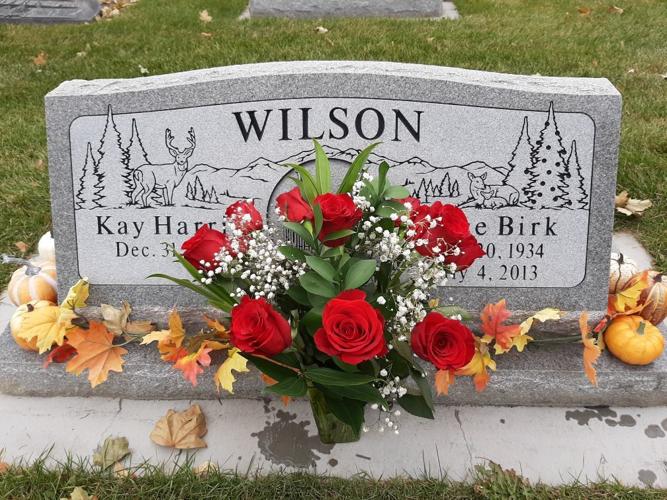
As children moved out, grandchildren were born and retirement came, my grandfather continued to love and serve anyone he came across. Then, he took on a new service role as his wife descended rapidly into the unkind darkness of dementia. Although she passed on July 4, 2013, he continues to bring her a dozen red roses every Nov. 14 — but instead of sitting proudly on the kitchen table, they instead sit humbly on a cold headstone.
This year, due to the COVID pandemic, my grandfather could not arrive at the American Fork, Utah, cemetery, roses in hand, on Nov. 14 to render his yearly service to his beloved. My mother felt deeply for her father on this day and expressed her concern while chatting casually with a childhood friend, Judy Johnson. Just a few short hours later, Judy texted my mother a picture of my grandmother’s grave. There sat a dozen red roses. Judy’s simple text message? “Tell your dad happy anniversary.”
COVID has taken our peace. It has taken our education, our jobs and our religious gatherings. It has taken our family parties, our graduations, and even our funerals. But the one thing COVID can’t take is kindness. COVID can’t stop a donation, COVID can’t stop prayers, and COVID can’t stop helping hands. COVID truly has taken so much, but on Nov. 14 — thanks to a grandfather’s service of nearly 86 years and a family friend willing to do the impossible — I learned that COVID simply can’t take love.
Jessica Sargent was born and raised in Pocatello. She is a former collegiate track athlete (2012-2016), a two time Idaho State University graduate (BA, MA) and is currently a full-time instructor at the College of Eastern Idaho in Idaho Falls.

(0) comments
Welcome to the discussion.
Log In