

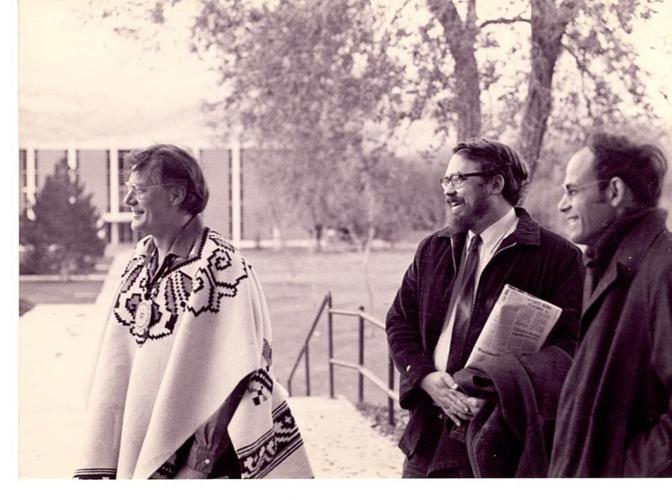

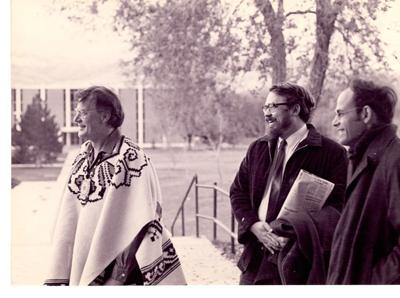
My first teaching job was at Idaho State University and I was lucky to be teaching there when Robert Bly came to read his poetry. The poet Duane Ackerson was in the Creative Writing Department and welcomed Robert Bly who had published the successful collection “Silence in the Snowy Fields” (1962). Bly questioned the work of famous poets like T.S. Eliot and Ezra Pound for their “intellectual” approach to poetry. He preferred an “inward” reflection by writers and admired poets like Pablo Neruda and Rainer Maria Rilke. In 1968, Robert Bly received a National Book Award for his book of poems, “The Light Around the Body.” He was also a vehement critic of the Vietnam War and donated money to the Draft Resistance Movement. He had a running feud with fellow writer James Dickey who wrote the disturbing novel, “Deliverance.”
Robert Bly’s reading at Idaho State University was a success. Bly’s poetry is simple, yet evocative with clear imagery. Wearing a serape over jeans, Bly proved to be an entertaining dynamic reader of his work, despite a slight w-r substitution in his speech. (“We are dwiving on ice slick woads…Minnesota.”) He connected with a delighted audience of students and faculty through his warmth and theatricality. During a meet-and-greet party with the English Department, I asked Robert Bly what he thought of John Keats. Waiting for a profound comment by a modern poet on the famous author of “Ode to a Nightingale,” Bly paused and answered with a knock-knock joke:
“Knock, Knock.”
“Who’s there?
“Keats.”
“Keats who?”
“Keats me, you fool.”
Despite this unexpected response to my dumb question, we got along fine and kept in touch over the years. Bly sent me many of his autographed books of poetry and prose, sometimes with drawings and comic remarks.
Though a celebrated poet, Robert Bly is best remembered today for his 1990 best seller, “Iron John: A Book About Men,” which inspired the mythopoetic men’s movement. Robert Bly believed that American boys too often lacked father figures and mentors. The fairy tale of “Iron John” held lessons that could provide positive images of masculinity. Workshops for men were conducted outdoors and included Native American rituals. Bly met with criticism from feminists for excluding women, though he insisted he did not blame feminism for American men either losing their identity as men or developing a toxic masculinity. Critic Charles Upton considered Bly’s approach “self-defeating in its efforts to redefine masculinity by a regressive return to the primitive ‘wild’ self.”
Perhaps because I was raised by a single father, I admired but did not connect with “Iron John” as much as others did. The book remains popular to this day, however, and workshops and retreats now include women.
Around 2010, I noticed a drop in Robert Bly’s communication. In 2012, his daughter Mary told Minnesota Public Radio that Bly had Alzheimer’s disease. Bly died at his home in Minneapolis on Nov. 21, 2021, at the age of 94.
I believe much of Robert Bly’s work will stand the brutal test of time. I also am aware that after this Martin Luther King Jr. holiday, the Voting Rights Act was blocked. Perhaps we need new visionary activist poets to visit our universities and inspire our youth to take basic freedoms seriously.
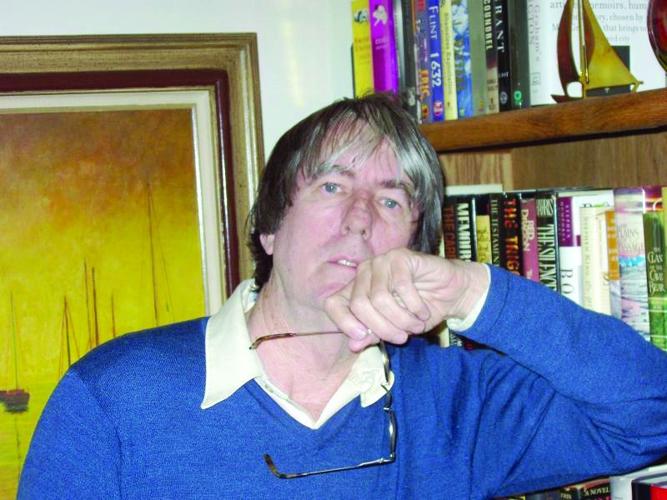
Michael Corrigan graduated from San Francisco State with a Master of Arts degree in English and creative writing. He was active in theater and attended the American Film Institute. He retired from Idaho State University as an instructor of English and speech communications. He has written several books, including “Confessions of a Shanty Irishman,” “Mulligan” and “These Precious Hours.” NPR broadcast his play for two readers: “Letters from Rebecca.”

(0) comments
Welcome to the discussion.
Log In