

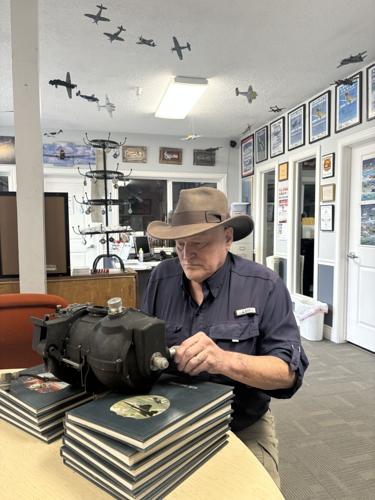
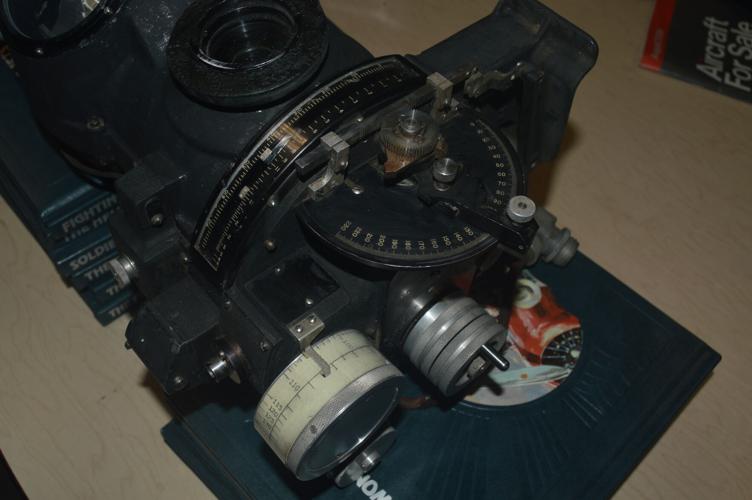

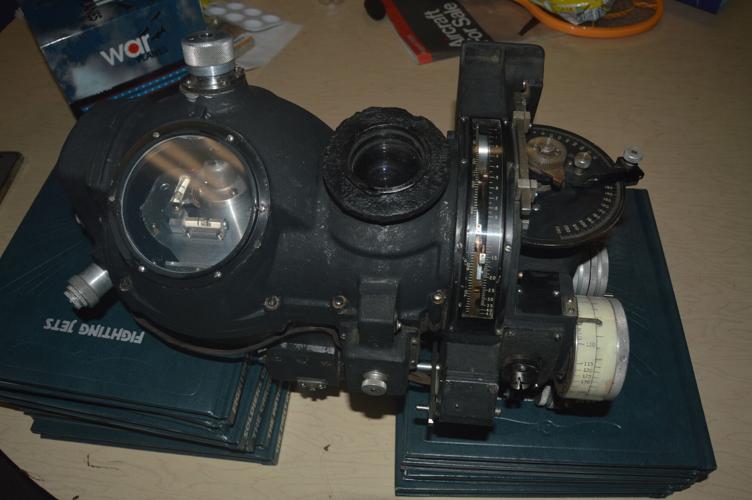

REXBURG — Roger Olsen, a volunteer at the Legacy Flight Museum, discovered a Norden bombsight tucked away in one of the display cases.
“It was just sitting in a case. It looked like it had 80 years of dust and grime,” Olsen said.
Olsen took a screwdriver, dug out the grime, and touched it up with paint. He ordered a manual for it online, hoping he could take it apart, but said it was an “insurmountable process.” The Norden bombsight is made up of about 2,000 parts.
“Back then, this was way ahead of its time. This does the computation for acceleration due to gravity, for wind, for crosswind, changing in barometric pressure. Everything is all compensated for with a device that didn’t use any electronics,” Olsen said.
Olsen became familiar with the Norden bombsight as a teenager. He would watch “flour bombings” at airshows, which was dropping a bag of flour on a target from the plane. He wanted to know what could be built to get a more accurate aim.
“I realized it had to be gyro-stabilized, and someone said, ‘Oh you need a Norden bombsight.’ So, I started reading about them,” Olsen said.
Following World War 1, the need for precision bombing developed, Olsen said. He explained that pilots previously would have mechanic sight on a plane and depending on speed and altitude they would drop a bomb by hand or release.
In the early 1920s, Carl Norden began the creation of the Norden bombsight. The Norden bombsight compensates for the movement of a plane, Olsen explained. No matter what the plane was doing, the bombsight was always aimed at the target and followed it.
The bombsight contains an analogue computer that solves a differential equation that calculates speed and altitude.
“That’s the real beauty of this thing. That’s a mechanical computer,” Olsen said.
Olsen said Norden claimed the bombsight could drop a bomb into a pickle barrel from 12,000 feet. This could only be done, Olsen explained, under absolute, ideal conditions. The bombardier would need a perfectly calibrated sight, a pilot and bombardier would need to have worked together before and have a lot of experience, and they would need to be working under very good weather conditions. These ideal conditions would allow the bombardier to land the bomb within about 300 feet of the target 50% of the time.
When they were flying in tight formation, in bad weather, with people trying to kill you, and under a lot of stress, the success rate dropped.
“Those ideal conditions are never met. They were lucky if they would get 10% of their bombs within a quarter mile from 20,000 feet,” Olsen said. “It was still a lot better than a guess.”
The Norden bombsight was second to the Manhattan Project in terms of secrecy.
“It was a secret for so long,” Olsen said.
Olsen said, unfortunately, a German spy named Herman W. Lang was looking for Norden. He was employed by the Norden Company, and in 1937 Norden gave Lang the bombsight plans. Although the Germans had the plans, they didn’t do high altitude bombing and never used the bombsight, Olsen explained.
The Norden bombsight was expensive, Olsen said. It cost $6,000-$7,500 to produce and sell it to the government. Olsen said that translates today to $130,000-$160,000.
Paul Tibbets was the pilot of the Enola Gay aircraft and trained his crew to use the Norden bombsight. The bombsight was on the Enola Gay when the first atomic bomb was dropped on Hiroshima.
“They speculated, but they didn’t know for sure until they took off. Tibbets came on the intercom and said, ‘We’re delivering the first atomic bomb,’” Olsen said.
The crew flew under ideal conditions and dropped the bomb less than 100 yards from where it was supposed to land, Olsen said.
He said the bombsight helped the United States win the war in Europe.
“Even though it wasn’t as accurate or precise as Norden said it was, it was still a lot better than what they had before,” Olsen said.
The bombsight was used up until the Vietnam War. Olsen said instead of dropping bombs with it, they dropped listening devices along the Ho Chi Minh Trail. By doing so, the United States was able to track Vietnam convoys and troop movement.
Olsen’s been volunteering at the Legacy Flight Museum for about five months. He said he hesitated to come out because it’s not a hobby, it becomes an addiction.
“You can’t leave it alone. Most of us that fly, it’s a compulsion. I didn’t want to get it back in my blood,” Olsen said. “Now I come out here even when we’re not open. I’m doing all kinds of other projects.”
Olsen said the Norden bombsight will be displayed at the Legacy Flight Museum within the next two or three weeks. The museum is open on Saturdays from 9 a.m.- 5 p.m.

(0) comments
Welcome to the discussion.
Log In