

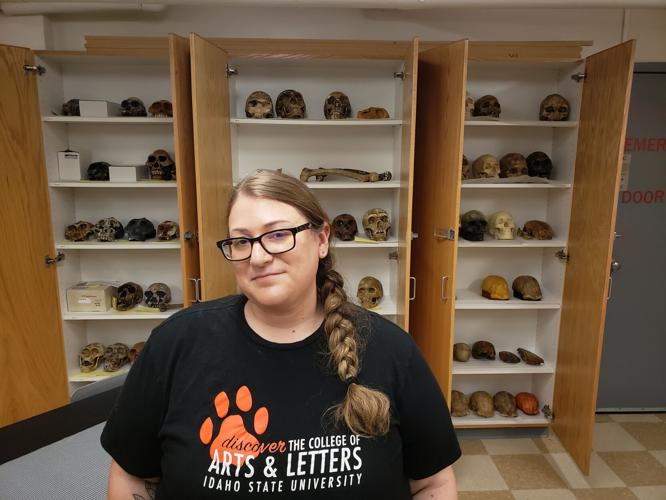



POCATELLO — It’s only fitting that the laboratory that houses the bones, teeth and skeletal remains of the cases that one local bioarcheologist has been tasked with forensically analyzing are stored in a place called Graveley Hall.
While the building located on Idaho State University’s Pocatello campus is named after Lottie M. Graveley, the first woman to be appointed to the state board of education, and is alleged to be haunted, today it’s the home of the school’s biological anthropology laboratory.
It’s the place where bioarcheologist and ISU anthropology professor Samantha Blatt works to unearth the mysteries and untold stories that have been buried for as long as the bones and human remains have been concealed by the earth.
“The overarching thing that I am is a biological anthropologist,” Blatt said. “That includes looking at skeletons, it includes teeth and it includes all time periods really. I specialize in skeletal analyses and odontology or dental analyses. With dental anthropology, we are interested in just teeth, dental structures and sometimes oral structures, how they grow, the disease processes in them, metric and morphological characteristics and how we can use that to learn about people, to learn about their diets, how old they were or what their population affinity was.”
In addition to teaching the next generation of students the ins and outs of anthropology, Blatt is known for assisting law enforcement agencies throughout Idaho and beyond in working to identify the bones and skeletal remains associated with cold case investigations.

Bioarcheologist and Idaho State University anthropology professor Samantha Blatt, kneeling with blue gloves on, teaches students and law enforcement about excavation during a mock dig in 2018 near the school’s Stephens Performing Arts Center.
“I work on cases in New Hampshire, Iowa and Illinois,” Blatt said. “Last year I worked on a case from Illinois using a forensic genetic genealogy process for a woman that had been missing since 1992. I actually look for cold cases and am actually going to be teaching a cold case class in the fall where I try to teach students how to look at the entire case and not just from an anthropology standpoint. I try to explain that we have criminologists and sociologists here that can help in cold cases. I try to tell them that they don’t have to know anything about anthropology, but if they’re interested in true crime, they could be helpful to a case.”
Her skillset, network of colleagues and ability to serve as an intermediary with organizations that specialize in DNA analysis — such as the California-based DNA Doe Project or Texas-based Othram Labs — has helped authorities identify several sets of human remains.
She played a pivotal role in the identification of Joseph Henry Loveless, the infamous Idaho bootlegger, accused murderer and escaped convict whose torso was found in Buffalo Cave in Dubois in August 1979, followed by his limbs in March 1991.
Over 35 years after hunters discovered a partial human skull in the Trail Hollow area of Oneida County, Blatt’s work was able to help authorities positively confirm that the skull belonged to one of two Pocatello teenagers, Patricia Campbell, 15, who went missing alongside Tina Anderson, 12, from Pocatello’s Alameda Park during a 1978 Pioneer Day celebration.
She is also currently assisting the Bear Lake County Sheriff’s office in analyzing a human jaw bone with teeth that beachgoers unearthed while digging on the northeast corner of Bear Lake south of North Beach Road in Bear Lake County on July 27.
“It’s hard for me to say how many cases that I have worked on or assisted with in some way,” Blatt said. “I know that since I’ve been here at ISU, I’ve worked on probably around 80 cases with different levels of involvement. These can include cases that end up being historic or archaeological.”
One such case that originated as a forensic anthropological investigation and ended with the remains being repatriated to the lineal descendants of a Native American tribe located in Idaho followed the discovery of human bones protruding from a badger hole in southwestern Idaho in April 2017.
After Idaho Fish and Game workers discovered the remains of a child between the ages of 4 and 6 and a teenager or young adult between the ages of 16 and 20 on federally owned land about 5 miles from the small city of Mountain Home, investigators began the process of trying to determine if they had discovered the scene of a double homicide or the disturbed grave of young 19th century pioneers who died going west on the nearby Oregon Trail.

A faunal of animal bones that were provided to the Idaho State University Anthropology Department for analysis after being discovered inside of a sack.
Blatt at the time was a visiting anthropologist professor at Boise State University and utilized a process called “bomb pulse rating,” a special type of carbon dating that’s used to determine if the bones belonged to people who lived before or after the introduction of atomic radiation to the atmosphere from atmospheric nuclear bomb tests in the 1950s.
“There’s traditional radiocarbon that can go back many many thousands of years,” Blatt said. “But when I was still at BSU, I used bomb pulse dating because we couldn’t tell definitively if the remains were archaeological or not. Even back then, some people thought that was a ridiculous thing to try to do because it was not commonly used in forensics. But bomb pulse dating will tell you after the period of time that we started dropping atomic bombs and decades from then to now because the change in the atmosphere is so drastic.”
When Blatt first became a visiting professor at BSU in 2013, she was among very limited company, she said.
“At that time in 2013 there were almost no other biological anthropologists in the state and none of them were doing casework, especially in southern Idaho,” Blatt said. “There was nobody really in the Snake River plain or Treasure Valley areas that were doing this type of work.”
Today, that number has grown, although not extensively. However, those in the field are doing much of the same type of forensic analysis that Blatt is involved with and are located at all three of the state’s four-year research universities, establishing what Blatt described as a triangle of coverage that encompasses much of the Gem State.
“Before I got to Idaho there was Margaret Streeter, who is an anthropologist at BSU,” Blatt said. “Now, I think there are four of us, all women. We have this sort of triangle coverage area that we never had before.”
It’s not just marquee cases that Blatt has assisted with. She said she also takes pride in working on projects for MMIP, or Missing or Murdered Indigenous Persons. Located underneath the umbrella of the U.S. Department of Justice, the MMIP unit focuses on analyzing and solving missing and murdered cases involving Native American Indians and Alaska Natives.
“We have a couple of MMIP projects that have involved us trying to build databases and figuring out solutions to this epidemic because MMIP cases are incredibly underreported,” Blatt said. “Montana is really the only state that has funding that is getting traction on building something. There are reports that exist in Idaho but there’s no real process and there is no money that is going specifically toward those projects. We’ve been working with folks from the Shoshone-Bannock Tribes to try and really gain their perspective more than anything as to what is helpful to them culturally and what we can provide that is actually meaningful to them.”
Native Americans aren’t the only marginalized group that Blatt has worked to gain a better understanding of when it comes to particular aspects of her research. Blatt said in recent years there has been “a big surge of homicides related to the LGBTQ+ community” that has resulted in her working to understand the importance of gender identity.
“There are only two sexes and in our field we only do sex estimation,” Blatt said. “But recently, myself and a handful of my colleagues as well as up-and-coming graduate students have been looking at the importance of gender. I cannot define someone’s gender identity, but I can look for contextual clues and incorporate what we call harm reduction strategies to try and educate law enforcement on the proper way to describe things.”
She continued, “For instance we can include things like what particular items of clothing are recovered that might not make sense for what we’re seeing as the estimated sex. We can also look at things like breast or genital implants, or sometimes there are feminization surgeries that we might be able to look for. We are working to include statements in our reports that say things like, ‘Here is our sex estimation but sex is not gender and the gender identity might not be the same as the estimated sex.’ I think it can be helpful to the community and law enforcement to use the correct terms. We avoid using pronouns and instead put ‘they’ because using the wrong term can impact the person well after they have died.”
Moving forward, Blatt said she is hopeful that her contributions to the field of forensic anthropology will fall on the side of humanitarianism and activism, one that leaves a lasting impression on those who follow in her footsteps, and particularly for projects that involve minorities and marginalized groups.
“I think that the field in general can move in that direction, where we actually look at the people that we’re serving and try to represent them more fairly,” she said. “For instance, with gender studies that is definitely looking at a specific group and seeing what their needs are, seeing that they need help, and then trying to look out for specific ways to help that specific group.”
She continued, “I think that forensic anthropology can do more for that, but we’re definitely leading that way. So it’s a good thing we’re leading that way, but I definitely like to bring awareness to minority groups.”

(0) comments
Welcome to the discussion.
Log In