

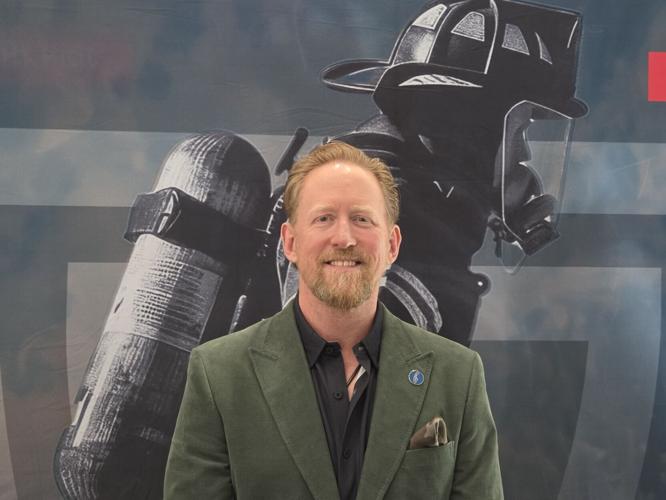
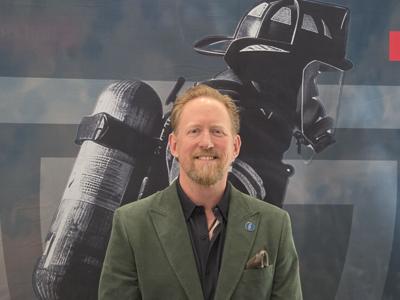
One of the most famous Navy SEALs in modern history spoke Saturday at the Heroes Defense annual 9/11 tribute gala at the Mountain America Center in Idaho Falls.
Rob O’Neill took a few moments to speak before headlining the event, sharing insights about his service.
He is the SEAL who fired the shots that killed al-Qaida leader Osama bin Laden during the May 2011 raid by the SEAL Team Six assault force in Abbottabad, Pakistan. O’Neill worked alongside 23 other SEALs during Operation Neptune Spear — the famous attack on bin Laden’s compound.
“The bin Laden raid was a great mission because it did prove when we decide we want to do the right thing we can send people to make it happen,” O’Neill said. “We’ve proven it recently in Venezuela with Maduro.”

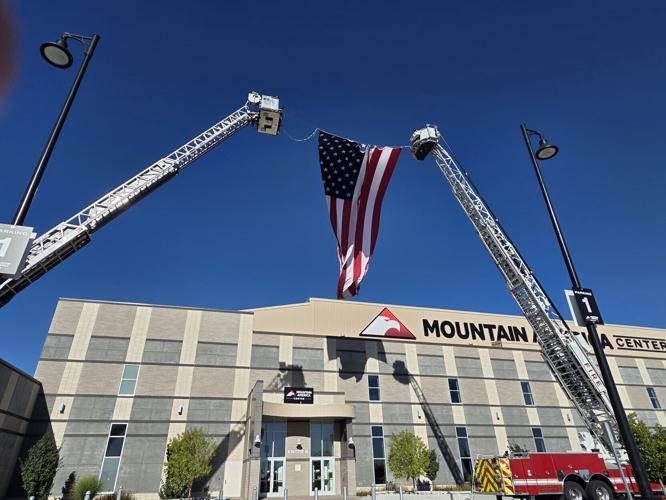
An American flag held aloft by ladder trucks of the Ammon and Idaho Falls fire departments rises above the entrance for Saturday’s annual Heroes Defense 9/11 tribute gala at the Mountain America Center in Idaho Falls.
Nicolás Maduro is the former president of Venezuela who was captured by U.S. forces in a military raid in January and is currently jailed in New York City facing federal drug trafficking and weapons charges.
“Once we put politics aside and do what we think is right we can do anything we want,” O’Neill said. “Even two different presidents doing missions like that.”
Democratic President Barack Obama officially ordered and authorized Operation Neptune Spear, while Republican President Donald Trump ordered the raid that captured Maduro.
“(Obama’s approval of the raid) was extremely unique because it was before re-election,” O’Neill said. “Regardless of what they say, all politicians want a second term. If we fail, he doesn’t get it. But he made the call, because it was the right call. Politics weren’t involved because the secretary of defense at the time was Republican Robert Gates.”
Trump ordered the military and law enforcement operation that captured Maduro.
“I think it’s more volatile now as far as the political landscape,” O’Neill said. “One of the reasons this country can be great is that when the time is right to make the right decision both sides have proven they will do it.”
O’Neill was on the stairs leading to the top floor during the raid on bin Laden’s compound. He was the second man on the stairs, with a lead point man directly in front of him clearing the way as they moved up tightly together toward the third floor.
The point man encountered bin Laden near the top and fired the initial shots, then moved to secure women in the hallway who might have had suicide vests. O’Neill stepped past the point man into the room next and fired the shots that killed bin Laden.
“Honestly some of the stories are so dramatic, it’s almost like there’s no way that happened,” O’Neill said. “I just know it really well because I was there.”
SEAL Team Six — officially known as the Naval Special Warfare Development Group — is the U.S. Navy’s premier Tier One special mission unit. Tier One units are the most elite, highly funded and secretive special operations forces in the U.S. military, handling the nation’s most sensitive counterterrorism, hostage rescue and direct-action operations. SEAL stands for sea, air and land, describing the three environments in which the Navy’s special operations forces are trained to operate.
“On my first appointment with SEAL Team Six, we rescued Marcus Luttrell,” O’Neill said.
On June 28, 2005, a four-man reconnaissance team of regular Navy SEALs — Michael Murphy, Matthew Axelson, Danny Dietz and Luttrell — was ambushed in the mountains of Afghanistan. O’Neill was part of the military elements that participated in the search-and-rescue mission to locate and extract Luttrell, later depicted in the film “Lone Survivor.”
Luttrell was rescued during an extension of Operation Red Wings known as Red Wings II. Luttrell was aided by an Afghan villager named Mohammad Gulab, who found him, sheltered him from the Taliban and alerted American forces, leading to the rescue operation.
O’Neill was also part of the team that assisted in the rescue of Capt. Richard Phillips, the American cargo ship captain taken by Somali pirates off the Horn of Africa — an event later adapted into the film “Captain Phillips.”
“On my birthday, Good Friday, April 10, 2009, I left my daughter’s Easter tea party at her preschool,” O’Neill said. “Fifteen hours and 46 minutes later, I was in the Indian Ocean rescuing Richard Phillips on Easter.”
O’Neill’s most notable missions remain vivid to him.
“When I was on these missions knowing that potentially it would be something big, I just do mental snapshots of here’s what happened,” he said. “I was constantly taking mental snapshots, and I’m able to relive them, and it’s not because of ‘Oh, look how cool I am,’ but here’s what screwed up on the mission. I screwed up or someone or something screwed up and someone adjusted. Here’s how we adapted. Here are the traits that were common to our success. Instead of the details of what it smelled like going up the stairwell, I can tell them we were successful because we realized the perfect plan only exists in the planning room. We were prepared when we got there. So I just remember the stories.”
O’Neill traces his ability to tell those stories to a quote from American politician and writer John W. Gardner: “History never looks like history when you are living through it. It always looks confusing and messy, and it always feels uncomfortable.”
“One thing that helps me is I tell the truth,” O’Neill said. “My model now in life is I’m going to tell you what I think the truth is. If I’m wrong and you prove it, I’ll apologize. If I’m right and you’re offended, that’s just your problem. Remembering the truth is really, really easy.”
His message to the attendees at Saturday’s event — an audience of firefighters, police officers, service members, veterans and the families who support them — centered on being so close to the 25th anniversary of 9/11.
“Never go to bed angry with anyone in your family because it’s not the thing you’re worried about that happens,” O’Neill said. “It’s COVID on a Thursday. It’s 9/11 on a Tuesday. On Sept. 10, 2001, I guarantee someone went to bed that night angry and went to work angry and then jumped out of the skyscraper. If you want to be successful, take care of your family.”
That belief extends to SEALs, too.
“The key to our success, even on the Tier One level, is we were really good because we were good to each other,” O’Neill said. “My personal attitude was I was excited every day to wake up early because I’d go to a place and work with people who are better than me.”
O’Neill also addressed recent comments made by Trump. The president on Friday labeled the Iran war “small potatoes,” his latest attempt to minimize a six-month conflict that has caused a large spike in gas prices and has led to the deaths of 18 American military personnel.
Trump argued the engagement consisted primarily of “intermittent strikes” and that its human toll was relatively small compared to historical conflicts like the Vietnam War.
“I know Donald Trump and I don’t think he would consider that small potatoes,” O’Neill said. “I’ve seen how he responds to the fallen in private. I’d love to see the full conversation because that doesn’t sound like him.”
Trump also created controversy with comments about the USS Abraham Lincoln, a nuclear-powered aircraft carrier deployed to the Middle East during the Iran war for 264 days without a port call — a modern record for continuous time at sea.
Investigative reports from military-focused outlets, lawmakers and family members described grim conditions on board. Trump dismissed those reports last month, calling the concerns and journalism “fake news” and countering accounts from families and sailors by saying the deployment was “not nearly long enough.”
“He was saying that, I think, just because of the success they were having,” O’Neill said. “He wasn’t considering how hard it is working in the fleet as a sailor, and that is harder than being a Navy SEAL. That’s a very difficult job. I’m 50 years old and I still call my mom when I’m having a bad day. If I was a sailor and hadn’t set foot on land in 2026, I too would be bitching at my mom. I think it’s a very fine line. You really need to take care of your people. I’m glad they’re getting a port call.”
The USS Abraham Lincoln wrapped up a scheduled five-day port visit Sunday in Thailand and is currently heading back toward its home port of San Diego.
“Knowing Donald Trump, he doesn’t take lightly what the servicemen and women are doing, and him saying something like that would be more of the arrogance of how awesome our carriers are, not the morale welfare of the actual sailors,” O’Neill said. “If he said it again, I would recommend that without his security maybe he goes 10 straight days on a carrier.”

(0) comments
Welcome to the discussion.
Log In