

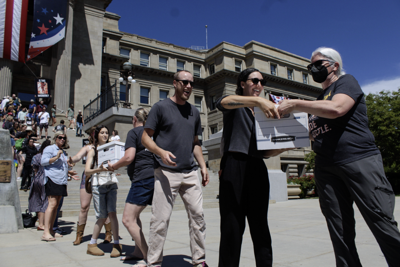

Idahoans United for Women and Families, the grassroots organization behind Proposition One, filed a lawsuit late Wednesday against Idaho Attorney General Raúl Labrador and Secretary of State Phil McGrane.
The suit asks the Idaho Supreme Court to strike down the "Yes" and "No" statements, jointly written by Labrador and McGrane’s offices for November’s ballot, and order them replaced with lawful, clear and concise language in keeping with two decades of Idaho election history.
This is the second time that the grassroots organization has been forced to sue over ballot language for the same law, the Reproductive Freedom & Privacy Act (now known as Proposition One). Last year, the Idaho Supreme Court ruled largely in the grassroots organization’s favor in Idahoans United for Women & Families v. Labrador, ordering the attorney general and state of Idaho to rewrite Proposition One's short ballot title and fiscal impact statement after finding them misleading.
Idahoans United says Labrador's office has done it again. Idaho ballots over the past 20 years have traditionally featured a summary of an initiative followed by a brief, clear statement on the meaning of a “Yes” or “No” vote for voters. Typically, the “No” portion was about 11 words long and read: “A No vote would make no change to current Idaho law."
For Proposition One, Labrador and McGrane’s offices abandoned that practice and jointly drafted what the suit calls a misleading "No" statement. Even though the law requires a concise statement to help voters understand the impact of their vote, the 38-word statement written for Proposition One is the longest proposed in Idaho history – by a wide margin.
The "No" statement also purports to describe Idaho's existing abortion laws without addressing the severity of Idaho's ban or its lack of exceptions, including omitting that abortion is a felony under Idaho law, that criminal and civil penalties exist for doctors, and the lack of a health-of-the-mother exception. It also does not disclose that a federal court found part of Idaho’s law unconstitutional less than two weeks ago.
“We were shocked and have not seen anything like this in prior elections,” said Melanie Folwell, executive director of Idahoans United.
The language was only shared with Idahoans United late Monday, notably after the voter pamphlet had already been sent to print, she said.
"This issue was settled by the Idaho Supreme Court last June," Folwell said. “The direction from the court was clear: Idaho voters deserve clear, accurate, and fair language on the ballot to inform their vote. This long, confusing, biased Yes/No language, hustled in at the last minute, is incredibly disappointing.”
Idahoans United's legal counsel sent Labrador and McGrane a letter Tuesday, requesting the statements be withdrawn and replaced with lawful, clear and concise language. The offices have refused, and now — with just days between now and the Sept. 11 printing of ballots — the group will seek relief in court.

(0) comments
Welcome to the discussion.
Log In