

A federal judge heard arguments Tuesday on whether to bar the state of Idaho from enforcing a new law that will block transgender people from changing their birth certificates to match their gender identities.
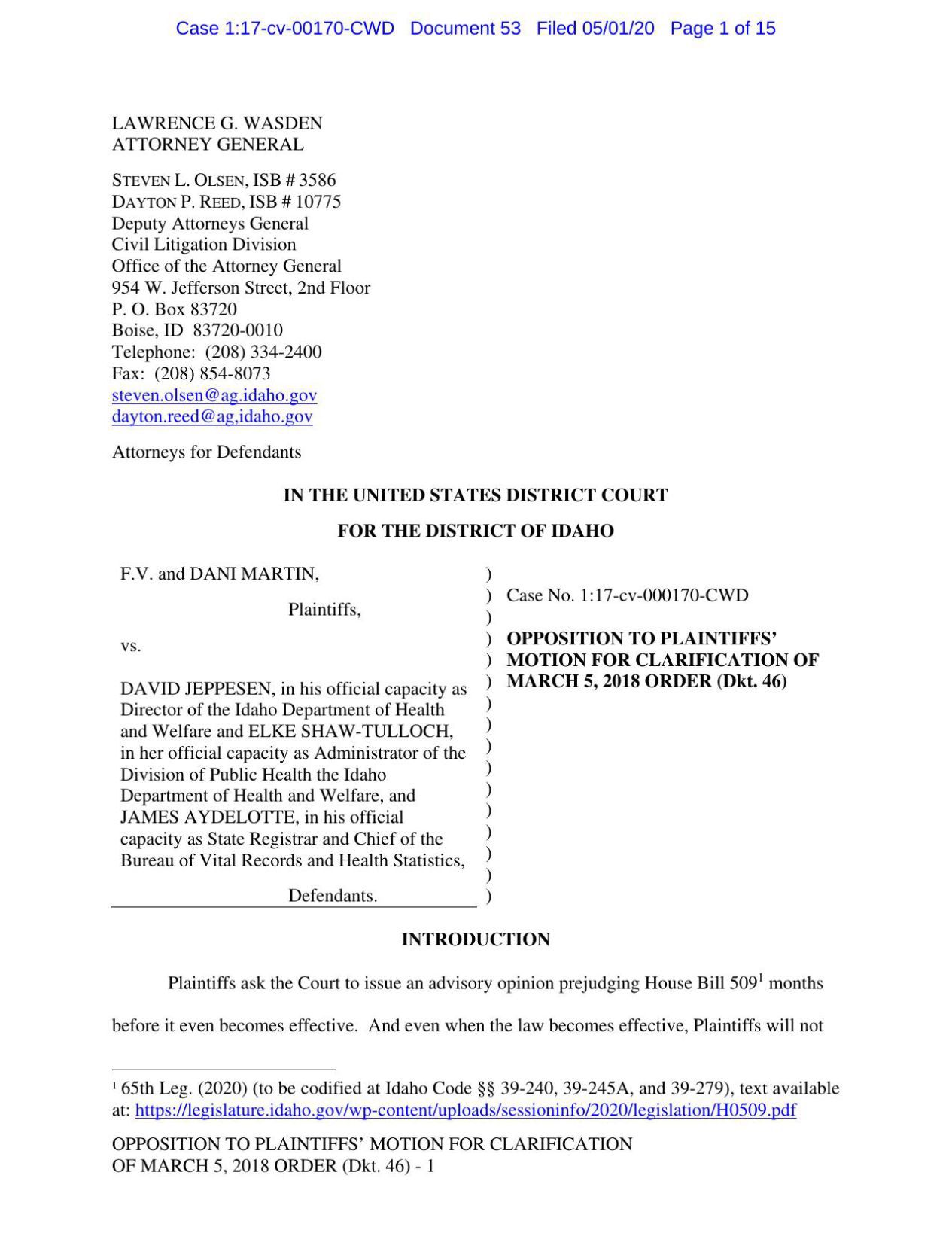
Magistrate Judge Candy Dale, who issued the 2018 ruling that forced the state to let transgender people change their birth certificates, heard arguments via videoconference from Peter Renn, a lawyer with Lambda Legal who also represented the plaintiffs in the 2018 case, and Idaho Deputy Attorney General Steven Olsen. Lambda Legal is asking Dale to issue a clarification of her 2018 ruling that would in effect bar enforcement of the Idaho Vital Statistics Act, or House Bill 509, which passed this year and sets new restrictions on changing birth certificates.
One disputed question is whether the law, which will take effect July 1 if the court doesn’t act, constitutes a complete ban on transgender people changing their birth certificates.
“If this court’s ruling meant anything at all, it is that a categorical ban is permanently enjoined,” Renn said.
The bill does allow people to ask a court to change their birth certificates “on the basis of fraud, duress, or material mistake of fact.” Olsen said this makes it different than the previous policy.
“It is not a categorical ban,” he said. “A person can change their sex identity on their birth certificate upon a court-ordered change in sex designation.”
Dale asked Olsen several questions about how this would play out in reality and whether a transgender person would be able to change their birth certificates under these criteria. Olsen said Dale’s questions reinforced another one of his arguments, namely that the court should wait until the law takes effect and there is a lawsuit involving its enforcement. Olsen said the correct course would be to file a new suit to litigate the constitutionality of House Bill 509, not to clarify the 2018 ruling.
“Your question points out the need to have a case before a court that evaluates the issues that you’ve raised,” Olsen said.
Renn said the court doesn’t need to wait until someone is affected before deciding whether the bill violates the 2018 ruling and that the law would not let transgender people change their birth certificates. He pointed to its legislative intent language, which defines biological sex as chromosomes and reproductive anatomy present at birth and says people should not be allowed to change their birth certificates “based upon subjective feelings or experiences,” which Renn called a clear and derisive reference to gender identity. Renn said lawmakers who voted for the bill would likely be shocked if it does in fact allow transgender people to change their birth certificates.
“The entire point of the law was to ban these precise types of corrections,” he said.
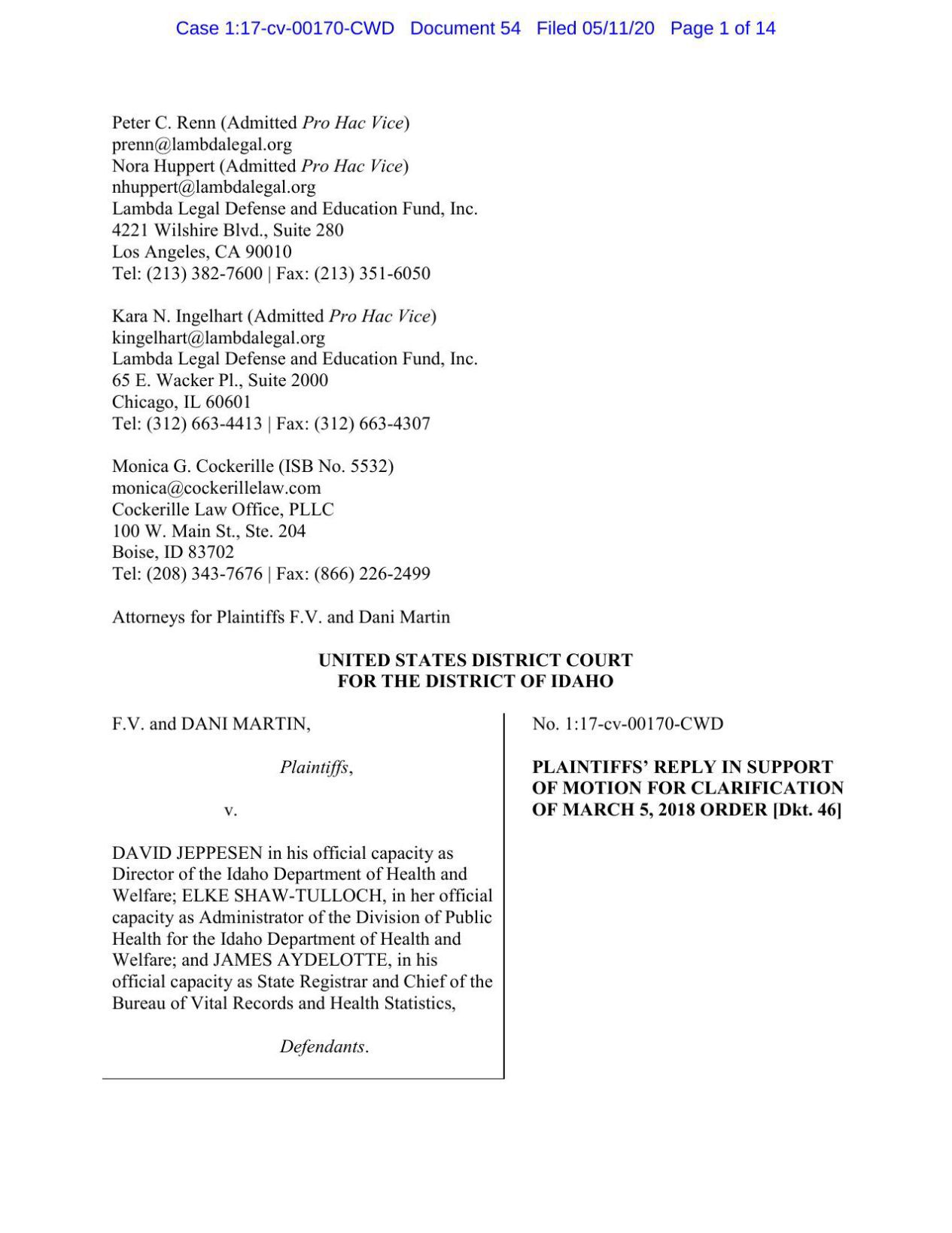
The plaintiffs have asked Dale to issue a ruling by June 1.
“I’m not making any promises, but we’ll do our best to see if we can make that happen,” Dale said.
House Bill 509 was sponsored by Rep. Julianne Young, R-Blackfoot, and passed with most Republican lawmakers in support of it and all the Democrats opposed. It and several other bills related to transgender rights were among the most controversial of the 2020 legislative session. Another law passed this year that bans transgender girls and women from female high school and college sports teams is also being challenged in court.

(0) comments
Welcome to the discussion.
Log In