



POCATELLO — Net metering is a compensation system that Idaho first implemented in 1983 and is the sterling incentive for new solar customers. After the upfront installation costs of panels, homeowners can, in essence, sell the excess power generated by their rooftops back to the grid.
Despite being in place for 35 years, Idaho Power is looking to change this practice, and solar advocates and some locals are not happy.
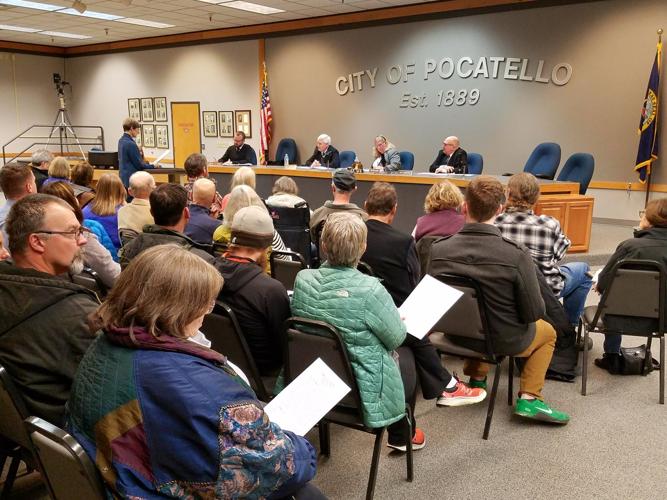
Multiple Southeast Idaho residents provided testimony on Monday to state utility regulators opposing Idaho Power’s attempt to change the practice. Testimony was received by the Idaho Public Utilities Commission (PUC) in front of a standing-room only crowd at Pocatello City Hall. The commission delayed Idaho Power’s request in October to allow time for public comment.
The delay followed Idaho Power’s July request to the PUC asking for permission to eliminate the current net metering tariff for new residential and small business customers — those with alternate energy systems totaling 25 kilowatts or less — and replace it with two new customer classifications.
Idaho does not have a statewide net metering policy. However, each of the state’s three investor-owned utilities — Avista Utilities, Idaho Power and Rocky Mountain Power — has developed a net metering tariff that has been approved by the PUC.
Currently, Idaho Power customers with on-site power generation pay a base fee of $5 per month and a per-kilowatt fee for the net amount of electricity used, accounting for the power generated by systems like rooftop solar panels.
While the number of net metering customers on Idaho Power’s system is small now, the utility company said that number is rising. Idaho Power has gone from about 350 net metering customers in 2012 to almost 1,500 in 2017 and projects that number to grow to between 6,171 and 7,032 by 2021.
Idaho Power has said the current electrical grid system was not designed to account for homeowners who installed their own solar panels — resulting in traditional power customers being forced to make up any budget shortfalls. Idaho Power called it a “wealth transfer from lower-income customers to higher-income customers.”
Idaho Power requested a compensation scheme for on-site power generating customers like those with solar panels that reflects distributed generation costs and benefits to the local grid, but did not propose what the new rate structure would look like.
Stacey Donohue, PUC technical analysis group program manager, previously testified that the commission’s analysis of Idaho Power’s consumption data found “no evidence justifying a separate rate class for net metering customers.” She states Idaho Power “did not file a cost of service study demonstrating any meaningful differences in net metering customers compared to standard residential customers.”
Further, Donohue found that Idaho Power’s “calculation overstates the future cost shift.”
All of the testimony provided by Southeast Idaho residents on Monday agreed with testimony previously provided by PUC staff, largely questioning the lack of evidence provided by Idaho Power to justify the classification changes and the potential impact the changes could have on the economy and environment in Idaho.
Sue Skinner, a Pocatello resident and retired environmental protection specialist with the Environmental Protection Agency, was one of the first to testify on Monday and is one of at least 10 separate entities supporting the commission intervening in the case, which include the Snake River Alliance, the Sierra Club and the Idaho Conservation League.
“In researching this issue, it appears that nationally, utility lobbyists have joined together on a policy detrimental to the solar industry,” Skinner said. “The cover of the utility lobby as a whole seems to be driving this issue. What is missing is specific data for Idaho as to infrastructure costs, not on a statewide basis but on a localized basis. This is what the commission and the current residential solar customers need to know before a decision is made.”
Skinner continued, “Anything to discourage residential solar use and net metering goes against the future of our great state and our country. Clean energy is what keeps Idaho’s air pure, keeps us out of wars and allows each of us to do our part as individuals.”
Another person to testify was Mike Engle, a member of the Portneuf Resource Council in Southeast Idaho and former director of engineering for a solar panel manufacturer startup. Engle asked the PUC to reject Idaho Power’s request for three reasons.
“First, I’m representing local Pocatello interests in kicking off a solarize campaign in Southeast Idaho, similar to the very successful solarize projects in the Boise area,” Engle said. “Our Solarize project is on hold pending the outcome of these decisions. Second, as a homeowner, I am interested in energy independence and installing solar on my home. I believe it is the right of all Idahoans to pursue this goal.”
Engle continued, “Third, Idaho Power currently charges $5 per month for net metering customers to stay on the grid. Idaho Power should be allowed to charge a fair price for grid access; however, what’s fair to both Idaho Power and its customers should be the result of transparent and data-driven cost benefit analysis. The process should be fair to all.”
Interested parties who would like to provide input in the case but were unable to attend the hearing may submit comments until the conclusion of a technical hearing scheduled for March 8. To comment, visit www.puc.idaho.gov.
PUC is expected to render a decision on the request on Friday.

(0) comments
Welcome to the discussion.
Log In