


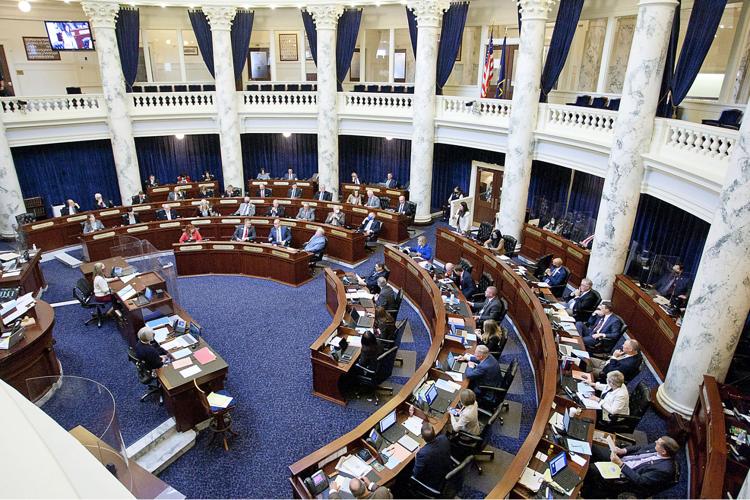
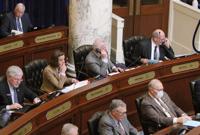

BOISE — The Idaho House on Friday passed bills on campus free speech, abortion and more, but made no firm steps forward in its deadlock over education funding bills caught up in a dispute about “social justice indoctrination.”
The House Ways & Means Committee met Friday morning and discussed a proposed bill from Rep. Greg Chaney, R-Caldwell, on “Ideological Freedom, Education.” The measure was designed to allay fears from some House Republicans, urged on by the Idaho Freedom Foundation, that Idaho’s public schools and colleges are attempting to indoctrinate students with leftist political ideologies, particularly around race and “social justice.”
Chaney told the committee his proposal would address “divisive concepts” in both K-12 public schools and higher education.
“There’s been a lot of controversy around certain areas of instruction. While there is certainly First Amendment rights to discuss certain things, there are also competing rights against the government compelling speech,” he said. “This seeks to recognize the rights of academics to discuss difficult topics, perhaps topics and conversations that need to happen, and the rights of students to not be compelled to adhere to an ideology or point of view to which they do not agree.”
The bill would define “divisive concepts,” including a long list of items pertaining to race, racism and sexism, and forbid teaching them in grades K-8. It would allow them to be taught in grades 9-12 and higher education, as long as “viewpoint neutrality” is maintained in the teaching. Violations could be pursued under the Idaho Tort Claims Act.
“The intention is that this act would never be invoked, but merely ensure freedom of viewpoint in these discussions,” Chaney said.
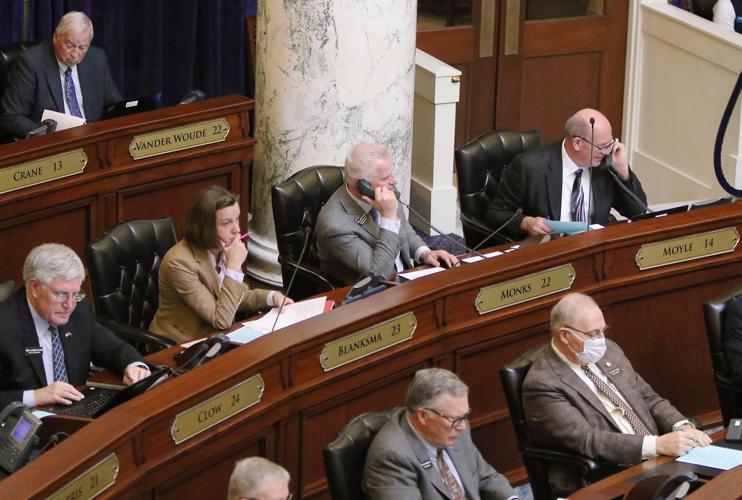
Rep. Jason Monks, R-Meridian, asked, “So would this apply to organizations that may receive grants that the state allocates, meaning Pre-K?”
Chaney said only if they meet the definition of school districts.
Monks then asked if the committee could delay introducing the bill and have more discussions to see if something could be included about Pre-K grants as well.
“I’m trying to get to our issue that we had with other bills here, and see if we could address that at the same time,” he said.
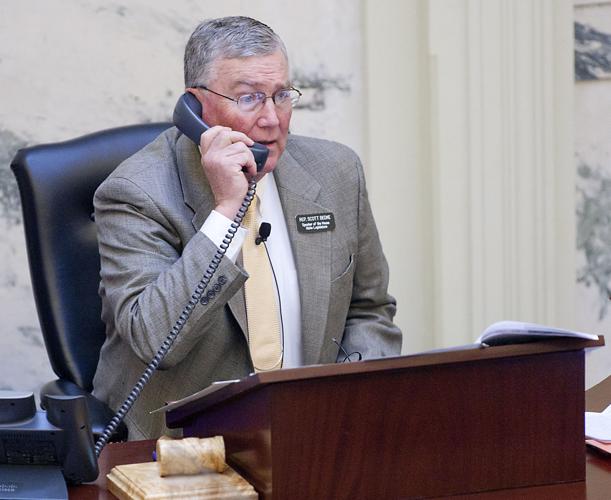
House Speaker Scott Bedke said, “Yeah. I think it’s prudent that we make informed and in-depth decisions from this point forward in the session.”
He said he was optimistic that the proposal could ease the way for the House to pass the stalled budget bills for public schools and higher education.
“Our whole education system, its core mission is to turn out educated young adults that can go and compete and get good jobs so they can support themselves and their families,” Bedke said. “And anything that detracts from that mission is outside of the core values.”
‘FETAL HEARTBEAT’ BILL
After a long and impassioned debate, the House on Friday passed HB 366, the latest version of the “fetal heartbeat” anti-abortion bill, which seeks to ban abortions as soon as a fetal heartbeat can be detected. Similar legislation has been passed in 12 other states, but none has been upheld in court.
“We want to save baby lives,” sponsor Rep. Steven Harris, R-Meridian, told the House. “When does life begin? It begins at conception,” he said.
Under Roe vs. Wade, however, the U.S. Supreme Court precedent, abortion is legally permissible before fetal viability, roughly around 24 weeks into gestation. Through the use of an invasive trans-vaginal ultrasound, a fetal heartbeat can now be detected at as early as six weeks of gestation, before most women know they are pregnant.
“Our ultimate goal, of course, is to overturn Roe vs. Wade and make abortion illegal in Idaho and in the United States,” Harris told the House. “While we wait, we still want to save babies.”
The bill would take effect only if another state’s law were upheld by its federal Court of Appeals. Harris said the idea is that Idaho’s law would then be challenged up to the 9th Circuit Court of Appeals, which likely would rule against it, creating the kind of split between circuits that would prompt U.S. Supreme Court review.
Debate against the bill came from both ends of the political spectrum. Rep. Heather Scott, R-Blanchard, decried the bill for including limited exemptions for cases of rape or incest if a police report is provided.
“Why are we allowing the killing of babies just because of how they were made? It’s not right,” she said.
Rep. Chris Mathias, D-Boise, argued that the requirement for a police report ignores the fact that such a report likely wouldn’t be available until an investigation has concluded, as much as three months after the crime.
“It’s mean, it’s incomprehensible, it’s inconsiderate, and mostly it’s unconstitutional,” Mathias told the House. “This bill is unconstitutional.”

(0) comments
Welcome to the discussion.
Log In