



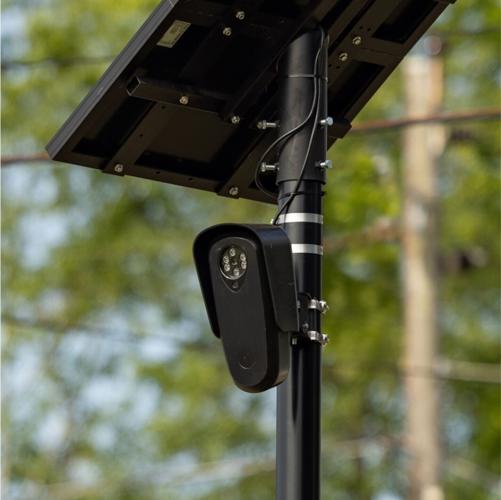
IDAHO FALLS — Automated license plate readers provide an important law enforcement tool, but the cameras in use in Idaho Falls are causing controversy.
A private company called Flock Safety, headquartered in Atlanta, contractually operates 13 cameras at various intersections for the Idaho Falls Police Department and nine for the Bonneville County Sheriff’s Office.
“We were a late adopter,” Idaho Falls Police Chief Bryce Johnson said during an interview July 1. “There have been license plate readers in Southeast Idaho for about a decade. We put ours in shortly after Twin Falls and Pocatello. Ours went in about a year ago. Most law enforcement agencies that have gone with license plate readers in Idaho are using Flock right now.”
Flock Safety is a public safety technology company that operates a nationwide surveillance network of AI-powered ALPR cameras. Its systems are deployed by thousands of law enforcement agencies to capture objective evidence — like vehicle make, model and license plates — to help solve and deter crime.
The camera takes a picture of a vehicle’s rear license plate as it goes through an intersection.
“There’s not a right to privacy on a public roadway,” Johnson said. “They are set up to look at specific intersections.”
License plate pictures sit in a database for 30 days and then are purged as required by state law.
In Idaho Falls, the Flock Safety camera controversy centers on privacy concerns and potential violations of state law regarding the commercial use of ALPR data. Critics argue that the city’s contract allows Flock to improperly use collected images to train its AI systems.
Public comments at the June 4 City Council meeting questioned whether the Flock contract violates state law. Critics argue that Idaho code dictates ALPR data “shall not be used for any non-law enforcement purpose.” Because Flock’s contract includes a clause granting the company an “irrevocable, worldwide license” to use a fraction of collected images as “training data” for its technology, opponents claim this constitutes an illegal commercial use.
In response, the city released the following statement June 19:
“The city’s legal team has not identified any compliance issues with the city’s agreement with Flock. We share the community’s commitment to transparency, accountability and protecting constitutional rights. ... Idaho Falls remains committed to balancing public safety with the privacy and liberty values our community holds dear.”
The situation has continued to escalate, primarily driven by a broader statewide pushback led by groups like Deflock Idaho.
During the Idaho Falls City Council meeting July 9, local resident Brian McKellar gave the city an ultimatum to cover or deactivate the cameras by July 29. Opponents are threatening to file tort claims — a required precursor to a lawsuit — seeking up to $1,000 per picture taken.
City Attorney Zachary Jones later announced at that meeting that the city is currently working to change its contract with Flock Safety.
“We’re in the process of amending the contract that we have with Flock Safety to get rid of the clause that allows Flock Safety currently to use data that’s gathered from our Flock Safety cameras to be used to train its Flock Safety AI software,” he said.
According to Johnson, the 13 cameras in use by police here is quite low for a city the size of Idaho Falls.
“A typical city of our size has about 35,” Johnson said. “Pocatello has 33 or 34, and it is a little bit smaller than we are.”
The Idaho Falls Police Department has multiple units installed on light poles throughout the city, including a cluster of three cameras operating at the intersection of 17th Street and Hitt Road.
“We would anticipate putting in more license plate readers,” Johnson said. “Whether they are Flock or not is a different story. We may look at some different vendors. But the technology itself and the results we get from it are speaking for themselves. We would want to expand it as time goes on.”
From a law enforcement perspective, the cameras provide a great service, such as when searching for a stolen vehicle.
“We put the license plate into the system,” Johnson said, “and it will find for us where it has been.”
If the license plate gets captured by a camera going through another intersection, police will be notified and the stolen car may be recovered.
The readers also assist police after they obtain a warrant for a suspect of aggravated battery, for example.
“Once we get that warrant, we want to arrest him,” Johnson said. “The vehicle associated with this suspect just went through this intersection.”
The police chief makes an important distinction about what the cameras do not do.
“It doesn’t track people individually,” Johnson said. “If it did that, it would be considered unconstitutional.”
In addition, none of the cameras are pointed at buildings or private property.
“They are pointed on a public road where there is no expectation of privacy,” Johnson said. “There is no live feed. You can’t pan and tilt the camera. It’s capturing, in the vast majority of time, the rear license plate of the vehicle as it goes through an intersection on a public roadway.”
Police run plates to locate stolen vehicles, Amber Alert subjects and suspect vehicles involved in crimes.
“We have to have a suspect of a misdemeanor or a felony,” Johnson said. “State law allows for some traffic violations.”
He added, “Once we have a suspect from one of those crimes, then we can say we’re now looking for this particular license plate, and then we can retrieve that data out of it. That’s how the system is designed to work.”
Due to the angles of how the pictures are taken, no view shows who is in the vehicle.
“We haven’t seen one that has done that,” Johnson said. “Ours are set up to capture the rear license plate. It very rarely captures the front license plate. Cars are not required to have a front license plate. So it’s a less effective use.”
If the camera finds the license plate being sought, it potentially lets police know the location of a suspect because of a vehicle that is associated with that suspect.
“It’s just one of those tools that help us find bad guys and solve crimes,” Johnson said. “The technology itself is absolutely vital. It is a huge public safety resource. It keeps bad people from doing bad things. It’s not creating files on regular people just minding their own business.
“If people are uncomfortable with the way that one particular company operates, we’re going to look at other companies,” Johnson said. “What people think, what people say matters. This is a democracy. If the best choice is to move away from Flock, we’re open to that. We’ll go to where we think we can get the best service and does the best for Idaho Falls.”
At least four major companies supply ALPRs that are actively available and in use by law enforcement agencies across Idaho.
“There are other companies that will provide us license plate readers that don’t operate the same way Flock does, and we’re more than happy to test and evaluate them,” Johnson said. “There’s a reason you have so many jurisdictions around the country going with Flock. It was a good product, and it had a good price point. The other products have higher price points. We’ll evaluate several other companies and see what their costs would be, what they can offer us. Line out how they store their data.”
The city signs an annual contract based on how many cameras are in use.
“License plate readers are for about $45,000 to $50,000 for the ones we have right now,” Johnson said.

(0) comments
Welcome to the discussion.
Log In